
The SecurityOfficer'sManual
Get Licensed · First Edition
SECTION 0 · THE SECURITY OFFICER'S MANUAL
Someone's worst day is your working dayTHE SECURITY OFFICER'S MANUAL
THE SECURITY OFFICER'S MANUAL. UK Professional Practice. First Edition.
Published by Get Licensed Ltd. www.get-licensed.co.uk
THE SECURITY OFFICER'S MANUALtext
Read this once. It matters.
COPYRIGHT & SCOPE
© Get Licensed Ltd. All rights reserved. No part of this publication may
be reproduced without written permission from the publisher.
SCOPE. This manual states the law of England and Wales as at 20 August
2026. Scotland and Northern Ireland differences: see p.204 and p.205.
NOT LEGAL ADVICE. This manual provides general operational reference
information for security officers. It does not constitute legal advice. Laws and regulations
change. Verify current legislation before acting. Consult qualified legal professionals for
specific legal questions.
FIRST RESPONSE ONLY. Medical information is for first response only. It
does not replace professional medical training or treatment. The publisher accepts no
liability for actions taken based on this manual.
→ Legislation index · p.1812
CONTENTS
FIND IT FAST
Six sections, colour-coded on the page edge. Life-threat basics start
on page 1.
1LEGAL POWERS17
2INCIDENTS51
3MEDICAL99
4OPERATIONS127
5COMMUNICATIONS155
6QUICK REFERENCE177
3
THE SECURITY OFFICER'S MANUALquickref
Any answer in under 10 seconds
HOW TO USE THIS Manual
This is a tool, not a textbook. Five habits get you to any answer in
under 10 seconds.
LOOK at the coloured edges Each
section has an edge colour. Find your section from the closed book.
USE the two ribbons Keep one in
Medical, always. Move the other to your assignment's key page.
USE the index at the back Every
topic, symptom, and script, listed at the back.
FOLLOW the See: pointers They
name the exact page. Follow them mid-incident. No hunting.
FLIP overleaf for special cases Special situations always sit on the page after the main
topic.
| Section | Covers | Edge colour |
|---|---|---|
| 1 Legal Powers | Arrest, force, search, trespass, evidence | Navy |
| 2 Incidents | Response procedures for every situation | Yellow |
| 3 Medical | First response until help arrives | Green |
| 4 Operations | Patrols, access, CCTV, handover | Mid green |
| 5 Communications | Radio, scripts, statements, reports | Teal |
| 6 Quick Reference | Numbers, law summaries, checklists, logs | Black |
→ Emergency numbers ·
p.178 → Life-threat pages · p.94
THE SECURITY OFFICER'S MANUALquickref
Six formats. Learn them once.
PAGE TYPES
Every page uses one of six formats. The label sits at the top of the
page. Learn them once, navigate forever.
| Format | How to read it |
|---|---|
| FLOWCHART | Decision tree. Start at the top question. Follow your answer down. |
| CHECKLIST | Steps in order. Complete each one. Tick boxes provided. |
| QUICK REFERENCE | Facts and data. Scan for the line you need. |
| SCRIPT | Exact words to say. Read them out or adapt them. |
| MATRIX | Comparison table. Find your scenario in the rows. |
| DIAGRAM | Visual procedure. Follow the numbered steps around the picture. |
Numbered lists mean order matters. Plain tick boxes mean do them all,
any order.
5
THE SECURITY OFFICER'S MANUALquickref
Eight icons. Instant recognition.
ICON KEY
See a WARNING icon? Stop. Read the full text before acting.
| Icon | Name | Meaning |
|---|---|---|
| ⚠️ | WARNING | Legal risk or critical caution. Stop and read carefully. |
| ✓ | DO THIS | Recommended action. Best practice. Follow it. |
| ✗ | DON'T DO THIS | Prohibited action. Common mistake. Avoid it. |
| 📞 | CALL | Contact required. Escalation point. Make the call. |
| ⏱️ | TIME-CRITICAL | A time limit applies. Act now. |
| 📝 | DOCUMENT | Write this down. Create a record. It becomes evidence. |
| 👁️ | OBSERVE | Watch for this. Gather detail. Pay attention. |
| 🔒 | SECURE | Lock down. Preserve the scene. Control access. |
6
THE SECURITY OFFICER'S MANUALchecklist
Ten minutes now saves you mid-incident
BEFORE YOUR FIRST SHIFT
01
COMPLETE the personal details page Use pen. See: Personal details, next page.
02
READ the six life-threat pages They follow the personal details page. Read them before you need
them.
03
LEARN the icon key Eight icons.
See: Icon key.
04
PLACE both ribbons One in the
green Medical section. One on your site's key page.
05
FIND the index at the back Know
where it starts.
06
BROWSE each section once Know
what exists before the night you need it.
This manual lives on your phone. Have it on every shift.
→ Personal details ·
p.8 → Icon key · p.6 → Life-threat pages · p.97
THE SECURITY OFFICER'S MANUALfill
Complete this page now.
PERSONAL DETAILS
Full name
SIA licence number
Licence expiry date
Employer
Work mobile
Control room number
Emergency contact. If you are hurt on shift, colleagues use this.
Emergency contact name
Relationship
Phone
Medical information is optional. Complete it if you want first aiders
to know.
Blood type
Allergies
Medical conditions
Medications
First Aid at Work: expiry date
Other certifications and expiry dates
8
THE SECURITY OFFICER'S MANUALquickref
Start here. Match what you see.
SOMEONE IS DOWN
999
Life at risk? Call now. Speaker on. Then turn to the right page.
| You see | Go to |
|---|---|
| Blood spreading fast | CATASTROPHIC BLEEDING. Press hard on the wound as you turn. |
| No response to shout and shoulder shake | CPR & AED ESSENTIALS. Call 999 first, then check breathing. |
| Clutching throat. Cannot speak or breathe | CHOKING. Ask them: 'Are you choking?' |
| Unconscious but breathing normally | RECOVERY POSITION. |
These six pages are the fast versions. The green Medical section
carries the full detail. Same numbers, same order.
→ Catastrophic bleeding
· p.10 → CPR & AED essentials · p.11 → Choking · p.12 → Recovery position · p.13 → Full medical section · p.1029
THE SECURITY OFFICER'S MANUALchecklist
Pressure on the bleeding point. Now.
CATASTROPHIC BLEEDING
Pulling a dressing off an embedded object restarts the bleed. Never remove
it. Press around the object instead.
999
Press hard on the bleeding point. Call 999 now.
CALL 999, or send someone
Say 'life-threatening bleeding'. The handler talks you through
it.
PRESS hard on the wound
Direct pressure on the point. Dressing, cloth, or bare hand.
Firm and constant. No dabbing.
SWAP a soaked dressing
Blood coming through? Remove it. Press again with a fresh
dressing on the point.
APPLY a tourniquet
Arm or leg still bleeding: 5-7cm above the wound. Never over a
joint.
TIGHTEN until bleeding stops
It hurts them. Keep going. Note the time. Never loosen or
remove it. Still bleeding? Second tourniquet above the first.
Bleed kit on site? Pack the wound with its dressing first, then press
hard. No tourniquet? The 999 handler can direct an improvised one.
→ Severe bleeding: full
page · p.109 → Tourniquets in detail ·
p.11010
THE SECURITY OFFICER'S MANUALchecklist
Adult. Unresponsive. 999 first.
CPR & AED ESSENTIALS
Gasping or slow laboured breathing is NOT normal breathing. Start CPR.
Unsure? Start anyway. You cannot make it worse.
AEDAutomated external defibrillator. A
machine that shocks a stopped heart. It speaks instructions out loud. Anyone can use it.
CALL 999 immediately
Unresponsive? Call before the breathing check. Speaker on. Send
someone for the AED.
CHECK breathing while it connects
Tilt the head, lift the chin. Look, listen, feel. No more than
10 seconds.
START compressions
Heel of hand, centre of chest. Depth: 5-6cm. Rate: 100-120 per
minute.
GIVE 2 breaths after 30
Tilt head, pinch nose. Blow steadily for 1 second. Watch the
chest rise.
REPEAT 30:2 without pausing
Unwilling to give breaths? Compressions alone still work.
ATTACH the AED on arrival
Turn it on. Follow the voice prompts. It talks you through
every step.
RESUME CPR after any shock
Straight back on the chest.
Stop only when help takes over, or they show signs of life and breathe
NORMALLY. Breathing normally? Recovery position. See: Recovery position.
→ CPR adult: full page ·
p.102 → Unresponsive person flowchart ·
p.101 → AED step by step · p.104 → Recovery position · p.1311
THE SECURITY OFFICER'S MANUALflowchart
Ask them: 'Are you choking?'
CHOKING
1Can they cough, speak, or breathe?
A strong cough can clear it on its own.
SEVERE: call 999. Start back blows now (steps below).
▼ ALL YES
MILD: encourage coughing. Stay with them and watch. If it worsens,
treat as severe.
NO
GIVE up to 5 back blows
Lean them forward. Heel of hand between the shoulder blades.
Check after each.
GIVE up to 5 abdominal thrusts
Stand behind. Fist above the navel. Pull sharply inward and
upward.
REPEAT the cycle
Alternate 5 and 5 until clear. Unconscious? Start CPR. See: CPR
& AED.
GET them checked after
Thrusts can injure inside. Do not let them leave. Record the
incident.
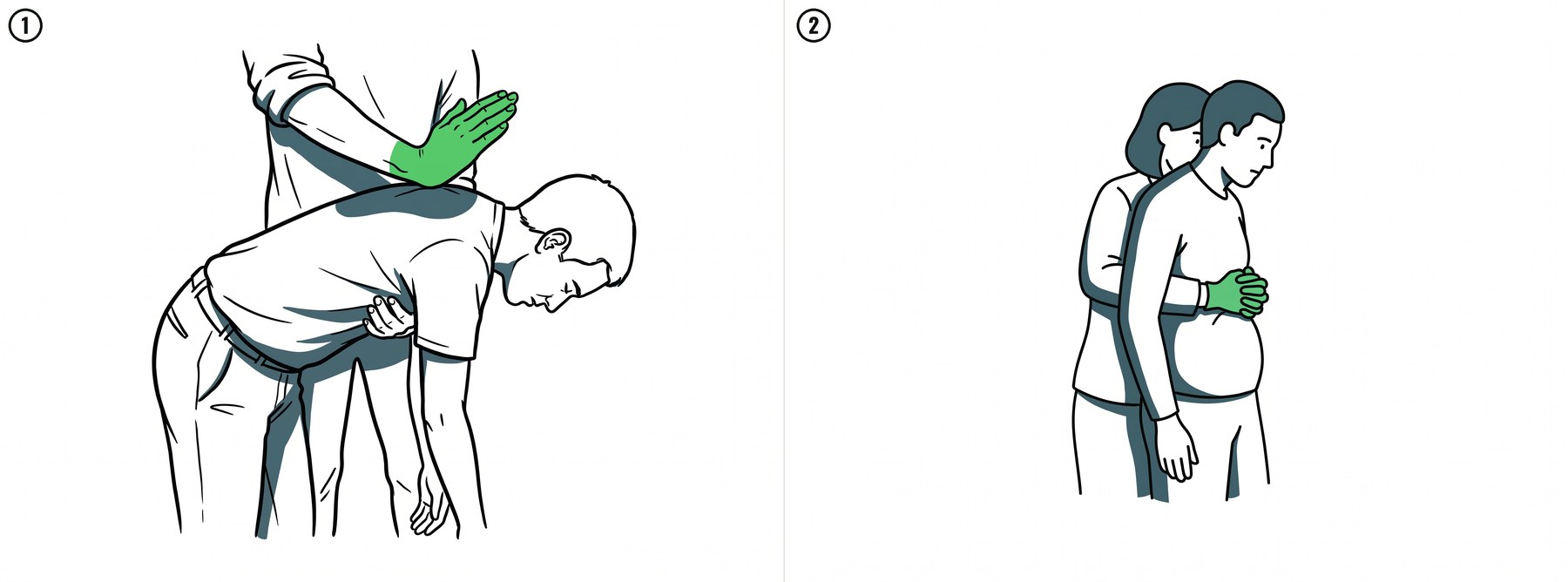
→ Choking: full page ·
p.107 → Pregnant, infant, unconscious ·
p.108 → CPR & AED essentials · p.1112
THE SECURITY OFFICER'S MANUALdiagram
Unconscious and breathing normally
RECOVERY POSITION
Suspected spinal injury (fall, collision, blow to head or neck)? Do not
move them. Hold the head still, in line with the body. Wait for paramedics.
999
Call now if not already done. Then position them.
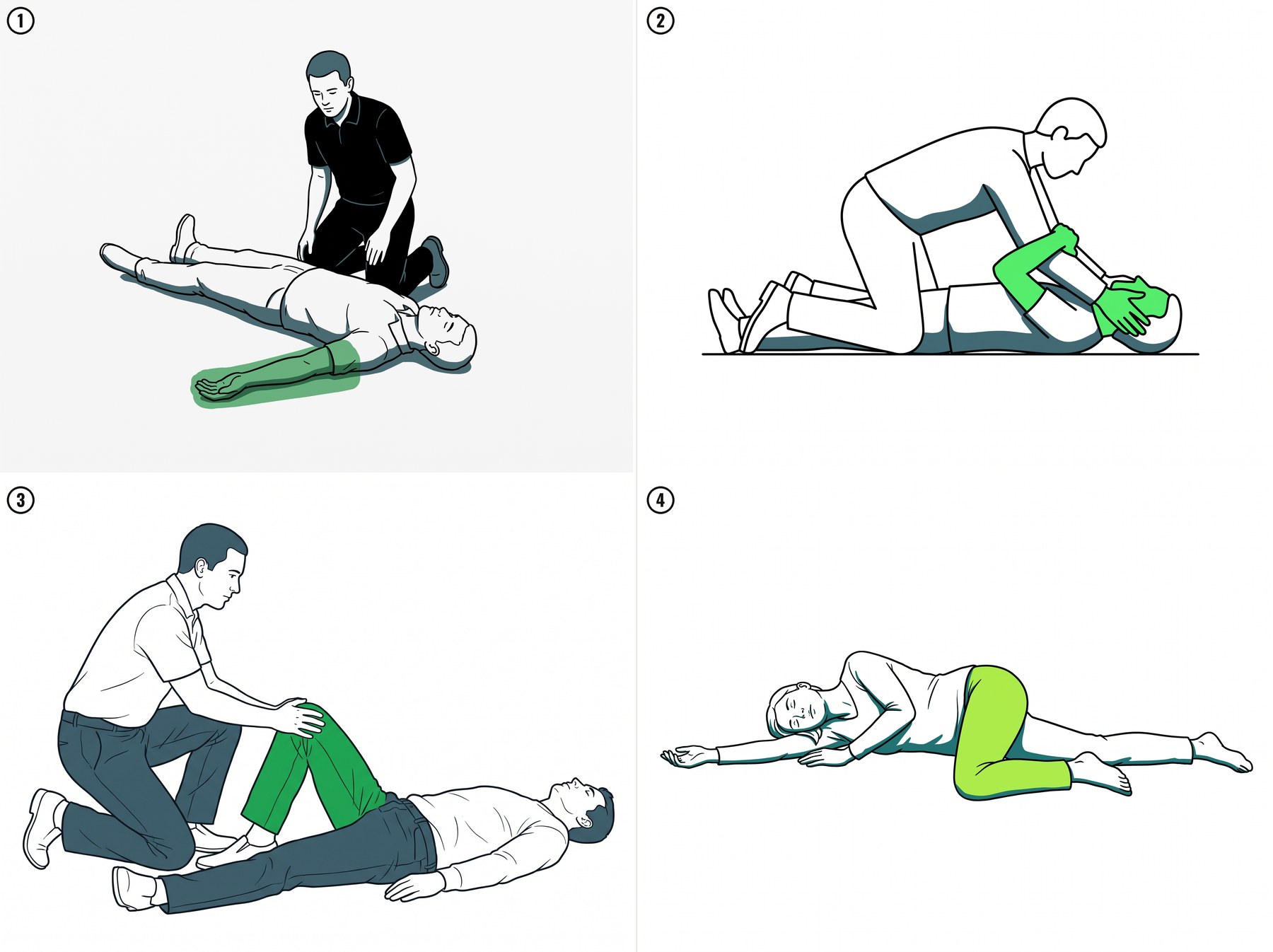
1Kneel beside them. Nearest arm out
at a right angle, palm up.
2Far arm across the chest. Back of
their hand against their cheek. Hold it.
3Bend the far knee, foot flat. Pull
that knee to roll them towards you.
4Top leg at right angles. Tilt the
head back to keep the airway open.
ANGLE the face slightly down Fluids drain out, not into the airway.
CHECK breathing constantly If it
stops: roll them onto their back. Start CPR. See: CPR & AED.
→ Recovery position:
full page · p.106 → CPR & AED
essentials · p.1113
THE SECURITY OFFICER'S MANUALquickref
Answer in this order
THE 999 CALL
The operator asks these questions, in this order. Answer clearly. Stay
on the line until told to hang up.
| They ask | You give |
|---|---|
| Where are you? | Full address, postcode, nearest landmark, floor level. |
| What happened? | One line: collapse, fall, bleeding, overdose. |
| How many hurt? | Number of casualties. |
| What condition? | Conscious? Breathing? Bleeding? |
| Who are you? | Name, callback number, 'security officer on site'. |
SEND someone to meet the ambulance At the entrance, in hi-vis.
CLEAR the access route Open
doors. Move obstacles. Hold the lift at ground.
CONTINUE first aid Keep
bystanders back. Protect their dignity.
→ Making the 999 call:
full page · p.125 → Emergency numbers ·
p.17814
THE SECURITY OFFICER'S MANUALchecklist
One officer is already working
SECOND OFFICER ARRIVING
Do not duplicate their job. Take the jobs they cannot do. In this order.
ANNOUNCE yourself
Say: 'Second officer. What do you need?' Do not interrupt CPR.
CONFIRM 999 is called
Not called? Call now, speaker on. Then update control by radio.
FETCH the AED and bleed kit
Nearest ones. Run.
TAKE over compressions
Swap every 2 minutes, at the end of a set of 30. No pause.
MANAGE the space
Move bystanders back. Screen the casualty. Protect their
dignity.
MEET the ambulance
At the entrance, in hi-vis. Clear the route. Hold the lift.
NOTE times and facts
Collapse time, 999 time, shocks given, tourniquet time. For the
record later.
Paramedics arrive: give them the times, what happened, and what you
both did. Then write it up.
→ CPR & AED
essentials · p.11 → The 999 call · p.14 → Occurrence book · p.13015
THE SECURITY OFFICER'S MANUALquickref
This section in one look
FRONT MATTER DIGEST
999
Life at risk? Call now. Speaker on.
| You see | Do first | Go to |
|---|---|---|
| Blood spreading fast | Press hard on the bleeding point. | Catastrophic bleeding |
| No response to shout and shake | Call 999, then check breathing. | CPR & AED essentials |
| Clutching throat, cannot speak | Ask them: 'Are you choking?' | Choking |
| Unconscious, breathing normally | Roll them onto their side. | Recovery position |
FIND sections by colour Green is
Medical.
FOLLOW the See: pointers They
name the exact page. No hunting mid-incident.
USE the index Every topic,
symptom, and script.
COMPLETE your personal details page Do it before your first shift.
→ Someone is down ·
p.9 → How to use this manual · p.4 → Before your first shift · p.7 → Emergency numbers · p.17816
1
SECTION 01 · LEGAL POWERS
Know exactly what you can and cannot doLEGAL POWERS
Arrest: the four gates. Force and safe restraint. Search by consent.
Trespass and removal. Criminal vs civil. GDPR, evidence and court. Every page starts with
what to do.
1
1 · LEGAL POWERSflowchart
The four gates. All must pass.
CITIZEN'S ARREST
Unlawful arrest = false imprisonment. You can be sued and prosecuted.
Indictable offenceA serious crime that
can be tried in Crown Court. Theft, burglary and robbery all qualify.
1Indictable offence?
Theft, burglary, robbery, fraud, ABH/GBH (real injury). NOT common
assault.
DO NOT ARREST. Document. Call 101.
▼ YES
2Arrest necessary?
Only to stop injury to anyone, loss of or damage to property, or
making off before police arrive.
DO NOT ARREST. Monitor. Call police.
▼ YES
3No time to wait for police?
Could police realistically arrest instead? If they can get here in
time, this gate fails.
DO NOT ARREST. Call 999. Observe and report.
▼ YES
4Sure of your grounds?
You saw the act, or evidence is clear. Offence over? Stricter rule:
see Arrest After the Event.
DO NOT ARREST. Suspicion is not enough.
▼ ALL YES
PROCEED. Say the arrest words. Minimum force. Call 999 now.
ANY GATE FAILS
Refusing a name is NEVER a ground to arrest. If they also walk off, the
ground is the making off.
LEGAL BASIS · s24A(1)-(4) PACE 1984→ What counts as indictable · p.19 → Offence already over? · p.20 → The arrest words · p.21 → Use of force · p.2318
1
1 · LEGAL POWERSquickref
Gate 1: is it serious enough?
INDICTABLE OFFENCES
Indictable = serious, can be tried in Crown Court. Summary-only =
minor, magistrates only. You may arrest ONLY for indictable offences. Unsure? Do not arrest.
Call police.
- Theft (any value)
- Robbery
- Burglary
- Fraud
- ABH / GBH (actual / grievous bodily harm: real injury, cuts, bruising)
- Criminal damage (ANY value)
- Drug possession with intent to supply
- Assault on an emergency worker
- Sexual assault, exposure, voyeurism (NOT all sexual offences: some are summary-only)
- Arson
- Common assault (a scuffle, a slap, a shove)
- Drunk and disorderly
- Minor public order offences
- Begging
Two traps. Criminal damage of £5,000 or under is a summary offence, so
there is no citizen's arrest power. Over £5,000, or any damage by fire, the power applies.
Simple trespass is not an offence: civil only, so no arrest power.
LEGAL BASIS · s24A PACE 1984; s22 MCA 1980;
Interpretation Act 1978 Sch 1→ The four gates · p.18 → Trespass: the law · p.3519
1
1 · LEGAL POWERSscenario
The shoplifter trap
ARREST AFTER THE EVENT
Wrong about the offence? Your arrest was unlawful, however reasonable your
suspicion. You face false imprisonment claims.
The offence is over and they are walking away. A stricter rule now
applies. An indictable offence must ACTUALLY have been committed. Reasonable suspicion alone
is not enough after the event.
R v Self [1992]: the case that sets the trap
A store detective arrested a suspected shoplifter. A court later
acquitted the man of theft. No theft proven meant the arrest was unlawful. Convictions
for assaulting those detaining him were quashed.
ARREST for what you witnessed Wherever possible. Your own eyes are your grounds.
BE CERTAIN an offence occurred After the event, certainty is the bar. Example: goods found
concealed past the tills.
NEVER arrest on suspicion alone After the event, if in doubt: observe, document, describe them
to police.
WRONG person is survivable If an
offence definitely happened, you may arrest anyone you reasonably suspect of
it.
LEGAL BASIS · s24A(2) PACE 1984; R v Self [1992] 1
WLR 657 (CA)→ The four gates · p.18 → Preserve the evidence · p.4520
1
1 · LEGAL POWERSscript
Say it clearly. Say it once.
WHAT YOU SAY: ARREST
Making a citizen's arrest for theft
“I am making a citizen's arrest.”
“You are under arrest for theft.”
“I saw you put the jacket in your bag and pass the tills.”
“The police are on their way. Stay here with me.”
“You can't arrest me. You're not police.”
“The law lets any person arrest for this. Police are coming.”
“Let me go or I'll sue you.”
“You'll speak to the police in a few minutes. They're on their way.”
“I didn't do anything.”
“Tell the police that. They will listen to you.”
- Name the offence in plain words
- Say what you saw, in one sentence
- Tell them police are coming
- Do not question them about the offence
- Do not threaten, bargain or mock
- Do not copy the police caution
LEGAL BASIS · s24A PACE 1984→ Making the arrest · p.22
→ If they struggle: safe restraint · p.2521
1
1 · LEGAL POWERSchecklist
After the words, before police arrive
MAKING THE ARREST
A back-room detention can become unlawful imprisonment. Stay public. Stay
visible.
01
SAY the arrest words See the
script on the previous page.
02
CALL 999 now Or radio control to
call. Never delay.
03
NOTE the exact time Time of
arrest goes in every report.
04
STAY with them In view of CCTV
and witnesses until police arrive.
05
DO NOT question them Interviews
are a police job.
06
PRESERVE the evidence Stolen
items, CCTV window, witness names.
07
HAND OVER to police Say what
you saw in one sentence. Give witness names and the CCTV window.
- Use minimum force to detain
- Keep them in a public, visible area
- Ask them to wait calmly
- Search them: police power only
- Handcuff unless immediate danger
- Take them to a back room
- Use force after they stop resisting
- Delay calling police
LEGAL BASIS · s24A PACE 1984→ Safe restraint · p.25
→ Evidence rules · p.4522
1
1 · LEGAL POWERSquickref
Three questions before you act
USE OF FORCE
You must justify every use of force. Every push, every hold.
You may use reasonable force to prevent crime or make a lawful arrest.
Force is always the last resort. Try de-escalation first.
| Test | Ask yourself, now |
|---|---|
| NECESSARY | Is force needed right now? Can I resolve this without it? |
| PROPORTIONATE | Match the threat. No more than required. |
| REASONABLE | Would a reasonable person agree, given what I honestly believe? |
Courts judge you on what you honestly believed at the time, not with
hindsight.
LEGAL BASIS · s3 Criminal Law Act 1967; s76 CJIA
2008→ De-escalation first · p.69 → Force options matrix · p.2423
1
1 · LEGAL POWERSmatrix
Match your response to the threat
FORCE OPTIONS MATRIX
Attempt de-escalation FIRST. Force is the last resort.
| THREAT | WHAT THEY DO | YOUR RESPONSE |
|---|---|---|
| COMPLIANT | Talks, follows requests | Talk. Ask. Direct. |
| PASSIVE RESISTANT | Refuses to move, goes limp | Firm, clear commands. Repeat once. |
| ACTIVE RESISTANT | Pulls away, pushes, struggles | Control holds. Escort by the arm. |
| ASSAULTIVE | Punches, kicks, spits | Block. Create distance. Call urgent assistance. |
| LIFE THREAT | Weapon, choking, group attack | Any force needed to survive and escape. |
Step down the ladder the moment they calm. De-escalate as fast as you
escalated. Record the behaviour that justified each level you used.
LEGAL BASIS · s3 Criminal Law Act 1967→ Going to ground? Read this first · p.25 → De-escalation · p.69 → After using force · p.2824
1
1 · LEGAL POWERSquickref
Restraint kills. Know how.
SAFE RESTRAINT (1/2)
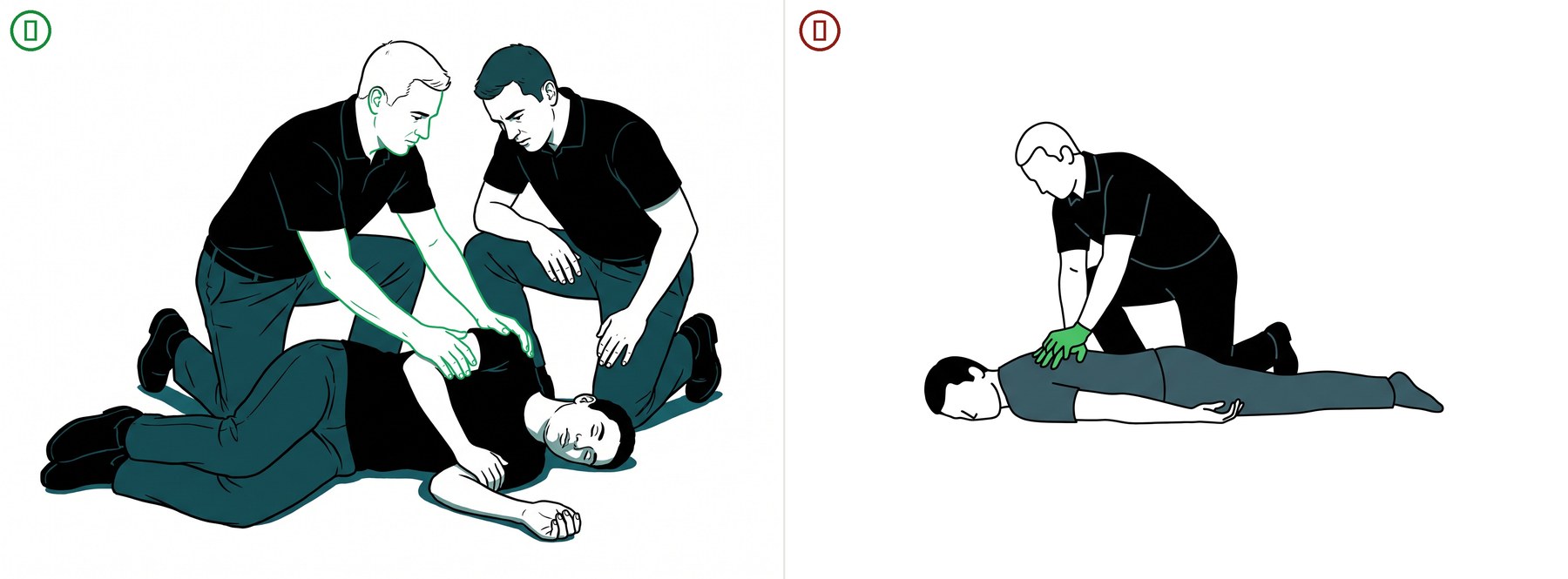
People die in prone restraint. Face down plus pressure on the back stops
breathing. Minutes, sometimes less.
'I can't breathe' is a medical emergency, not resistance. A person who
can speak may still be unable to breathe. Release the pressure at once.
- Turn them onto their side as soon as you can
- Use holds that leave the chest free
- Loosen your grip the moment they calm
- Keep talking to them throughout
- Hold anyone face down longer than seconds
- Kneel or lean on the back, chest or neck
- Bend them forwards over their knees
- Force them against a wall or counter while bent
- Sit on them, ever
Positional asphyxiaDeath or brain
damage because the restraint position stops breathing. The main killer in restraint deaths.
LEGAL BASIS · SIA guidance: reducing risk in
physical intervention→ Monitoring and release · p.26 → Not breathing? CPR · p.10225
1
1 · LEGAL POWERSchecklist
Monitor. Release. Recover.
SAFE RESTRAINT (2/2)
There is no safe length of prone restraint. Every second face down raises
the risk. Think seconds, not minutes.
01
GET them off their front Side,
sitting, kneeling or standing. As soon as practicable.
02
ASSIGN one person to breathing Airway. Breathing. Circulation. They watch nothing else.
03
LISTEN and act 'I can't
breathe', gurgling, going quiet or limp: release now.
04
RELEASE once controlled Loosen
or let go at the earliest opportunity.
05
CALL 999 if anything is wrong Blue lips, vomiting, no response. Start CPR if not
breathing.
06
WATCH them after release Collapse can follow minutes later. Recovery position if drowsy.
Keep checking breathing.
EXTRA DANGER if any of these:
DRINK or drugs Intoxication of
any kind.
LARGE build Big or heavy
people are at higher risk.
EXHAUSTION Worn out after a
struggle.
EXTREME agitation Or a mental
health crisis.
HEART or breathing conditions Anything known or suspected.
Any of these: make the restraint even shorter.
LEGAL BASIS · College of Policing APP: control,
restraint and searches→ CPR · p.102 → Recovery position · p.106 → After using force · p.2826
1
1 · LEGAL POWERSquickref
You do not have to wait to be hit
PRE-EMPTIVE FORCE
You may act first if you honestly believe an attack is coming now. The
belief must be honest. The force must still be reasonable and no more than needed.
FISTS clench, stance squares Body loads up before a punch.
THREATS turn specific 'I'm
going to hit you.'
HANDS reach for an object Bottle, glass, pocket, waistband.
THEY close distance fast Aggressive movement straight at you.
TARGET glance They look where
they plan to strike.
Statement wording that stands up
I believed I was about to be attacked. He raised his fists and stepped
towards me. He said 'you're getting it'. I had no route away. I pushed him back to
create distance.
LEGAL BASIS · Beckford v The Queen [1988] AC 130
(PC); s76 CJIA 2008→ After using force · p.28 → De-escalation · p.6927
1
1 · LEGAL POWERSchecklist
The first hour is evidence hour
AFTER USING FORCE
Write your account BEFORE viewing any footage. Courts trust untainted
memory.
01
CHECK for injuries Them and
you. Get medical help if needed.
02
KEEP body-worn video recording Never stop or delete. Footage protects you.
03
NOTIFY control and supervisor Immediately, by radio or phone.
04
PRESERVE CCTV footage Ask
control to save the time window now.
05
GET witness details Names and
numbers before they drift away.
06
DO NOT discuss with colleagues Protect your memory. It is evidence.
01
WRITE your account Within 1
hour. Before viewing CCTV.
02
RECORD the threat you faced Exact behaviour, exact words.
03
RECORD the force you used And
why each level was necessary.
04
SIGN and date the report Note
the time you wrote it.
→ Body-worn video ·
p.144 → Witness statements · p.168 → Occurrence book · p.13028
1
1 · LEGAL POWERSscript
You have no search powers. None.
SEARCH = CONSENT ONLY
You have NO power to search anyone. Not even someone you have arrested.
Every search needs consent.
CONSENT is freely given No
threats, no pressure, no tricks.
THEY know they can refuse Tell
them, every time.
THEY know what happens Explain
what the search involves.
THEY are not vulnerable No
children, no one drunk, no one in crisis.
HAVE a witness present For
every search, no exceptions.
Asking to search a bag
“I'd like to check your bag. You can say no.”
“If you say no, I can't search you. I may ask you to leave.”
“Are you happy for me to look?”
“Go on then.”
“Thanks. Open it up and hold it for me, please.”
LEGAL BASIS · No statutory search power exists for
security officers→ Can and cannot · p.30 → Entry condition searches · p.3129
1
1 · LEGAL POWERSquickref
The lines you never cross
SEARCH: CAN AND CANNOT
'Implied consent' at the door is legally weak. Get explicit consent, every
time.
- Ask to search bags
- Ask them to empty their own pockets
- Look without touching (visual check)
- Ask them to remove an outer coat
- Use walk-through detectors
- Force any search
- Touch the person
- Ask them to remove other clothing
- Do any intimate search
- Search without clear consent
- Seize or confiscate their property
01
STOP No consent means no
search happens.
02
EXPLAIN the entry conditions Search is the condition of coming in.
03
ASK them to leave If they
refuse the entry conditions.
04
CALL police if you suspect crime 999 if in progress, 101 otherwise.
05
DOCUMENT the refusal Time,
words used, witness name.
→ Refusing entry
script · p.160 → Found something? · p.3230
1
1 · LEGAL POWERSscript
Search as a condition of entry
ENTRY CONDITION SEARCH
SIGNAGE before the entry point Clear and visible before they commit to the queue.
CONFIRM verbally at the search Signage alone is not consent.
FREE to refuse and leave No
penalty for walking away.
Search at the door
“Entry needs a bag search.”
“You can refuse. Then I can't let you in, and you're free to leave.”
“Happy to go ahead?”
“You didn't search him!”
“Everyone with a bag gets checked. Same rule for all.”
Best practice: a same-gender officer searches. None available? Offer a
choice: wait for one, or decline the search. Use a witness. Write down the decision.
→ Search rules ·
p.3031
1
1 · LEGAL POWERSchecklist
A knife or weapon in the bag
FINDS: WEAPONS (1/3)
Never ask the person to handle or remove the weapon. It can be used on
you.
STEP BACK
Keep them, and everyone else, away from the weapon.
CALL 999 now
Possession of a blade or offensive weapon is indictable.
Arrest only if all four gates pass.
SECURE it only if you must
Only to prevent immediate danger. Handle minimally: forensics
matter.
PHOTOGRAPH in place if safe
Note the exact position before anything moves.
LOG everything
Time, words spoken, who was present.
LEGAL BASIS · s24A PACE 1984→ The four gates · p.18
→ Evidence rules · p.4532
1
1 · LEGAL POWERSchecklist
Seize, seal, log, hand over
FINDS: DRUGS (2/3)
Never return drugs to the person. Never keep them longer than necessary.
You may take drugs found in a search, but ONLY to hand them to police.
That is your legal protection. Hand them over as soon as possible.
GLOVES on if available
Protect yourself and the evidence.
SEAL in a numbered bag
Tamper-evident bag or envelope.
LOG with a witness
Drug find record: time, place, description, both names.
STORE locked
Safe or secure cabinet only.
HAND to police for a receipt
Get the receipt. File it with the log.
LEGAL BASIS · s5(4) Misuse of Drugs Act
1971→ Evidence rules · p.45 → Occurrence book · p.13033
1
1 · LEGAL POWERSchecklist
Legal items the venue prohibits
FINDS: BANNED ITEMS (3/3)
Lawful personal property stays theirs. Refuse entry if you must, but never
seize it. Drugs and weapons follow the previous pages instead.
EXPLAIN the venue policy
Alcohol, recording devices: whatever your site bans.
OFFER secure storage
Cloakroom or storage box if the site has one.
ISSUE a receipt if stored
Numbered ticket. Log the item.
REFUSE entry if they decline
Their choice: store it or leave with it.
DOCUMENT the interaction
Time, item, outcome.
→ Weapons · p.32 → Drugs · p.33 → Refusing entry script · p.16034
1
1 · LEGAL POWERSquickref
Civil matter. Common law power.
TRESPASS: THE LAW
You may use reasonable force to remove a trespasser for the occupier.
First ask them to leave. Then give them real time to comply. Get the site manager's
authority before removing anyone.
| CIVIL TRESPASS | AGGRAVATED TRESPASS | |
|---|---|---|
| What it is | Entering or staying without permission | Trespass PLUS an act intended to intimidate, obstruct or disrupt a lawful activity |
| A crime? | No. Civil matter only | Yes. Summary offence |
| Police attend? | Usually not | Yes. Call them |
| Arrest power? | None | None for you: summary-only |
Your authority is COMMON LAW, not statute. Section 3 Criminal Law Act
1967 does NOT cover simple trespass: it only applies if things turn criminal, like an
assault on you.
LEGAL BASIS · Common law; Hemmings v Stoke Poges
Golf Club [1920] 1 KB 720→ Removal procedure · p.36 → Use of force · p.2335
1
1 · LEGAL POWERSchecklist
Five stages before any contact
REMOVING A TRESPASSER
Your authority stops at the boundary. Once they are off site, never pursue
or follow.
IDENTIFY yourself
"I am the security officer for these premises."
EXPLAIN
"You don't have permission to be here."
ASK them to leave
"I'm asking you to leave now."
WARN of the consequence
"If you don't leave, I may use reasonable force."
WAIT
Give real time to comply and a clear route out.
ESCORT with minimum force
Only if they still refuse. Arm escort to the exit.
DOCUMENT everything
Each stage, times, exact words, witnesses.
CALL police if it escalates
Violence or aggravated trespass: 999.
LEGAL BASIS · Common law: occupier's
agent→ Force options · p.24 → Safe restraint · p.25 → Word-for-word script · p.163 → Banning them · p.3736
1
1 · LEGAL POWERSscript
The owner decides who comes in
BANNING AND EXCLUSION
Issuing a ban after an incident
“On behalf of [owner], you are banned from these premises.”
“The ban lasts [duration].”
“If you come back, you will be trespassing and we will call police.”
“Do you understand?”
“You can't ban me.”
“The owner chooses who comes in. I act for the owner.”
RECORD name and description Full name if known, clear description always.
RECORD date, time, duration When issued, how long it runs.
RECORD the incident The
specific reason for the ban.
RECORD who authorised it Manager or owner, by name.
PHOTOGRAPH if policy permits Check site policy first.
ASK management to write A
verbal ban is valid. Written notice is stronger.
→ Trespass law ·
p.35 → Occurrence book · p.13037
1
1 · LEGAL POWERSquickref
Same law, different handling
SPECIAL TRESPASS CASES
Vulnerable person? Assess mental health, intoxication and risk before any
removal.
| Who | What changes | What you do |
|---|---|---|
| Protesters | Peaceful protest rights do not extend onto private land | Same removal stages. Blocking access = aggravated trespass: call police. |
| Rough sleepers | Often vulnerable | Compassion and dignity. Assess vulnerability before any force. Prefer patience over contact. |
| Former employees | Leaving the job ends implied permission | Ask HR to send written notice of the ban. Refuse entry. Call police if they will not leave. |
→ Removal procedure ·
p.3638
1
1 · LEGAL POWERSmatrix
Only criminal matters can justify arrest
CRIMINAL VS CIVIL
| CRIMINAL | CIVIL | |
|---|---|---|
| Who acts | The state prosecutes. Police investigate | Person sues person or company. No police |
| Outcome | Fines, prison | Compensation |
| Your arrest power | Only if indictable AND all four gates pass | NONE. Ever |
| Examples | Theft, ABH/GBH, criminal damage, fraud | Simple trespass, contract disputes, debt, negligence |
Civil matter in front of you? You still have tools: refuse entry,
remove trespassers, ban, document. You just cannot arrest.
→ The four gates ·
p.18 → Trespass law · p.3539
1
1 · LEGAL POWERSquickref
999, 101, or handle it yourself
WHEN TO CALL POLICE
Life at risk. Crime in progress. Weapons.
Person detained. Violence.999
Crime already over, no ongoing threat. Minor
damage. Suspicious activity.101
| Police will NOT attend | Do this instead |
|---|---|
| Simple trespass (civil) | Run the removal stages, this section |
| Customer complaints and disputes | Refer to site management |
| Parking disputes on private land | Follow the site's parking process |
| Lost property reports | Log it, store it, follow site process |
→ Emergency numbers ·
p.178 → Removing a trespasser · p.3640
1
1 · LEGAL POWERSquickref
Four rules keep you safe
GDPR ESSENTIALS
Breaking GDPR rules costs fines up to £17.5 million or 4% of turnover.
Handle data with care.
COLLECT only what you need If
you don't need it, don't record it.
KEEP it secure Locked away or
password protected. Always.
DELETE when no longer needed Follow your site's retention policy.
BE transparent Signage and
privacy notices tell people they are recorded.
| CCTV and video | Written records |
|---|---|
| Footage, still images, number plates, body-worn video | Names, addresses, contact details, incident reports, visitor logs |
GDPR is the law controlling how you collect, store and use personal
data. All of the above counts.
LEGAL BASIS · UK GDPR→ CCTV compliance · p.42
→ Subject access requests · p.43 → Data
breach · p.4441
1
1 · LEGAL POWERSchecklist
Signage and retention
CCTV COMPLIANCE
SIGNS before the camera area Visible before anyone enters the recorded zone.
NAME the data controller The
company name, on the sign.
STATE the purpose Why
recording happens.
GIVE a contact for enquiries Phone or email on the sign.
SHOW the camera symbol The
standard pictogram.
| Type | Keep for |
|---|---|
| Standard CCTV footage | 30 days |
| Incident footage | Until the case is resolved |
| Incident reports | 7 years |
These are typical examples only. Check your site's retention policy.
LEGAL BASIS · UK GDPR→ Subject access requests · p.43 → Body-worn video · p.14442
1
1 · LEGAL POWERSchecklist
Anyone can ask for their data
SUBJECT ACCESS REQUESTS
Your company must respond within ONE MONTH. Your job: log it, get details,
escalate today.
A SAR is a request for the personal data you hold on someone. It can
be verbal. 'Can I see your CCTV of me?' is a valid SAR.
01
LOG the date received The
company's one-month clock starts today.
02
TAKE their contact details Name, phone or email.
03
ESCALATE today Data Protection
Officer or duty manager.
04
DO NOT handle it yourself Never promise, refuse, or hand over data.
Someone asks for their data
“Thanks. I'll pass this to our data protection team.”
“Can I take your contact details?”
“They will reply within one month.”
LEGAL BASIS · UK GDPR→ GDPR essentials · p.4143
1
1 · LEGAL POWERSchecklist
Your five moves, in order
DATA BREACH RESPONSE
If the breach risks people's rights and freedoms, your company must tell
the ICO (Information Commissioner's Office) within 72 hours of becoming aware.
Data breachPersonal data lost, stolen,
or seen by someone who should not see it.
01
STOP the breach if safe Close
the screen, secure the file, recover the device.
02
REPORT to your supervisor now Immediately, whatever the hour.
03
NOTE the time of discovery The
company's 72-hour clock starts now.
04
DOCUMENT the facts What
happened, when, what data is affected.
05
PRESERVE evidence Delete
nothing. Change nothing.
ICO helpline0303
123 1113
ICO online reportingico.org.uk
LEGAL BASIS · UK GDPR→ GDPR essentials · p.4144
1
1 · LEGAL POWERSquickref
Protect it or lose the case
EVIDENCE: GOLDEN RULES
Contaminated or mishandled evidence can be thrown out of court.
MINIMISE handling Fewer people
touching it means less contamination.
DOCUMENT every touch Who
handled what, and exactly when.
SECURE the scene Control
access immediately.
| Type | Examples |
|---|---|
| Physical | Weapons, clothing, stolen goods |
| Documentary | Receipts, letters, notes |
| Digital | CCTV, emails, access logs |
| Testimonial | Witness accounts, your statement |
→ Chain of custody ·
p.46 → Securing a scene · p.4745
1
1 · LEGAL POWERSfill
Who held it, from find to court
CHAIN OF CUSTODY
Chain of custodyA written record of
everyone who handled evidence, from finding it to court.
Item description (detail, serial numbers)
Found by (name)
Location found (exact spot)
Date and time
Every transfer: who, to whom, when, signature
Photograph evidence where it lies before anyone moves it. Include
something for scale.
→ Evidence rules ·
p.45 → Occurrence book · p.13046
1
1 · LEGAL POWERSchecklist
Lock it down until police arrive
SECURING A SCENE
01
CORDON the area Tape,
barriers, or people standing post.
02
CREATE one way in and out Single entry and exit point.
03
LOG everyone in and out Name,
time, reason.
04
TOUCH nothing Move nothing.
Clean nothing.
05
PROTECT from weather Cover
outdoor evidence without touching it.
06
NOTE the time secured In your
notebook, then the occurrence book.
07
BRIEF your relief fully Hand
over everything before you leave.
REQUEST CCTV preservation now Before it overwrites.
NOTE cameras and angles Camera
numbers covering the scene.
RECORD the time window Exact
start and end needed.
DO NOT watch footage first Write your account before viewing anything.
→ Handover · p.128 → Witness statements · p.16847
1
1 · LEGAL POWERSchecklist
Before court, and in the box
COURT ATTENDANCE
Stay calm under cross-examination. Never argue with the lawyers.
TELL your employer As soon as
the summons arrives.
RE-READ your statement You may
refer to it in the box.
REVIEW your original notes The
ones made at the time.
DRESS smart and plain Conservative. No branding.
ARRIVE 30 minutes early Bring
ID and the witness summons.
TAKE the oath clearly Oath or
affirmation, your choice.
LISTEN to the whole question Then answer only that question.
SPEAK slowly to the bench Address the magistrates or jury, not the lawyer.
SAY 'I don't know' when true It is a strong answer, not a weak one.
STICK to what you saw Heard
and did. Nothing more.
→ Cross-examination ·
p.49 → Witness statements · p.16848
1
1 · LEGAL POWERSscript
They test you. Stay steady.
CROSS-EXAMINATION
Defence lawyer challenges your evidence
“Isn't it true that...”
“No. What I saw was...”
“You're lying.”
“No. I am telling the truth.”
“You can't be certain.”
“I am certain because...”
“(a long, confusing question)”
“Could you repeat the question, please?”
TELL the truth, nothing else You are not there to win a conviction.
STICK to your own senses What
you personally saw, heard and did.
EXPLAIN plainly No jargon, no
abbreviations.
DO NOT volunteer extras Answer
the question. Then stop.
→ Court attendance ·
p.48 → Witness statements · p.16849
1
1 · LEGAL POWERSquickref
Five powers, five limits
LEGAL POWERS DIGEST
| Power | Authority and limits |
|---|---|
| Citizen's arrest | Indictable offence AND all FOUR gates pass. Call 999 at once |
| Use of force | Necessary, proportionate, reasonable. Last resort |
| Restraint | Never face down. Chest free. Release at the earliest moment |
| Search | Consent only. No consent, no search |
| Remove trespassers | Common law, for the occupier. Ask, warn, wait, minimum force |
| Ban from premises | Owner's authority. Document fully |
Key law: s24A PACE 1984 (citizen's arrest) · s3 Criminal Law Act 1967
(force to prevent crime) · Common law (removing trespassers) · s5(4) Misuse of Drugs Act
1971 (holding drugs for police) · UK GDPR (data). England and Wales law: Scotland differs.
4
Gates must pass before any arrest. When in doubt: OBSERVE · DOCUMENT ·
CALL POLICE.
LEGAL BASIS · See legislation index→ The four gates · p.18
→ Use of force · p.23 → Safe restraint ·
p.25 → Search by consent · p.29 → Removing a trespasser · p.36 → Banning · p.37 → Legislation index · p.18150
1
2
SECTION 02 · INCIDENTS
Classify fast. Act in the right order.INCIDENTS
Classification and dynamic risk first. Then theft, assault, intoxication,
drugs, trespassers and de-escalation. Then weapons, suspicious items, active threat, mental
health, missing persons and safeguarding. Fire and newer threats follow. The quick reference
closes the section.
2
2 · INCIDENTSmatrix
Four levels. Know yours in seconds.
INCIDENT CLASSIFICATION
Never delay 999 for a Level 1 incident. Call 999 first. Report to your
supervisor after.
Level 1 is the most severe. The lower the number, the faster you act.
| LEVEL | SEVERITY | EXAMPLES | YOUR RESPONSE |
|---|---|---|---|
| 1 | CRITICAL | Weapon. Active threat. Fire. Serious injury. Death. Suspicious item. High-risk missing child. | 999 NOW. Then control + manager. |
| 2 | SERIOUS | Assault with injury. Robbery. Intruder. Citizen's arrest made. Other missing child. | Control + supervisor. Within 5 minutes. |
| 3 | MODERATE | Theft, offender gone. Trespasser refusing. Intoxicated person. Dispute. Minor damage. Alarm. | Control room. Within 15 minutes. |
| 4 | MINOR | Lost property. Found property. Complaint. Equipment fault. | Log and report when practical. |
A missing child is Level 1 if under 10, vulnerable, or abduction is
possible. Otherwise Level 2. Escalate the moment a high-risk sign appears or the search
stalls.
→ Escalation decision
· p.53 → Missing child · p.9152
2
2 · INCIDENTSflowchart
Who to call, in what order
ESCALATION DECISION
Calling the wrong contact first costs minutes. For Level 1, 999 always
comes before control.
1Everyone safe? No threat to life?
No weapon, fire, serious injury, active threat or high-risk
missing child.
LEVEL 1. Call 999 now. Then control and manager.
▼ YES
2No injury, crime in progress, or
missing child?
Assault with injury, robbery, intruder, arrest made: all Level 2.
LEVEL 2. Call control + duty supervisor.
▼ YES
3Everyone calm and cooperative?
Refusing to leave, intoxicated, verbal dispute, minor damage:
Level 3.
LEVEL 3. Call control room. Monitor. When resolved, log and
report.
▼ ALL YES
LEVEL 4. Log it. Report by end of shift.
ANY NO
| CONTACT | WHEN |
|---|---|
| 999 | Level 1. Call first, before anyone else. |
| Control room | Every incident, after any 999 call. |
| Duty supervisor | Level 2, or control not answering. |
| Site manager | Levels 1 and 2, media on site, legal issues. |
→ Radio procedure ·
p.157 → Emergency numbers · p.17853
2
2 · INCIDENTSchecklist
The 10-second check before you act
DYNAMIC RISK ASSESSMENT
No task on site is worth your life. When risk beats benefit, withdraw and
observe.
Every 'if safe' in this manual means this check. Run it before you
approach. Run it again every time something changes.
SPOT the threat
What exactly is the danger? Person, object, place, crowd?
ASK what could go wrong
Picture the worst realistic outcome if you step in now.
WEIGH acting against waiting
Is acting worth the risk? Police may be minutes away.
CHECK your exit
Know your way out before you step in. Keep it behind you.
DECIDE: act, wait, withdraw
Withdrawing to observe is a decision, not a failure. Say so in
your report.
New weapon, second person, blocked exit: each one restarts the check.
Record what you decided and why. That record protects you in any review.
→ Use of force ·
p.24 → Report writing · p.17154
2
2 · INCIDENTSflowchart
See all three, or do not approach
THEFT: RESPONSE
Do not chase offenders off site. Your safety and your witness evidence
come first.
1Saw them select the item?
Watch continuously. Do not lose sight.
Observe only. Alert control. Do not approach.
▼ YES
2Saw concealment or tag removal?
Into clothing, bag or pram. Price-tag swaps count.
Keep watching. Note description. Do not approach.
▼ YES
3Past the last till without paying?
They must pass the last payment point.
Wait. They may still pay. Stay in sight.
▼ ALL YES
Approach outside, calm and polite, with backup. Script overleaf.
ANY NO
Common signs: working in pairs, oversized or unseasonal clothing. Also
repeat visits without buying, and watching staff rather than goods.
LEGAL BASIS · s1 Theft Act 1968→ Citizen's arrest gates · p.18 → Approach scripts · p.5655
2
2 · INCIDENTSscript
Calm words. Outside the store.
THEFT: THE APPROACH
Approaching a suspected shoplifter outside the store
“Excuse me. I'm the security officer for this store. I believe you
have items you haven't paid for. Please come with me to the office so we can sort this
out.”
“It wasn't me. Prove it.”
“I understand. I saw you conceal the items and walk past the tills.
Please come with me, or I will call the police.”
LET them go if they run Do not
chase, tackle, grab, or follow in a vehicle.
NOTE direction and description Clothing, features, companions, vehicle and
registration.
CALL control with the description
SECURE the CCTV footage Tell
control which cameras and times to save.
Your witness evidence is worth more than a struggle. Do not risk
injury for stock.
→ Citizen's arrest
gates · p.18 → Theft evidence · p.5756
2
2 · INCIDENTSchecklist
If detained, police take over
THEFT: EVIDENCE
Do not chase or use force to recover goods from someone who has left. You
have no power once they are off site. You risk committing assault.
01
CALL 999 now A detained person
means police must come. Note the exact time of detention.
02
DO NOT search them Police
search. You may ask them to show items voluntarily.
03
PHOTOGRAPH items where they lie Do not move them. They are evidence.
04
SECURE CCTV footage
05
GET witness names and numbers
06
WRITE your report this shift Memory fades fast. Facts first, exact words in quotes.
| OFFENDER DETAILS | INCIDENT DETAILS |
|---|---|
| Full description. Name and address if given. | Items taken and their value. |
| Direction of travel if they fled. | Time of offence. CCTV camera numbers. |
| Companions and any vehicle. | Witness names and contact numbers. |
If they used or threatened force to steal or escape with goods, tell
police. That makes it robbery, not just theft.
LEGAL BASIS · s8 Theft Act 1968
(robbery)→ Search needs consent · p.29 → Occurrence book · p.130 → Report writing · p.17157
2
2 · INCIDENTSchecklist
Voice first. Never alone.
ASSAULT: RESPOND
You can become the next victim. Do not step in if the risk check says
withdraw.
CALL 999
Say 'assault in progress' and the exact location.
ALERT control, request backup
Wait for backup unless the victim is in immediate danger.
INTERVENE with voice first
From a safe angle. Do not step between them alone.
SEPARATE and preserve
Keep parties apart. Do not clean blood. Bag weapons without
touching. Secure CCTV and witnesses.
Verbal intervention, from a safe position
“STOP! Security! The police have been called. Move away from each
other NOW.”
→ Dynamic risk check
· p.54 → Can you detain? · p.59 → Bleeding control · p.10958
2
2 · INCIDENTSmatrix
One row tells you your powers
ASSAULT: CLASSIFY
A citizen's arrest for a finished offence is lawful only if the offence
really happened. If in doubt, let them leave and rely on your evidence.
| TYPE | WHAT IT MEANS | YOUR RESPONSE |
|---|---|---|
| Common assault | Threat or minor contact. No injury. | Separate parties. Document. Offer victim 101. No power to detain. |
| ABH | Actual bodily harm. Bruising, cuts, minor fractures. | 999. First aid. Detention possible: see below. |
| GBH | Grievous bodily harm. Serious wounds, broken bones. | 999 and ambulance now. Detention possible: see below. |
| Sexual assault | Unwanted sexual contact or behaviour. | 999. Protect the victim. Preserve evidence. See victim care. |
Indictable offenceA serious crime that
can be tried in Crown Court. ABH, GBH and robbery qualify. Common assault does not.
DETAIN only if ALL four hold:
01
INJURY is ABH or worse An
indictable offence. Common assault never qualifies.
02
SAFE to do so Run the dynamic
risk check first.
03
NEEDED to stop them Detention
must stop escape or further injury.
04
POLICE cannot arrive in time If they can, wait and point them out.
For common assault with no injury: never detain. Record a full
description and direction of travel. Secure CCTV. Give police your account.
LEGAL BASIS · s24A PACE 1984; s39 Criminal Justice
Act 1988→ Citizen's arrest gates · p.18 → Restraint safety · p.2559
2
2 · INCIDENTSchecklist
Safety, warmth, dignity
ASSAULT: VICTIM CARE
For sexual assault, the victim's dignity and the evidence come before
everything else you do.
MOVE victim somewhere safe Only if needed and they can move.
ASSESS injuries, call ambulance Call for anything you cannot rule out. Head injuries
hide.
GIVE first aid within training
KEEP them warm and reassured Never leave a victim alone.
Reassuring the victim
“You're safe now. Help is on the way. I'm going to stay with you. Is
there anyone you'd like me to contact?”
SEXUAL ASSAULT: private room now Offer a same-gender officer if available.
DO NOT ask for detail Police
specialists take the account. You just keep them safe.
ADVISE: do not wash or change Washing, showering or changing clothes destroys
evidence.
RECORD only the basics Time
reported, who reported it, officers attending. Nothing more.
→ Bleeding control ·
p.109 → Witness statement · p.16860
2
2 · INCIDENTSquickref
Drunk, drugged, or ill?
INTOXICATED PERSONS
Intoxication can mask a medical emergency. Head injury and diabetes can
mimic drunkenness. If unsure, treat as medical.
ASSESS: drunk or medical?
Can they answer simple questions? Any fall, head knock,
medication, diabetes?
POSITION at an angle
Do not block their exit. Keep your own.
SPEAK slowly and simply
One short sentence at a time. No lecturing, no mocking.
OFFER water, a seat, help
Then decide: can they leave safely? Next page.
| ALCOHOL SIGNS | DRUG SIGNS |
|---|---|
| Slurred speech. Unsteady on feet. | Pinpoint or dilated pupils. |
| Smell of alcohol. | Extreme energy or extreme drowsiness. |
| Glazed, bloodshot eyes. | Paranoia, sweating, jaw clenching. |
→ Decide: eject or
help · p.62 → Recovery position · p.10661
2
2 · INCIDENTSflowchart
Can they leave safely?
INTOXICATED: DECIDE
You can be liable if someone you eject comes to harm. Never eject a person
into danger.
1Awake, answering, no injury signs?
Rousable, knows where they are, no head knock, breathing normally.
Treat as medical. Call 999. Recovery position if unresponsive and
breathing.
▼ YES
2Can they walk unaided?
Steady enough to leave without falling.
Do not eject. Sit them somewhere safe. Stay with them. Call an
ambulance if they worsen.
▼ YES
3Safe for them outside?
Not freezing, no busy road, coat on, not alone if vulnerable.
Do not eject into danger. Keep them warm. Arrange a taxi, a
friend, or an ambulance.
▼ ALL YES
Assist them out. Offer a taxi or a friend's collection. Log it.
ANY NO
Asking an intoxicated person to leave
“Hello, I'm security here. Are you okay? Is there someone I can call
for you?”
“I can see you've had a few drinks. I need you to leave now. Shall I
call you a taxi, or is someone collecting you?”
→ Recovery position ·
p.106 → De-escalation · p.6962
2
2 · INCIDENTSquickref
Looks drunk. May be a crime.
SPIKING: SPOT IT
Eject a spiked person as a drunk and you hand them to their attacker. Rule
out spiking first.
SpikingGiving someone alcohol or drugs
without their knowledge or consent. Drinks, food, vapes and needles all count. Spiking is a
crime.
SUDDEN collapse or confusion Far more affected than their drinks could explain. Rapid change
over minutes.
SYMPTOMS after one drink Friends say 'they have only had one or two'. Believe
them.
LOSS of muscle control Cannot
stand, slurred speech, blurred vision, nausea, blackouts.
MEMORY gaps, vacant stare Confused about where they are. Unusually compliant with a
stranger.
SOMEONE steering them out A
person they do not seem to know insists on leaving together.
If in doubt, treat it as spiking. The standard 'assist exit, call a
taxi' response is the wrong response here.
LEGAL BASIS · Offences Against the Person Act 1861
s.24; Crime and Policing Act 2026 (commencement pending)→
Spiking: respond · p.6463
2
2 · INCIDENTSchecklist
Victim first. Evidence second.
SPIKING: RESPOND
Spiking drugs leave the body fast. Act now or the evidence is gone.
STAY with them
Somewhere safe and staffed. Never alone. Never with the
suspected spiker.
GET medical help
Unresponsive, vomiting or struggling to breathe: call 999 now.
KEEP the drink
Bag the glass or bottle. Do not tip it away or wash it.
SECURE the CCTV
Save footage of the victim, their drink, and everyone near it.
FIND the suspect
Still in the venue? Point them out to police. Do not confront
alone.
REPORT and record
Police, control, occurrence book. Encourage the victim to
report and get tested early.
- I believe you. This is not your fault.
- We will keep your drink for the police.
- Is there someone I can call to stay with you?
- You've just had too much.
- Off you go, get a taxi.
- Are you sure? You seem fine to me.
LEGAL BASIS · Offences Against the Person Act 1861
s.24; Crime and Policing Act 2026 (commencement pending)→
Recovery position · p.106 → Witness
statement · p.16864
2
2 · INCIDENTSchecklist
Never touch. Always document.
DRUG INCIDENTS
Never touch drugs or needles with bare hands. Use gloves or slide paper
underneath.
01
PHOTOGRAPH drugs where they lie Do not move them first. Drugs already seized in a search are
handled differently: seize, seal, hand to police.
02
SECURE the area Limit access
until police arrive or control decides.
03
CALL police 999 for a large
quantity or dealing. 101 for a small find.
04
RECORD who found it, when, where
05
DO NOT try to identify it Never taste, sniff or handle a substance.
DEALING SEEN: do not approach Observe from a safe distance only.
NOTE all parties Descriptions,
times, locations, vehicles, direction of travel.
SECURE CCTV footage
CALL 999 Supply is a serious
offence. Scales, cash and many small bags suggest dealing.
LEGAL BASIS · Misuse of Drugs Act 1971→ Drugs found in a search · p.33 → Drug recognition · p.66 → Unresponsive person · p.10165
2
2 · INCIDENTSquickref
What you might see
DRUG RECOGNITION
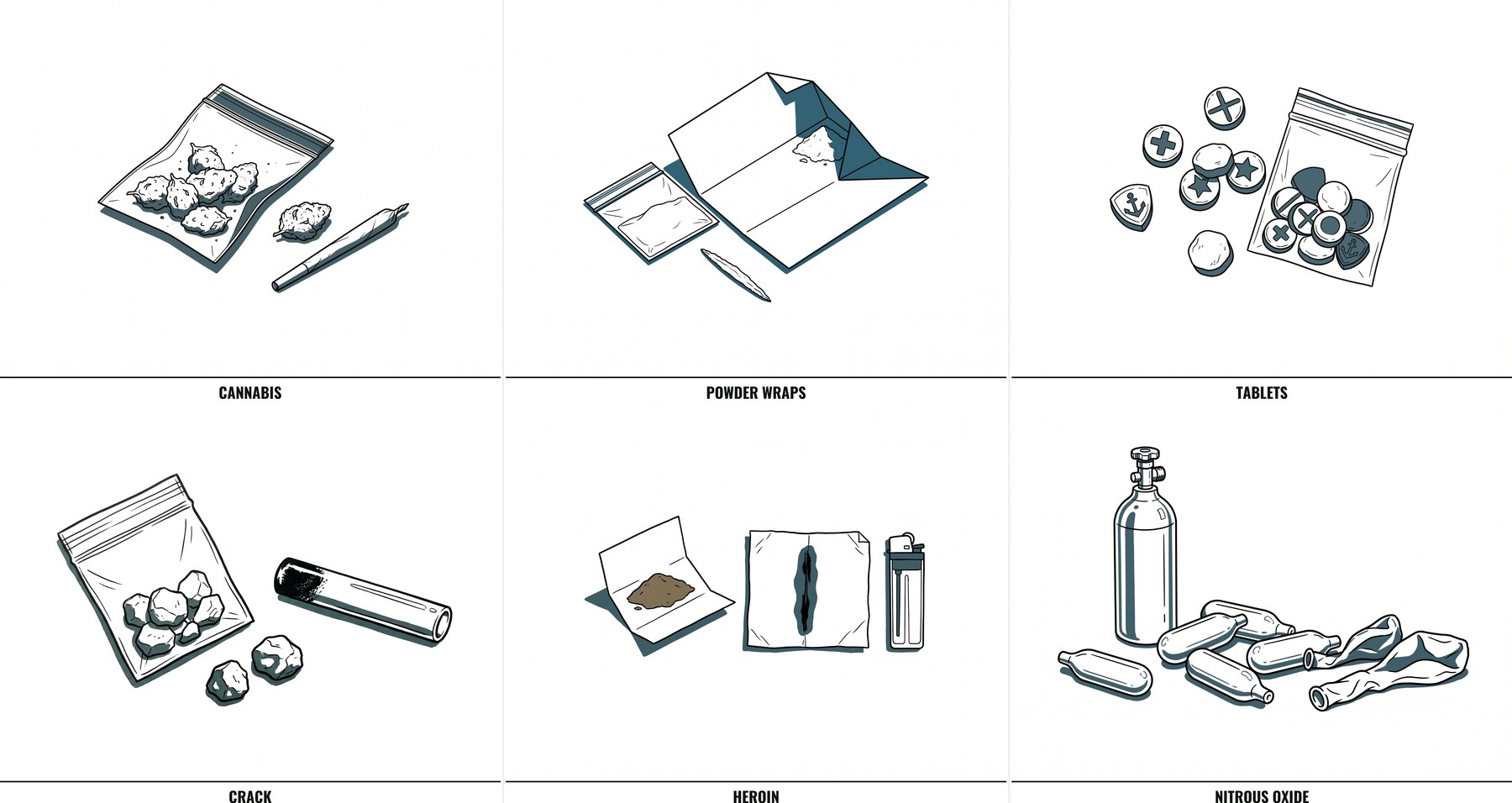
| SUBSTANCE | LOOKS LIKE | USER SIGNS |
|---|---|---|
| Cannabis | Green or brown plant matter. Distinctive smell. | Red eyes, slow speech, hungry. |
| Cocaine / crack | White powder or small 'rocks'. | Hyperactive, dilated pupils, sniffing. |
| Heroin | Brown or white powder. Foil, needles. | Pinpoint pupils, drowsy, 'nodding'. |
| MDMA / ecstasy | Coloured pills, crystals, powder. | Jaw clenching, sweating, euphoric. |
LOOK for paraphernalia Small
bags with residue. Rolled notes, straws, cut cards.
LOOK for burnt foil, pipes Also needles, syringes and spoons: do not touch.
SCALES + cash + small bags That pattern points to dealing, not use. Call 999.
→ Drug incident
response · p.65 → Unresponsive person ·
p.10166
2
2 · INCIDENTSquickref
Children used to move drugs
COUNTY LINES
County linesGangs using children and
vulnerable adults to move and sell drugs, often far from home, controlled through phone
lines.
YOUNG person, older company Controlling adults who are not family. The child looks anxious
or coached.
TRAVELLING at odd hours School
time, late night. Loitering at stations or hotels, unsure of the address.
MULTIPLE phones and cash Handsets that keep ringing. Unexplained cash, rooms paid for in
cash.
REPEATED appearances At your
site for days, then missing, then back. New unexplained belongings.
Treat the young person as a victim, not an offender. Do not detain or
confront. Report to control and your safeguarding lead. Call 999 if they are at risk now,
otherwise 101.
→ Adults at risk ·
p.89 → Occurrence book · p.13067
2
2 · INCIDENTSquickref
Who is in front of you?
TRESPASSERS
Once they are off site your authority ends. Do not pursue or follow.
Ask them to leave on the occupier's behalf. Trespass alone is civil,
not criminal. The law and full removal procedure are on p.34 and p.35.
| TYPE | YOUR APPROACH |
|---|---|
| Accidental | Redirect politely. Usually a confused visitor. |
| Rough sleeper | Check wellbeing first. Offer shelter information. Vulnerability check before any removal. |
| Protesters | Civil trespass unless they obstruct or disrupt lawful activity, such as deliberately blocking access. Then call police, describe their actions, and let police decide the offence. |
| Former staff | Access ended with the job. Firm and professional. Involve HR in any dispute. |
| Banned person | Confirm identity if safe. Remind them of the ban. Ask them to leave. Document. Police if they refuse. |
CHECK before any forced removal Weather. Mental state. Intoxication. Mobility. Age and
vulnerability.
IF vulnerable, do not force Get your supervisor, welfare services or police instead.
Aggravated trespassTrespassing plus
deliberately obstructing, disrupting or intimidating people doing something lawful. A
criminal offence: police deal with it.
LEGAL BASIS · s68 Criminal Justice and Public Order
Act 1994→ Removal procedure and law · p.36 → Asking someone to leave · p.163 → Dynamic risk check · p.5468
2
2 · INCIDENTSquickref
Talk first. Force is last.
DE-ESCALATION: LEAPS
Force you could have avoided is force you must justify. De-escalation is
always your first response.
LISTEN
Let them speak. Do not interrupt. Show you are paying
attention.
EMPATHISE
'I understand you're frustrated.' Acknowledge the feeling, not
the behaviour.
ASK
'What would sort this out for you?' Questions lower the
temperature.
PARAPHRASE
'So what you're saying is...' Proves you listened.
SUMMARISE
'Here's what I can do.' Offer a way forward.
| DO | DON'T |
|---|---|
| Stand at a 45 degree angle. | Square up face-on. |
| Open palms, relaxed hands. | Cross arms or point a finger. |
| Keep a safe distance. | Invade personal space. |
| Low, calm, slow voice. | Match their volume. |
| Say 'and'. | Say 'but' or 'calm down'. |
→ De-escalation
scripts · p.70 → Use of force · p.2469
2
2 · INCIDENTSscript
Always give them a way out
DE-ESCALATION SCRIPTS
Angry person, rising voice
“Hello, I'm [name] from security. I can see you're upset. How can I
help?”
“They keep shouting.”
“I want to help you. I need you to lower your voice so we can talk.”
“They make threats.”
“I hear that you're frustrated. I can't accept threats. Let's find a
solution.”
“They need a way out.”
“Why don't we step over here where it's quieter and sort this out?”
Final warning. Choose ONE line. Say it exactly as printed.
“I've tried to resolve this. If this behaviour continues, I will ask
you to leave.”
“I've tried to resolve this. If this behaviour continues, I will call
the police.”
WATCH for violence signs Clenched fists, reddening face, pacing.
WATCH the target glance Looking at where they plan to strike. Step back, create
distance.
WATCH for squaring up Removing
jacket, chest out. Withdraw and call backup.
→ LEAPS model · p.69 → Refusing entry script · p.16070
2
2 · INCIDENTSchecklist
Level 1. Distance and 999.
WEAPONS: RESPONSE
You cannot outfight a weapon. Do not approach anyone with a weapon. Call
999 immediately.
DO NOT approach
Withdraw. Put solid barriers between you and them. Keep an
escape route.
CALL 999
Say 'person with a weapon'. Give location, weapon type,
numbers, descriptions, direction of travel.
EVACUATE and contain
Move people away from the danger zone. Let no one wander in.
OBSERVE only from hard cover
Only if fully protected. For a blade, do not observe: leave.
Next page.
DROPPED weapon: do not touch Note position. Clear the area. Guard it from a distance.
WAIT for the police all-clear Approach casualties only when police confirm the threat is
over.
GIVE first aid within training Move casualties only if they are in danger where they
lie.
KEEP witnesses together Collect contact details. Ask your supervisor to arrange trauma
support.
→ Blades: no safe
distance · p.72 → Run Hide Tell · p.81 → Bleeding control · p.10971
2
2 · INCIDENTSmatrix
Distance buys time. It is not safety.
BLADES: NO SAFE DISTANCE
Do not observe or challenge a person with a blade from any range. Leave,
direct others away, call 999. If an attack develops, follow Run, Hide, Tell.
There is no safe distance from a blade. An attacker covers 9 metres
(30 feet) in under 2 seconds. Create distance, but never rely on it. Put locked doors,
counters or vehicles between you. Keep an escape route at your back. Withdraw.
| WEAPON | THREAT | YOUR RESPONSE |
|---|---|---|
| Firearm | Critical. Long range. | 999. Run, Hide, Tell. |
| Knife or blade | Critical. Close range. | 999. No safe distance: withdraw behind barriers. Evacuate. |
| Blunt object | Serious. Close range. | 999. Keep distance and barriers. De-escalate by voice only. |
| Concealed | Unknown. Treat as serious. | 999. Do not challenge. Monitor from cover. |
SPOT concealment signs Repeated waistband checks. One arm held stiffly. Uneven
clothing bulge.
SPOT more signs Hand on hip
while running. Coat kept on in a warm venue.
→ Run Hide Tell ·
p.81 → Weapons response · p.7172
2
2 · INCIDENTSquickref
Attackers visit before they attack
HOSTILE RECONNAISSANCE
Hostile reconnaissanceInformation
gathering by someone planning an attack: checking targets, security and escape routes before
the day.
FILMING cameras or entrances Photographing CCTV positions, doors, fences and guard posts,
not the sights.
TESTING your response Leaving
bags, probing doors, setting off alarms, timing how fast you react.
ODD questions Staff numbers,
shift changes, what happens after hours, event capacity.
REPEAT visits, no purpose Same
person or vehicle at odd times. Loitering with sightlines to entrances.
AVOIDING staff Moves away when
you approach. Changes behaviour near cameras.
Suspicion comes from behaviour, never from race, religion, age or
dress. Alert, friendly, visible staff make attackers pick another target.
→ Challenge and
report · p.74 → Suspicious items · p.7573
2
2 · INCIDENTSscript
Customer service is a security tool
CHALLENGE AND REPORT
Person filming entrances or loitering repeatedly
“Hello! Can I help you? Are you looking for something?”
“Just waiting for someone.”
“No problem. I'm around if you need anything.”
“Why are you asking?”
“Part of my job to say hello. Give me a shout if you need directions.”
STAY friendly and visible
You are deterring, not accusing. Note how they react to being
noticed.
TELL control now
Description, location, behaviour, direction. Ask CCTV to track
and save footage.
CALL 999 if alarming now
Person still on scene and behaviour threatening? Police,
immediately.
REPORT it afterwards
Anti-Terrorist Hotline 0800 789 321, online at gov.uk/ACT, or
101.
LOG everything
Times, descriptions, vehicle plates, exact behaviour, in the
occurrence book.
→ Suspicious items ·
p.75 → Occurrence book · p.13074
2
2 · INCIDENTSflowchart
Most unattended items are lost property
SUSPICIOUS ITEMS: HOT
Do not handle, open, move or tamper with the item. Ever.
1Out in the open?
H = HIDDEN. Deliberately concealed items are suspicious.
Treat as suspicious. Go to the 4 Cs, next page. Do not touch.
▼ YES
2Looks ordinary? No wires,
batteries, tape, liquids or putty?
O = OBVIOUSLY SUSPICIOUS. Wires, circuit boards, batteries, tape,
liquids, putty.
Treat as suspicious. 4 Cs. Move people away now.
▼ YES
3Typical for this location?
T = TYPICAL. Lost luggage and deliveries are normal in many
venues.
Treat as suspicious. 4 Cs. Clear the area.
▼ ALL YES
Treat as lost property. Follow site procedure. Log it.
ANY NO
POSTED item warning signs Unexpected delivery. No return address. Vague or misspelled
label.
MORE warning signs Excessive
tape. Heavy for its size. Stains, oily marks, odours.
TREAT sounds as suspicious Ticking or buzzing: clear the area and go to the 4 Cs.
→ The 4 Cs response ·
p.7675
2
2 · INCIDENTSchecklist
Confirm. Clear. Communicate. Control.
SUSPICIOUS ITEMS: 4 CS
Radio and mobile phone signals can trigger a device. No transmissions
within 15 metres of the item.
CONFIRM it is suspicious
Use the HOT assessment, previous page.
CLEAR the area
At least 100m for a bag. 200m for a car or wheelie bin. 400m
for a van or lorry.
COMMUNICATE: call 999
Move out of line of sight, behind hard cover, then call. Then
notify control.
CONTROL the cordon
No one goes back in until police declare the item safe.
STAY out of line of sight Behind hard cover. Away from glass and parked vehicles.
PICK routes away from the item Do not default to fire routes or assembly points that pass near
it.
DISPERSE, do not assemble A
fixed crowd can be the target of a second device.
NO lifts, no fire alarm The
alarm sends crowds along fixed routes, possibly past the item.
ACCOUNT for staff and visitors
Tell police: exact location, size and description. Add who found it
and when, any sounds or smells, and evacuation status.
→ HOT assessment ·
p.75 → Fire evacuation (contrast) · p.83 → Emergency numbers · p.17876
2
2 · INCIDENTSquickref
Report it. Never touch it.
DRONE OVER SITE
Bringing down a drone is a crime, even over your own site. In law it is an
aircraft.
- Watch and record: times, flight path, what it hovers over
- Photograph or film the drone from the ground
- Look for the operator: they are usually within sight of it
- Report to control and police
- Shoot at, throw at, net or grab it
- Jam or block its signal
- Detain the operator or seize their controller or phone
- Ignore it because it flew away
TRACK it
Times, direction, height, hovering points, camera angle. Video
helps police.
FIND the operator
Scan roads and high ground nearby. Note description and
vehicle plate.
CALL police
999 if it endangers people, aircraft or a crowded event.
Otherwise 101.
TELL control and log it
Repeat visits can be hostile reconnaissance. Say so in your
report.
LEGAL BASIS · Air Navigation Order 2016; Wireless
Telegraphy Act 2006→ Hostile reconnaissance · p.73 → Occurrence book · p.13077
2
2 · INCIDENTSmatrix
Prepare for attack. It is the law.
MARTYN'S LAW
Know your site's tier and your part in its plan. Public venues must
prepare for terrorist attack. The plan only works through officers who know it.
| TIER | WHERE | MUST HAVE |
|---|---|---|
| STANDARD | 200 to 799 people may be present | Notify the SIA. Procedures for evacuation, invacuation (moving people inside to safety), lockdown and communication. |
| ENHANCED | 800 or more | All of that, plus security measures to reduce vulnerability, documented plans, and a named senior lead. |
The law is named after Martyn Hett, killed in the Manchester Arena
attack in 2017. The SIA is the regulator. Enforcement is expected from 2027. Good sites are
drilling now. Learn your part before the law requires it.
LEGAL BASIS · Terrorism (Protection of Premises)
Act 2025→ The four protect actions · p.79 → Your role · p.80 → Legislation index · p.18178
2
2 · INCIDENTSmatrix
Which action, when
THE FOUR PROTECT ACTIONS
The wrong action can move people towards the attack. Match the action to
where the threat is.
InvacuationBringing people inside,
into a safer part of the building, when the danger is outside.
| THREAT | ACTION |
|---|---|
| Attack outside or nearby | INVACUATE. Bring people in. Keep them away from doors, windows and glass. |
| Attack inside the building | EVACUATE away from the threat. Run, Hide, Tell. |
| Attacker trying to get in | LOCKDOWN. Lock and barricade entry points. People low, quiet, away from doors. |
| Every case | COMMUNICATE. Tell people what to do, calmly and clearly. Update control and 999. |
A suspicious item is different. Use the package-page distances and
routes. Never the fire routes.
LEGAL BASIS · Terrorism (Protection of Premises)
Act 2025→ Active threat · p.81 → Suspicious items · p.7579
2
2 · INCIDENTSchecklist
Know the plan before you need it
MARTYN'S LAW: YOUR ROLE
KNOW your tier Ask your
supervisor: standard or enhanced? Who is the responsible person?
KNOW the four actions Where
does your site invacuate? What locks down? Who decides?
WALK the ground Exits,
lockable rooms, refuges, muster areas. Learn them on quiet shifts.
DRILL when offered Rehearsed
actions survive stress. Unrehearsed plans do not.
REPORT gaps Broken locks,
blocked exits, dead radios. In writing, to your supervisor.
ACT confidently on the day The
public follows the calmest voice. Make it yours.
You are not the responsible person in law. Whoever controls the venue
holds that duty. But their plan only works through you.
LEGAL BASIS · Terrorism (Protection of Premises)
Act 2025→ Active threat · p.81 → Legislation index · p.18180
2
2 · INCIDENTSchecklist
Someone is causing serious harm now
RUN HIDE TELL
Your survival comes first. You cannot help anyone if you are a casualty.
RUN
If a safe route exists, go. Leave belongings. Bring others who
will come. Spread out from exits.
HIDE
Cannot run? Lock or barricade a room. Lights off. Phone
silent, vibrate off. Stay low. Open for no one.
TELL
When safe, call 999. Whisper if you must. Location, attackers,
weapons, descriptions. Stay on the line if safe.
999
Call when safe. Whisper if you must.
→ When armed police
arrive · p.82 → Lockdown and invacuation
· p.7981
2
2 · INCIDENTSchecklist
They cannot tell friend from attacker
ARMED POLICE ARRIVE
Armed officers may point weapons at you. Follow every command exactly and
instantly.
STOP what you are doing
HANDS visible at all times Empty, open hands. Do not hold up a phone, radio or
torch.
DO NOT run toward them
NO pointing, no sudden moves
OBEY every command immediately
EXPECT suspect treatment Police may treat you as a suspect at first. Stay calm. It
passes.
| TELL 999: THE THREAT | TELL 999: THE LOCATION |
|---|---|
| How many attackers. | Building address and entry points. |
| Weapons seen. | Floor or area they are in. |
| Descriptions and direction. | How many people are on site. |
Your job is to survive and to inform. Do not confront.
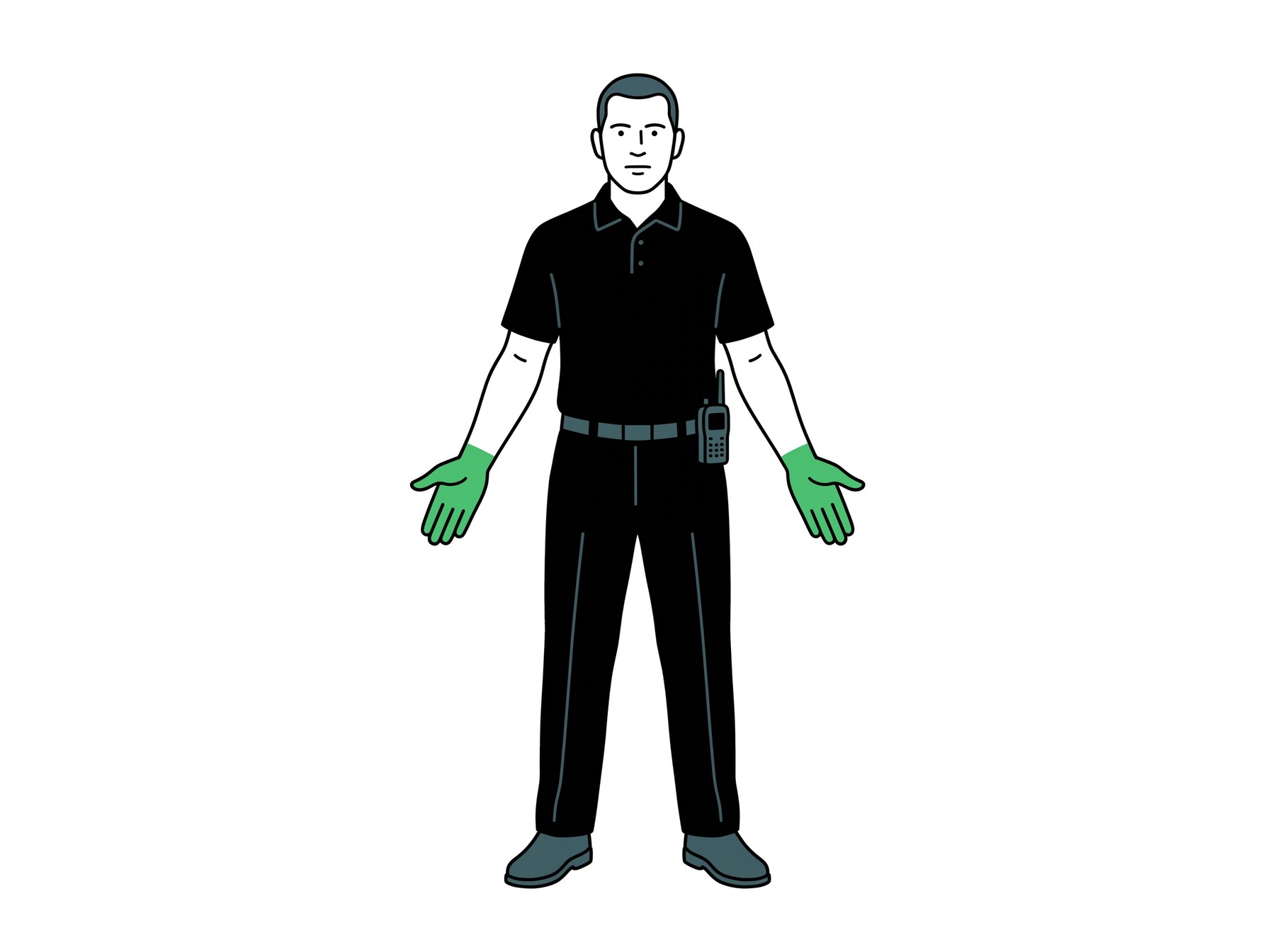
→ Run Hide Tell ·
p.8182
2
2 · INCIDENTSflowchart
The first 60 seconds
FIRE RESPONSE
Smoke kills. Raise the alarm before anything else.
RAISE the alarm
Nearest call point. Shout 'Fire, fire, fire' as you go.
CALL 999
Never assume others have. Give address, floor, what burns.
START the evacuation
Nearest safe exit. Radios are safe to use in a fire.
1Small fire, trained on this
extinguisher, clear exit behind you?
Waste-bin size, not spreading. Right class for what burns. Fire
never blocks your way out.
LEAVE. Close doors behind you.
▼ YES
2Ordinary materials burning (paper,
wood, fabric)?
Battery, gas or chemical fire? Never tackle it: toxic gas, violent
reignition.
GET OUT. Stay out. 999.
▼ ALL YES
One extinguisher, one attempt. Still burning? Leave and close the
door.
ANY NO
LEGAL BASIS · Regulatory Reform (Fire Safety) Order
2005→ Evacuation roles · p.84 → Emergency numbers · p.17883
2
2 · INCIDENTSchecklist
You are the fire marshal now
EVACUATION ROLES
People die going back for coats and laptops. Keep everyone moving out.
DIRECT people out Nearest safe
exit, not the door they came in. Keep them moving.
SWEEP your zone if assigned Toilets, meeting rooms, stores. Close doors behind you. Do not
lock them.
NO lifts Stairs only. Lifts
can stop at the fire floor or trap people.
HELP those who need it Follow
their PEEP. Take wheelchair users to the refuge: the protected area by the
stairs.
REFUSERS: do not force Warn
once, note who and where, move on. Tell fire crews immediately.
PEEPPersonal Emergency Evacuation
Plan: a pre-agreed plan for anyone who cannot leave the building unaided.
A suspicious item is not a fire. Use different routes and distances.
No radios or phones within 15 metres of the item.
LEGAL BASIS · Regulatory Reform (Fire Safety) Order
2005→ Assembly point · p.85 → Suspicious items · p.75 → Getting someone to leave · p.16384
2
2 · INCIDENTSchecklist
Count, report, hold the line
ASSEMBLY POINT
Fire crews will risk their lives for anyone unaccounted for. Make your
count accurate.
TAKE charge on arrival
High-vis on, voice up. Keep people together and off the road.
COUNT and roll call
Staff lists, visitor book, signing-in sheets. Note exactly who
is missing.
REPORT to fire crews
Who is unaccounted for and where last seen. Refuge occupants
first.
KEEP access clear
Move crowds and cars away from gates and hydrants for the fire
engines.
STOP re-entry
Nobody goes back, for anything. Stand where you can see the
doors.
Meet the first fire engine. Tell them: what is burning and where, who
is missing, hazards on site (gas, chemicals, batteries), and where the hydrants are.
→ Re-entry rules ·
p.8685
2
2 · INCIDENTSquickref
Only the fire service says safe
RE-ENTRY RULES
People die going back inside. Fire can reignite and floors can fail after
flames seem out.
- Allow re-entry after the fire and rescue service confirms the building is safe
- Let the responsible person then stand the site down, and log the time
- Allow re-entry after a confirmed false alarm, once the cause is found and logged
- Let anyone back in for belongings, bags, phones or pets
- Silence or reset the alarm before the cause is known
- Declare the building safe yourself, whatever the pressure from managers
Sample occurrence book entry
14:22 Fire alarm, Zone 3 (kitchen). Evacuated approx 180 to car park
assembly point. All accounted for 14:31. Brigade arrived 14:33. Burnt toast, no fire.
Alarm reset by engineer 14:50. Re-entry authorised by brigade and duty manager 14:52.
LEGAL BASIS · Regulatory Reform (Fire Safety) Order
2005→ Fire response · p.83 → Occurrence book · p.13086
2
2 · INCIDENTSquickref
A health event, not misconduct
MENTAL HEALTH CRISIS
A mental health crisis is acute psychological distress. Slow
everything down. Give space. Move slowly. One officer talks, not a crowd. No touching
without permission.
RECOGNISE the signs Talking to
voices. Extreme fear or paranoia. Confusion about time and place.
LOOK for harm signs Self-harm
marks. Extreme mood swings. Talk of suicide or death.
CHECK self-care Unable to look
after themselves: get help, do not eject.
- How can I help you?
- Take your time. I'm listening.
- You're not in any trouble.
- Calm down.
- Snap out of it.
- That's not real. There's nothing there.
→ Decide: danger or
support · p.88 → De-escalation · p.6987
2
2 · INCIDENTSflowchart
Danger, or support?
MENTAL HEALTH: DECIDE
Take any mention of suicide seriously. Ask directly. Stay with them until
help takes over.
1No danger to anyone right now?
No weapon, no self-harm happening, no immediate suicide risk.
Call 999. Ask for ambulance, plus police if violent. Stay with
them. Clear space around them.
▼ YES
2Can they keep themselves safe?
Oriented, responding, someone to go to, no suicide talk.
Do not leave them alone. Call NHS 111 for the crisis team. Inform
control.
▼ ALL YES
Support them. Stay calm and patient. Help them contact family or
Samaritans. Log it.
ANY NO
If they mention suicide, ask directly
“I'm concerned about you. Are you thinking about hurting yourself? I'm
here to help, not judge. Let me get you some support.”
Samaritans (free, 24/7)116 123
NHS crisis team111
Immediate danger999
→ Recognition and
approach · p.8788
2
2 · INCIDENTSquickref
Safeguarding is not just children
ADULTS AT RISK
Do not investigate. Your job is to notice, record and report.
OBSERVE
Note what you see and hear. Do not question or investigate.
RECORD
Exact words, times, injuries seen. Facts, not opinions.
REPORT
Supervisor and site safeguarding lead today. 999 if they are
in danger now.
Adult at riskAn adult who needs care
and support, is being abused or neglected or at risk of it, and cannot protect themselves
because of those needs (Care Act 2014).
CONFUSED and alone Dementia
wanderers: lost, cold, dressed wrongly for the weather. Stay with them.
SOMEONE controls them Another
person speaks for them, holds their money, cards or documents.
UNEXPLAINED injuries or fear Bruises, burns, flinching, fear of a partner, carer or
relative.
SELF-NEGLECT Unkempt,
malnourished, unable to manage basic needs or medication.
LEGAL BASIS · Care Act 2014 s.42→ Modern slavery signs · p.90 → Occurrence book · p.13089
2
2 · INCIDENTSquickref
Hidden in plain sight
MODERN SLAVERY
Never confront the suspected controller. You could endanger the victim and
destroy the evidence.
NO documents or money Someone
else holds their passport, ID or wages.
ESCORTED everywhere Dropped
off and collected. Never alone. Someone else answers for them.
FRIGHTENED and evasive Scared
of authority. Story does not add up or sounds rehearsed.
POOR physical condition Untreated injuries, unkempt, same clothes daily, sleeping at
the workplace.
CONTROLLED work gangs Vans of
workers, car washes, sites where workers seem watched.
You do not need to be sure. Report what you see. The helpline is
confidential, open 24 hours, and can act on concerns.
Modern Slavery Helpline (24/7)08000 121 700
Police, danger now999
Police, non-emergency101
LEGAL BASIS · Modern Slavery Act 2015→ Adults at risk · p.8990
2
2 · INCIDENTSchecklist
The first minutes decide it
MISSING CHILD
The first minutes decide an abduction. Call 999 at once if the child is
under 10, vulnerable, or abduction is possible. There is no minimum search time.
GET description, last seen
Age, clothing, hair, where and when last seen, who with.
CALL 999 now if high risk
Under 10, vulnerable, or abduction possible. The search
continues while you call.
ALERT all staff by radio
Broadcast the description. Assign search areas.
MONITOR every exit
Staff on doors. CCTV on unstaffed and fire exits. Watch anyone
leaving with a matching child.
SEARCH systematically
Start at last seen. Expand outward. Toilets, play areas, car
parks first. Re-check: people move.
CALL 999 if not quickly found
No fixed waiting period. Police accept a report immediately.
- Monitor exits and observe everyone leaving
- Engage verbally to delay: 'Excuse me, could you help us for a moment?'
- Note descriptions, direction of travel, vehicle details
- Call 999 immediately if you believe a child is being taken
- Physically detain, block or restrain members of the public
- Blockade the doors: monitor, do not imprison
- Accuse anyone without evidence
→ Missing adults and
risk · p.92 → Safeguarding concerns ·
p.9391
2
2 · INCIDENTSmatrix
Risk decides your speed
MISSING PERSONS
| RISK | WHO | YOUR RESPONSE |
|---|---|---|
| HIGH | Child with any escalating factor: very young, possible abduction, disability, medical needs, exploitation risk. Any vulnerable adult. | 999 now. Monitor exits. Search while you call. |
| MEDIUM | Any other missing child. Adults with health or welfare concerns. | Search at once. Call 999 without delay if not quickly found. |
| LOW | Adults only: no vulnerability, likely just separated. | Search and log. Call police if concern grows. |
01
GET description and last seen Name, age, build, hair, clothing, distinguishing features, who
with.
02
ASK about vulnerabilities Medication, dementia, distress, threats to harm themselves,
where they might go.
03
ALERT staff by radio, search Start at last seen. Expand outward. Re-check areas.
04
CALL police 999 for any
vulnerability. Police accept reports immediately: never wait 24 hours.
05
WHEN FOUND: stay until reunited Verify who collects a child. Stand down exit monitoring. Tell
all searchers. Report.
A child is anyone under 18. Treat every missing child as
time-critical, whatever their age. Police never grade a missing child low risk. You never
make the formal grading: when in doubt, treat as high risk.
LEGAL BASIS · Children Act 1989 s105 (child = under
18)→ Missing child actions · p.91 → Occurrence book · p.13092
2
2 · INCIDENTSquickref
See it. Report it. Never probe it.
CHILD SAFEGUARDING
A child stays at risk while you hesitate. Report concerns at once. Never
investigate yourself.
| ABUSE | WHAT IT CAN LOOK LIKE |
|---|---|
| Physical | Hitting, shaking, burning. Unexplained bruises, burns or fractures. |
| Emotional | Constant criticism, threats, rejection. Withdrawn, fearful or aggressive child. |
| Sexual | Any sexual act with a child. Sexual knowledge beyond their age. |
| Neglect | No food, shelter or supervision. Poor hygiene. Wrong clothing for the weather. |
WATCH for fear of going home
NOTE a child left unsupervised Alone for long periods, or out very late alone.
→ How to respond and
report · p.94 → Missing child · p.9193
2
2 · INCIDENTSchecklist
Observe. Record. Report.
SAFEGUARDING: REPORT
Never promise confidentiality. Never contact the alleged abuser. Describe
injuries in writing: never photograph a child.
OBSERVE
Note what you see. Do not investigate or question anyone.
RECORD
Write exactly what you saw or heard. Exact words. Date, time,
place, who. Keep notes secure.
REPORT
Tell your supervisor and the safeguarding lead today. Never
sit on it.
- You've done the right thing telling me.
- I take what you say seriously.
- I need to tell someone who can help keep you safe.
- I promise I won't tell anyone.
- Are you sure? Did they really do that?
- Tell me the whole story again.
Police (emergency)999
Police (non-emergency)101
NSPCC helpline0808 800 5000
Childline (for children)0800 1111
Local children's servicesWrite yours here on day one: ____________
→ Abuse types and
signs · p.93 → Report writing · p.17194
2
2 · INCIDENTSquickref
Post-incident reactions are normal
AFTER THE INCIDENT: YOU
GET checked
Injuries first, including ones that 'seem fine'. Adrenaline
hides pain.
WRITE your report now
Memory is evidence and fades fast. Facts first, feelings
later.
TALK to someone
Supervisor, a TRiM assessor if your firm has them, a colleague
you trust.
WATCH yourself for a month
Reactions usually settle within four weeks. If not, get help.
TRiMTrauma Risk Management: trained
colleagues who check in after bad incidents and point you to support. Peer support, not
therapy, not a fitness test.
Normal for a few weeks: poor sleep, replaying it, jumpiness, guilt.
Get help if it lasts past four weeks, gets worse, or you drink to cope. Talk to your GP.
Your employer's EAP offers free confidential counselling. Or call Samaritans on 116 123.
→ Report writing ·
p.171 → Assaulted at work · p.9695
2
2 · INCIDENTSchecklist
A crime, not part of the job
ASSAULTED AT WORK
Unreported assaults teach offenders they can do it again. Report every
single one.
GET safe, get first aid
You are the casualty now. Let someone else hold the scene.
CALL police
999 if the offender is still there. 101 afterwards. Always
report.
PRESERVE the evidence
Body-worn video, CCTV, torn clothing, witness names. Same
standard as any assault.
TELL your employer
Accident book and incident report. Serious injury goes to the
safety regulator (RIDDOR) via your employer.
WRITE your statement
Exact words, blows, injuries. You are the victim and the key
witness.
CHECK yourself afterwards
Use the welfare page. Reactions after an assault are normal.
The Crime and Policing Act 2026 creates a standalone offence of
assaulting a retail worker. It is not yet in force and covers retail premises only. On any
site, assaulting you is already a crime. Your report is what makes the law bite.
LEGAL BASIS · Crime and Policing Act 2026 s.45
(assault of a retail worker; commencement pending)→ After
the incident: you · p.95 → Body-worn
video · p.144 → Witness statement · p.16896
2
2 · INCIDENTSquickref
One line per incident
INCIDENTS QUICK REF (1/2)
| INCIDENT | KEY ACTIONS |
|---|---|
| Theft | Observe → Confirm all three → Approach outside → Police |
| Assault | 999 → Backup → Separate → First aid → Evidence |
| Intoxicated | Medical check → Calm approach → Decide: safe to leave? → Duty of care |
| Spiking | Believe them → Stay with them → Keep the drink → 999 if unwell |
| Drugs | Don't touch → Secure area → Police → Document |
| Trespasser | Ask to leave → Vulnerability check → Removal per p.35 → Police if needed |
| Aggression | LEAPS → Angle and space → Give a way out → Final warning |
| Weapons | DO NOT APPROACH → 999 → Evacuate → Contain. Blade: no safe distance |
| Suspicious item | HOT: Hidden? Obvious? Typical? → 4 Cs → 999 |
| Active threat | RUN → HIDE → TELL (999) |
| Lockdown / invacuation | Threat outside: INVACUATE → Inside: EVACUATE → Getting in: LOCKDOWN → Communicate |
Fire, people at risk, hostile activity and your own welfare: next
page.
→ Theft · p.55 → Assault · p.58 → Intoxicated · p.61 → Spiking · p.63 → Drugs · p.65 → Trespasser · p.68 → De-escalation · p.69 → Weapons · p.71 → Suspicious item · p.75 → Active threat · p.81 → Lockdown / invacuation · p.79 → Quick ref (2/2) · p.9897
2
2 · INCIDENTSquickref
One line per incident
INCIDENTS QUICK REF (2/2)
| INCIDENT | KEY ACTIONS |
|---|---|
| Fire | Raise alarm → Evacuate → 999 → See fire pages |
| Mental health | Calm → Space → Support → 999 if danger |
| Missing child | Description → Monitor exits → Search → 999: no waiting if high risk |
| Missing adult | Description → Search → 999 if vulnerable |
| Safeguarding: child | Observe → Record → Report → Never investigate |
| Adult at risk | Observe → Record → Report → 999 if danger now |
| Modern slavery | Spot signs → Do not confront → Helpline 08000 121 700 → 999 if danger |
| County lines | Victim, not offender → Do not detain → Safeguarding lead → 999 or 101 |
| Hostile reconnaissance | Engage friendly → Tell control → Log → 999, or 0800 789 321 after |
| Drone over site | Track → Never touch → Find operator → 101, or 999 if danger |
| Assaulted at work | Get safe → First aid → Always report to police → Welfare check |
Every incident: observe, document, report, escalate if needed. You
have limited powers. When in doubt: observe, document, call police, and call for backup.
→ Fire · p.83 → Mental health · p.87 → Missing child · p.91 → Missing persons · p.92 → Safeguarding: child · p.94 → Adult at risk · p.89 → Modern slavery · p.90 → County lines · p.67 → Hostile reconnaissance · p.73 → Drone over site · p.77 → Assaulted at work · p.96 → Quick ref (1/2) · p.9798
2
3
SECTION 03 · MEDICAL
Keep them alive until help arrivesMEDICAL RESPONSE
In this section: primary survey and CPR. AED. Recovery position. Choking.
Bleeding, catastrophic bleeding and shock. Fractures. Burns. Seizures. Diabetic emergency.
Heart attack. Stroke. Anaphylaxis. Sepsis. Overdose. Calling 999.
3
3 · MEDICALchecklist
Your first 60 seconds, every casualty
PRIMARY SURVEY: DR ABC
Unresponsive at step R? Call 999 immediately. Do not finish the survey
first.
60 sec
Complete DR ABC in under a minute. In this order, every time.
DANGER: check the scene
Traffic, fire, electricity, weapons, violence. Do not approach
until safe.
RESPONSE: shout and shake
Shout 'Can you hear me?' Gently shake the shoulders.
AIRWAY: tilt head, lift chin
Look in the mouth. Remove visible objects only. Never sweep
blind.
BREATHING: look, listen, feel
10 seconds. Watch the chest rise. Feel breath on your cheek.
CIRCULATION: find severe bleeding
Press hard on any serious wound. See: Severe bleeding.
→ Unresponsive person
· p.101 → Severe bleeding · p.109100
3
3 · MEDICALflowchart
Call 999 first. Then check breathing.
UNRESPONSIVE PERSON
Gasping, irregular, or slow laboured breathing is NOT normal breathing.
Start CPR.
999
Unresponsive? Call now, before the breathing check. Speaker on, or
send someone.
1Unresponsive?
No reply to a shout and a gentle shoulder shake.
They respond: keep them still. Monitor. In doubt, call 999. See:
When to call 999.
▼ YES
2Breathing absent or abnormal?
999 first: speaker on, send someone for an AED. Open the airway.
Check breathing while the call connects. The handler helps if you are unsure.
Breathing normally: recovery position. Monitor continuously. See:
Recovery position.
▼ ALL YES
START CPR NOW. 30 compressions, 2 breaths. Send for the AED. See: CPR
adult.
NO
AEDAutomated external defibrillator. A
machine that shocks a stopped heart back into rhythm. It speaks instructions aloud.
Unsure whether breathing is normal? Start CPR. You cannot make it
worse.
→ CPR adult · p.102 → Recovery position · p.106 → When to call 999 · p.124101
3
3 · MEDICALquickref
Age 12 and over
CPR: ADULT
Do not stop to check for a pulse. Keep going until help takes over.
30:2
Compressions to breaths. Until help takes over, or they show signs of
life and breathe NORMALLY.
PLACE heel of hand
Centre of the chest. Other hand on top, fingers interlocked.
PUSH hard and fast
Depth: 5-6cm. Arms straight, shoulders over your hands.
KEEP rate, full recoil
100-120 per minute, the beat of Stayin' Alive. Let the chest
rise fully between compressions.
TILT head, pinch nose
After 30 compressions. Lift the chin.
GIVE 2 breaths
Seal your mouth over theirs. Blow steadily for 1 second. Watch
the chest rise.
REPEAT 30:2 without pausing
Swap with another trained person every 2 minutes if you can.
Unwilling to give breaths? Compression-only CPR still works. Stop only
when: help takes over, they breathe normally, or the scene turns unsafe. Or you are
exhausted.
→ AED · p.104 → Child and infant CPR · p.103102
3
3 · MEDICALquickref
5 rescue breaths come first
CPR: CHILD & INFANT
Children usually arrest from lack of oxygen. Breaths come first. Never
skip them.
GIVE 5 rescue breaths first
Child or infant not breathing normally: breaths before
compressions.
START compressions
No signs of life during the breaths? Begin compressions now.
USE 30:2
The adult ratio you know. Trained in paediatric resuscitation?
Use 15:2.
DO 1 minute before leaving
Alone with no phone: 1 minute of CPR, then go and call 999.
| Child (1-12) | Infant (under 1) | |
|---|---|---|
| Hands | One or two hands. Whatever reaches the depth. | Two thumbs on the breastbone, hands encircling the chest. |
| Depth | At least one third of the chest. About 5cm, never over 6cm. | At least one third of the chest. About 4cm. |
| Position | Centre of chest, lower half of breastbone. | Centre of chest, lower half of breastbone. |
| Breaths | Smaller breaths. Enough to see the chest rise. | Cover mouth AND nose. Gentle puffs. |
Cannot press deep enough with two thumbs? Use the heel of one hand.
Depth matters more than technique.
→ Adult CPR · p.102 → Infant choking · p.108103
3
3 · MEDICALchecklist
It talks you through every step
AED: STEP BY STEP
Send someone for the AED. Do not stop CPR to fetch it yourself.
01
TURN the AED on Press power or
open the lid. Follow the voice prompts.
02
EXPOSE the chest Remove
clothing. Dry the chest if wet.
03
ATTACH pads as shown One below
the right collarbone. One on the left side, below the armpit.
04
PLUG in the connector Only if
the AED asks for it.
05
STAND clear for analysis Nobody touches the person while it analyses.
06
SHOUT 'Stand clear!' If shock
advised. Check nobody is touching them, then press shock.
07
RESUME CPR immediately Straight back on the chest after the shock.
08
FOLLOW the voice prompts No
shock advised? Continue CPR. The AED re-analyses.
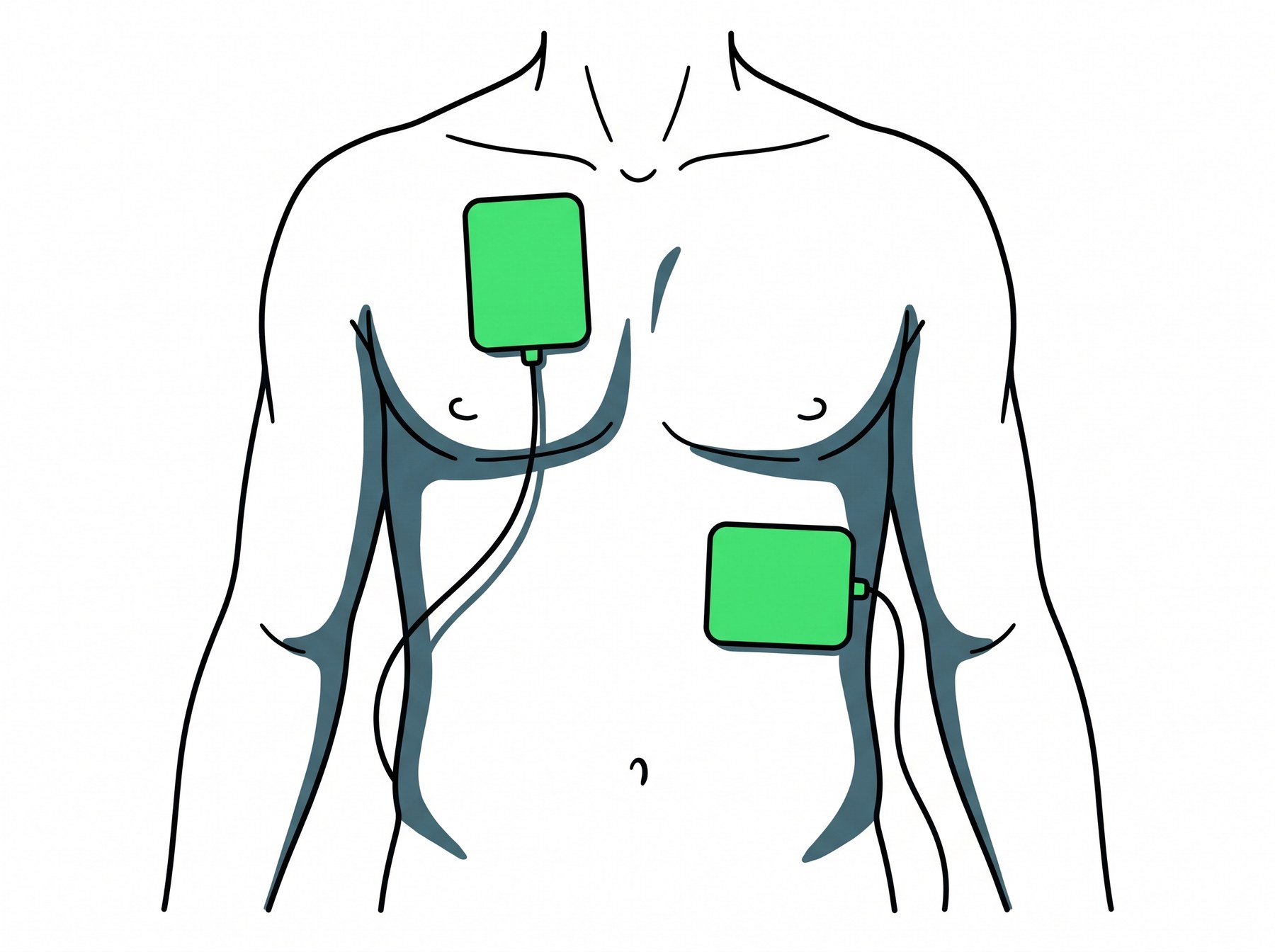
1Pad 1: below the right
collarbone.
2Pad 2: left side of the chest,
below the armpit.
→ CPR adult · p.102 → AED special cases · p.105104
3
3 · MEDICALquickref
Anyone can use an AED
AED: SPECIAL CASES
| Situation | What to do |
|---|---|
| Hairy chest | Shave with the razor from the AED kit, or press pads on firmly. Poor contact means an ineffective shock. |
| Wet chest | Dry the chest with a towel. Move away from puddles. An AED works safely in rain. |
| Pacemaker or implanted defibrillator | Lump or scar below the collarbone. Never place a pad over the device. Keep the pad at least 8cm clear, or place pads front and back. |
| Medication patch | Remove the patch. Wipe the skin. Then attach the pad. |
| Metal surface | Move them off metal if you can. If you cannot, use the AED anyway. It is safe. |
| Child (1-8) | Use paediatric pads if available. If not, adult pads: one on the front, one on the back. |
| Infant (under 1) | Paediatric pads, front and back. No paediatric pads? Use adult pads, front and back. |
Anyone can use an AED. It talks you through every step. Attach it and
keep doing CPR between prompts.
→ AED step by step ·
p.104 → Child and infant CPR · p.103105
3
3 · MEDICALdiagram
Unconscious and breathing normally
RECOVERY POSITION
Suspected spinal injury (fall, collision, blow to head or neck)? Do not
move them. Hold the head still, in line with the body. Wait for paramedics.
999
Call now if not already done. Then position them.
1Kneel beside them. Nearest arm
out at a right angle, palm up.
2Far arm across the chest. Back of
their hand against their cheek. Hold it.
3Bend the far knee, foot flat.
Pull that knee to roll them towards you.
4Top leg at right angles. Tilt the
head back to keep the airway open.
ANGLE the face slightly down Fluids drain out, not into the airway.
CHECK breathing constantly If
it stops: roll them onto their back. Start CPR. See: CPR adult.
Must leave them to get help? Recovery position first. On their back,
they can choke.
→ CPR adult · p.102 → Unresponsive person · p.101106
3
3 · MEDICALflowchart
Ask them: 'Are you choking?'
CHOKING
1Can they cough, speak, or breathe?
A strong cough can clear it on its own.
SEVERE: call 999. Start back blows now (steps below).
▼ ALL YES
MILD: encourage coughing. Stay with them and watch. If it worsens,
treat as severe.
NO
GIVE up to 5 back blows
Lean them forward. Heel of hand between the shoulder blades.
Check after each.
GIVE up to 5 abdominal thrusts
Stand behind. Fist above the navel. Pull sharply inward and
upward.
REPEAT the cycle
Alternate 5 and 5 until clear. Unconscious? See: Choking
special cases.
GET them checked after
Thrusts can injure inside. Do not let them leave. Record the
incident.
→ Choking special
cases · p.108 → Occurrence book · p.130107
3
3 · MEDICALquickref
Unconscious, pregnant, infant
CHOKING: SPECIAL CASES
Never use abdominal thrusts on an infant. They cause internal injury.
LOWER them to the ground
If they become unconscious. Carefully.
CALL 999 if not done
Speaker on. Stay with them.
START CPR: 30 and 2
Compressions can shift the blockage. See: CPR adult.
CHECK the mouth before breaths
Remove only what you can see. No blind finger sweeps.
| Casualty | What changes |
|---|---|
| Pregnant or larger person | Chest thrusts, not abdominal. Fist on the centre of the breastbone. Pull sharply inward. Up to 5. |
| Infant (under 1) | Face down along your forearm, head low. 5 back blows. Turn over: 5 chest thrusts, two thumbs. Repeat. Unconscious? Infant CPR. |
After ANY thrusts: get them assessed by a healthcare professional,
even if they seem fine. Fragments can remain in the airway.
→ CPR adult · p.102 → Child and infant CPR · p.103108
3
3 · MEDICALchecklist
Pressure on the bleeding point. Now.
SEVERE BLEEDING
Never remove a dressing packed around an embedded object. Press around it
instead.
10 sec
Get pressure on the wound within 10 seconds. Call 999.
01
CALL 999, or send someone Say
'severe bleeding'.
02
PRESS hard on the wound Direct
pressure on the bleeding point. Dressing, clean cloth, or bare hand.
03
HOLD the pressure. No dabbing Firm and constant, at least 10 minutes.
04
SWAP a soaked dressing Blood
coming through? Remove it. Press again with a fresh dressing on the
point.
05
BANDAGE the dressing firmly Loosen it if fingers or toes turn blue, cold, or numb.
06
NOTE the time you bandaged Write it down. Paramedics need it.
07
KEEP them warm. Reassure Watch
for shock. See: Shock.
Pressure not stopping a limb bleed? Escalate now. See: Catastrophic
bleeding.
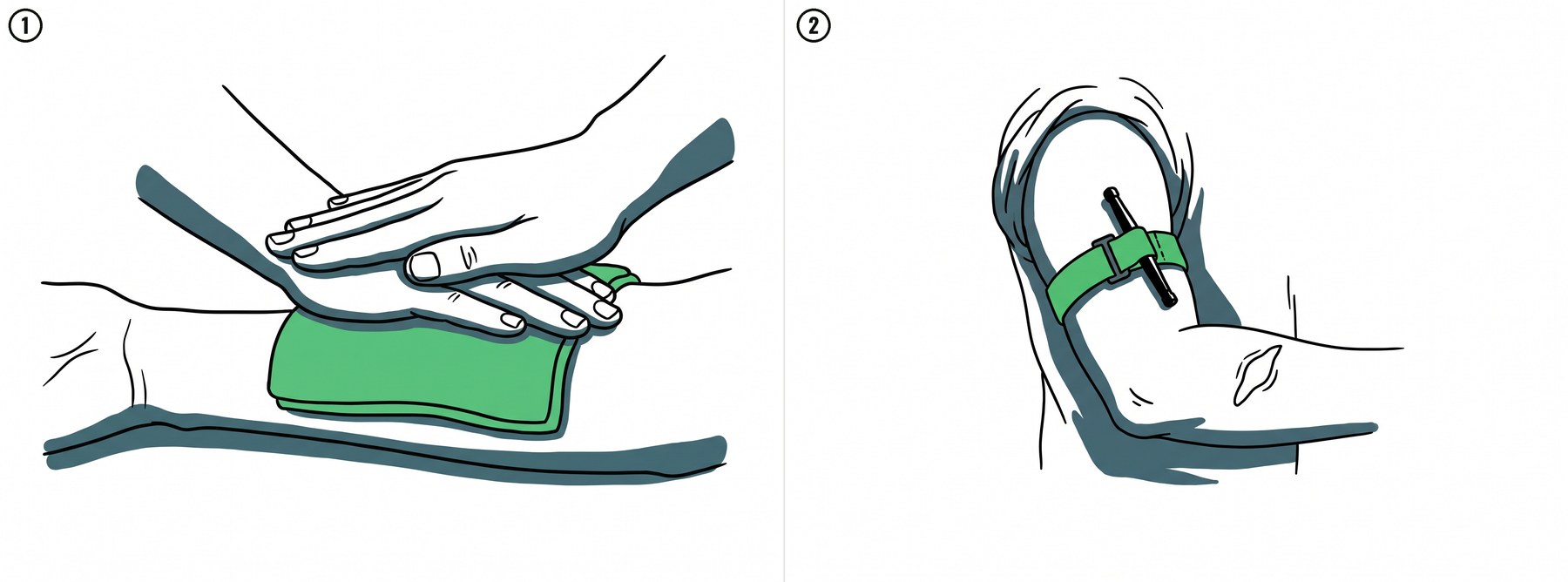
→ Catastrophic
bleeding · p.110 → Shock · p.112109
3
3 · MEDICALchecklist
Tourniquets and haemostatic dressings
CATASTROPHIC BLEEDING
A limb bleed that pressure cannot stop kills in minutes. Escalate without
hesitating.
Haemostatic dressingA dressing treated
with a clotting agent. Found in bleed-control kits. Pack it into the wound, then press hard.
CALL 999
Say 'life-threatening bleeding'. The handler talks you through
it.
PACK the wound
Haemostatic dressing from the bleed kit if your site has one.
Then press hard.
APPLY a tourniquet
Arm or leg still bleeding: 5-7cm above the wound. Never over a
joint.
TIGHTEN until bleeding stops
It hurts them. Keep going anyway.
WRITE down the time
On the tourniquet or their skin.
NEVER loosen or remove it
Only a healthcare professional does that. Still bleeding?
Second tourniquet above the first.
No commercial tourniquet? The 999 handler can direct an improvised
one: triangular bandage, belt, tie.
→ Severe bleeding ·
p.109 → Active threat response · p.81 → Shock · p.112110
3
3 · MEDICALquickref
Embedded objects, nosebleeds, amputation
BLEEDING: SPECIAL CASES
| Situation | What to do |
|---|---|
| Embedded object | Do NOT pull it out. Press around it. Build padding around it. Bandage it in place. |
| Nosebleed | Sit them down, head forward. Pinch the soft part of the nose for 10-15 minutes. Do not tilt the head back. |
| Amputation | Control bleeding at the stump. Wrap the part in a damp cloth. Seal in a plastic bag, place on ice. Send it with the casualty. |
| Eye injury | Cover the injured eye with a sterile dressing. No pressure on the eyeball. Ask them to keep both eyes still. Call 999 for serious injury. |
Every serious bleed can cause shock. Lay them down and watch for it.
See: Shock.
→ Shock · p.112 → Severe bleeding · p.109111
3
3 · MEDICALchecklist
The body shutting down from blood loss
SHOCK
ShockNot emotional upset. Circulation
failing after blood or fluid loss. It kills if untreated.
LOOK for pale, cold, clammy skin
FEEL for a rapid, weak pulse
WATCH for fast, shallow breathing
NOTE confusion, nausea, or vomiting
LIE them down
Raise the legs if injuries allow. Blood returns to the core.
CALL 999
Shock is an emergency in itself.
KEEP them warm
Blankets or coats.
GIVE nothing to eat or drink
They may need surgery.
MONITOR breathing and response
Be ready to start CPR. See: CPR adult.
→ CPR adult · p.102 → Severe bleeding · p.109112
3
3 · MEDICALquickref
Keep it still. Support it as found.
FRACTURES & SPRAINS
Open fracture (bone visible): cover with a sterile dressing. Control
bleeding around the bone. Call 999 now.
| Signs you can see | Symptoms they report |
|---|---|
| Swelling. Bruising. Deformity. Unnatural angle. | Pain at the site. Cannot move the limb. Grinding feeling. Heard or felt a snap. |
01
KEEP them still Move them only
if they are in danger.
02
SUPPORT the limb as found Do
not straighten it.
03
IMMOBILISE with padding or sling
04
APPLY a wrapped cold pack Never ice straight onto skin.
05
CHECK circulation past the injury Colour, warmth, feeling.
06
CALL 999 for suspected fractures Watch for shock. See: Shock.
Sprains: RICE. Rest the area. Ice, wrapped, 10-20 minutes. Compress
with a bandage. Elevate the limb.
→ Shock · p.112113
3
3 · MEDICALchecklist
Cool the burn, not the casualty
BURNS
20 min
Cool running water on the burn. Start now.
01
REMOVE them from the heat Only
if safe for you.
02
COOL under running water Cool,
not icy. 20 full minutes.
03
REMOVE jewellery and loose clothing Unless stuck to the burn.
04
COVER with cling film Lengthways along the burn. Never wrapped around a limb.
05
CALL 999 for serious burns Unsure what counts? See: Burns special cases.
06
KEEP them warm Cool the burn,
not the casualty. Watch for shock.
- Cool with tap water for 20 minutes
- Cover with cling film or a clean plastic bag
- Use ice, iced water, or very cold water
- Apply butter, creams, or lotions
- Burst blisters
- Remove clothing stuck to the burn
- Use fluffy materials like cotton wool
→ Burns special cases
· p.115 → Shock · p.112114
3
3 · MEDICALquickref
When to call 999. Chemical. Electrical.
BURNS: SPECIAL CASES
Electrical burns hide internal damage. Always call 999.
CALL 999: larger than their hand
CALL 999: face, hands, genitals Feet and joints too.
CALL 999: deep, white, or charred
CALL 999: chemical or electrical
CALL 999: smoke or steam inhaled
CALL 999: burn circles a limb
CALL 999: child or elderly casualty
CALL 999: any burn you doubt
| Chemical burns | Electrical burns |
|---|---|
| 1. Gloves on: protect yourself. 2. Brush off dry chemicals. 3. Flood with water, 20+ minutes. 4. Remove contaminated clothing. 5. Call 999. | 1. Touch nobody until the power is off. 2. Call 999. 3. Be ready for CPR. 4. Cool visible burns. 5. Find entry AND exit wounds. |
→ Burns · p.114 → CPR adult · p.102115
3
3 · MEDICALchecklist
Protect. Time it. Never restrain.
SEIZURES
Call 999 for: a first seizure, over 5 minutes, repeat fits, or injury.
Also for pregnancy, diabetes, or no waking up.
01
NOTE the start time Write it
down. The duration decides the 999 call.
02
CLEAR hazards away Furniture,
glass, crowds.
03
CUSHION the head Jacket or
anything soft.
04
STAY with them Talk calmly.
Keep bystanders back.
05
NOTE the duration when it stops
06
ROLL into recovery position Once the jerking stops. See: Recovery position.
07
REASSURE until fully recovered They may be confused. Give them time.
- Cushion the head
- Time the seizure
- Loosen tight clothing at the neck
- Restrain or hold them down
- Put anything in their mouth
Most seizures end on their own within 1-3 minutes. Stay calm and
protect them.
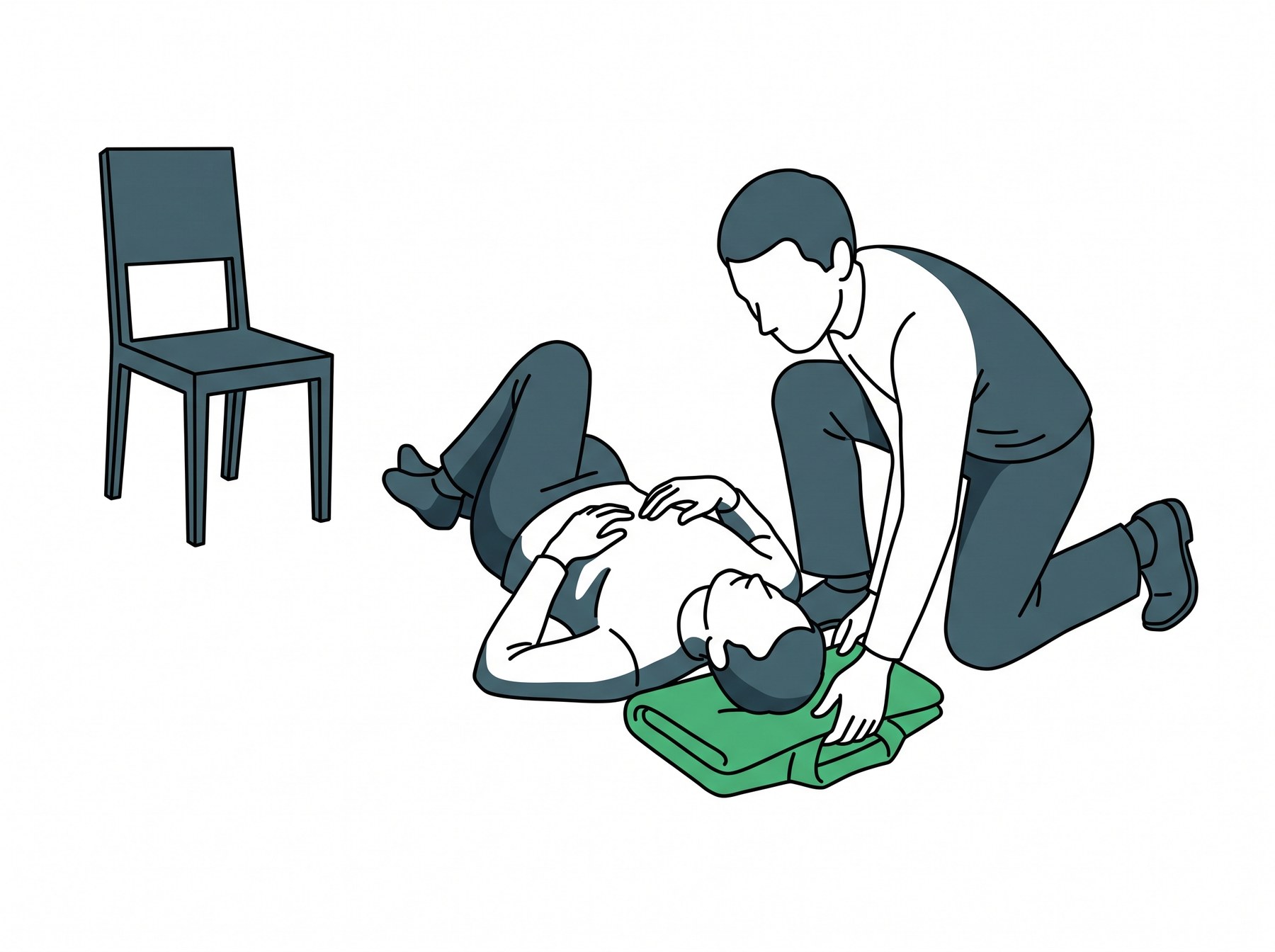
→ Recovery position ·
p.106 → When to call 999 · p.124116
3
3 · MEDICALmatrix
When in doubt, give sugar
DIABETIC EMERGENCY
Never put food, drink, or glucose gel in an unconscious person's mouth.
They will choke.
| LOW sugar (hypo) | HIGH sugar (hyper) | |
|---|---|---|
| Onset | Fast. Minutes. | Gradual. Hours or days. |
| Signs | Confused, irritable. Sweating, pale, trembling. Hungry. May pass out. | Very thirsty. Urinating often. Warm, dry skin. Fruity-smelling breath. |
| Action | Give fast-acting sugar (below). | Call 999. Monitor breathing and response. Be ready for CPR. |
1Conscious and able to swallow?
Look for a medical alert bracelet, insulin pen, or ID card.
Call 999. Nothing in the mouth. Breathing? Recovery position. See:
Recovery position.
▼ ALL YES
Give fast-acting sugar. 4 large jelly babies, 5 glucose tablets, or a
sugary (not diet) drink. Wait 10-15 minutes. No improvement? Call 999.
NO
Recovered? Follow with slow-release carbs: a sandwich or biscuits.
Stay until they are fully alert.
→ Recovery position ·
p.106 → Unresponsive person · p.101117
3
3 · MEDICALchecklist
Sit them down. Aspirin. 999.
HEART ATTACK
Delay kills heart muscle. Call 999 at the first suspicion. Never let them
drive or 'walk it off'.
CRUSHING or squeezing chest pain May spread to the arms, neck, or jaw.
BREATHLESS, sweating, feeling sick
PALE, blue, or grey skin Check
the lips too.
FEELS like bad indigestion A
burning chest can be a heart attack. Do not dismiss it.
CALL 999
Say 'suspected heart attack'.
SIT them on the floor
Knees bent, head and shoulders supported. Against a wall
works.
GIVE one 300mg aspirin
Ask them to chew it slowly. Not if allergic or under 16.
HELP with their angina medication
Their own GTN spray or tablets, if prescribed.
WATCH them constantly
Unresponsive and not breathing normally? CPR and AED. See: CPR
adult.
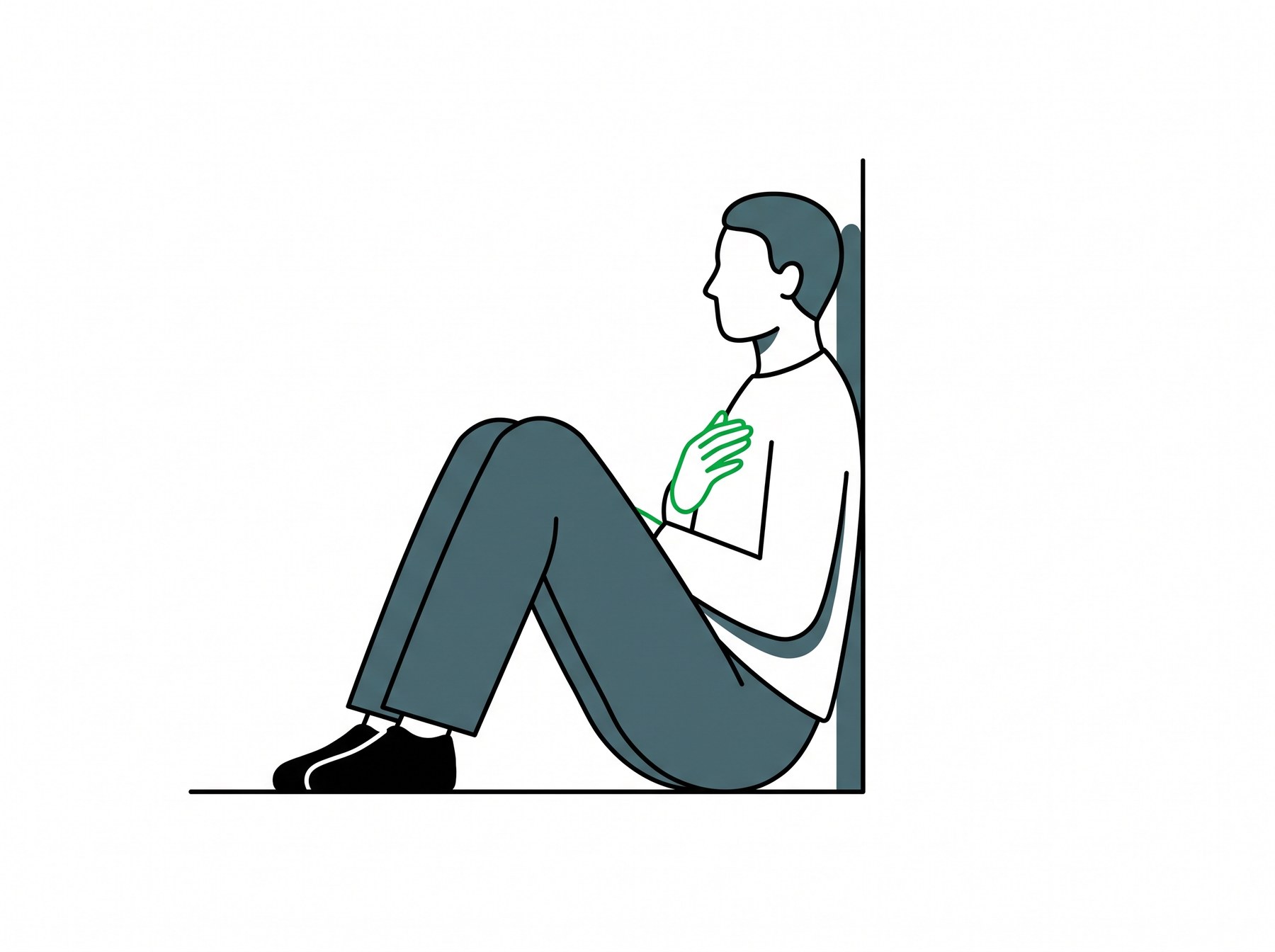
→ CPR adult · p.102 → AED · p.104118
3
3 · MEDICALchecklist
Face. Arms. Speech. Time.
STROKE: THINK FAST
Symptoms that fade still mean 999. A mini-stroke often warns of a full
stroke coming.
FACE: ask them to smile
One side drooping? Mouth or eye fallen?
ARMS: ask them to raise both
Can they lift both arms and keep them up?
SPEECH: ask their name
Slurred words? Confused? No answer?
TIME: call 999 now
Any ONE sign fails: call immediately. Note when symptoms
started.
KEEP them still and supported Reassure them. They can often hear you.
GIVE nothing to eat or drink Swallowing may fail. They can choke.
ROLL them if unconscious Breathing normally: recovery position. See: Recovery
position.
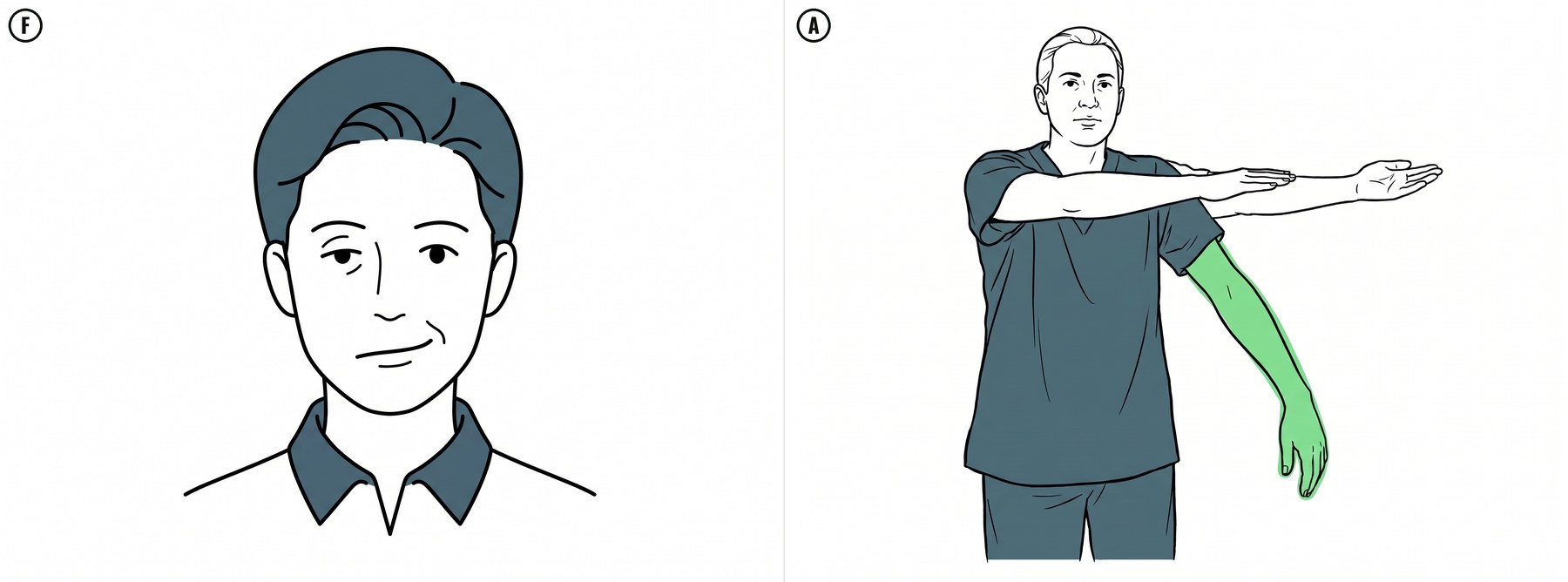
→ Recovery position ·
p.106 → Unresponsive person · p.101119
3
3 · MEDICALchecklist
Adrenaline pen. 999. Lie them flat.
ANAPHYLAXIS
Do not let them stand or walk at any time. Even if they say they feel
better.
Adrenaline auto-injectorA pre-loaded
pen (EpiPen, Jext) that injects adrenaline into the outer thigh. Many people at risk carry
one.
SWELLING of tongue or throat Often after food, an insect sting, or medication.
WHEEZING or struggling to breathe
FAINT, confused, or collapsing
SKIN pale, blue, or grey
USE their adrenaline pen NOW
Follow the pen's printed instructions. Help them, or do it
yourself.
CALL 999
Say 'anaphylaxis'.
LIE them flat, raise the legs
Struggling to breathe? Let them sit up slowly instead.
REMOVE any visible sting
GIVE a second pen
After 5 minutes, if not improving or symptoms return.
START CPR if breathing stops
See: CPR adult.
→ CPR adult · p.102 → Unresponsive person · p.101120
3
3 · MEDICALquickref
The infection emergency people miss
SEPSIS
Sepsis can look like flu or a hangover. Looks wrong and worsening fast?
Call 999.
SepsisThe body's extreme reaction to
an infection. It shuts organs down. A life-threatening emergency.
CONFUSED, slurring, not making sense
BREATHING very fast
SKIN blue, pale, or blotchy On
black or brown skin: check the palms and soles.
RASH that will not fade Press
a glass against it. Still visible? 999.
VERY high or very low temperature Hot or cold to the touch. Shivering.
CALL 999
Say: 'I think this could be sepsis.'
STAY and monitor response
Never send them off in a taxi or car.
TELL paramedics the history
Recent wound, infection, or illness that suddenly got worse.
→ When to call 999 ·
p.124 → Unresponsive person · p.101121
3
3 · MEDICALchecklist
999 first. Stay with them.
OVERDOSE RESPONSE
999
Call immediately. Say 'suspected overdose'.
| Depressants (opioids, alcohol) | Stimulants (cocaine, amphetamines) |
|---|---|
| Slow or shallow breathing. Pinpoint pupils. Blue lips or fingertips. Unresponsive. | Racing heartbeat. High temperature. Agitation, paranoia. Chest pain. Seizures. |
01
CALL 999: say suspected overdose
02
STAY with them Keep calm.
Reassure if conscious.
03
ROLL into recovery position Unconscious but breathing. See: Recovery position.
04
START CPR if not breathing See: CPR adult.
05
COLLECT drugs and containers Hand them to paramedics. Note what, when, how much.
→ Recovery position ·
p.106 → CPR adult · p.102 → Overdose special cases · p.123122
3
3 · MEDICALquickref
Naloxone, and the classic mistakes
OVERDOSE: SPECIAL CASES
Naloxone works only on opioids. Drug unknown? Give it anyway. If opioids
are not involved it will not harm them.
Naloxone (Narcan)A medicine that
reverses opioid overdose for a short time. Nasal spray or injection. Some sites carry it.
01
FOLLOW your site training Only
give naloxone if your site carries it and trained you.
02
GIVE it as trained Nasal spray
or injection.
03
STILL call 999 The effect
wears off. They can collapse again.
04
EXPECT a sudden wake-up They
may be confused or agitated. Stand slightly back.
05
KEEP monitoring A repeat dose
may be needed.
- Give naloxone if trained and available
- Recovery position while you wait
- Put them in a cold shower
- Give coffee or slap them awake
- Make them vomit
- Leave them alone
- Delay 999 for fear of consequences
Police attend only if the ambulance crew asks. Do not delay the call.
Focus on the casualty.
→ Overdose response ·
p.122 → Recovery position · p.106123
3
3 · MEDICALquickref
In doubt? Call. The handler decides.
WHEN TO CALL 999
UNCONSCIOUS or unresponsive See: Unresponsive person.
NOT breathing, or breathing abnormally See: CPR adult.
SEVERE bleeding that will not stop See: Severe bleeding.
HEART attack signs Crushing
chest pain. See: Heart attack.
STROKE signs Any FAST failure.
See: Stroke.
ANAPHYLAXIS Throat swelling
after food, sting, or medication. See: Anaphylaxis.
SUSPECTED sepsis See:
Sepsis.
SEIZURE over 5 minutes See:
Seizures.
SERIOUS injury or major burns See: Burns special cases.
OVERDOSE or poisoning See:
Overdose response.
CHOKING: cannot breathe or speak See: Choking.
DROWNING or near-drowning Pulled from water: 999 every time. Not breathing? Start
CPR.
Nobody criticises a 999 call made in good faith. Hesitation is the
only mistake.
→ Making the 999 call
· p.125 → Emergency numbers · p.178124
3
3 · MEDICALchecklist
Answer in this order
MAKING THE 999 CALL
The operator asks these questions, in this order. Answer clearly. Stay
on the line until told to hang up.
| They ask | You give |
|---|---|
| Where are you? | Full address, postcode, nearest landmark, floor level. |
| What happened? | One line: collapse, fall, bleeding, overdose. |
| How many hurt? | Number of casualties. |
| What condition? | Conscious? Breathing? Bleeding? |
| Who are you? | Name, callback number, 'security officer on site'. |
SEND someone to meet the ambulance At the entrance, in hi-vis.
CLEAR the access route Open
doors. Move obstacles. Hold the lift at ground.
CONTINUE first aid Keep
bystanders back. Protect their dignity.
UPDATE control by radio Record
everything in the occurrence book after handover.
→ Radio basics ·
p.157 → Occurrence book · p.130125
3
3 · MEDICALquickref
One line per emergency
MEDICAL QUICK REFERENCE
| Condition | Do this |
|---|---|
| Unconscious | Call 999 FIRST. Then check breathing. Breathing: recovery position. Not breathing: CPR. |
| Not breathing | 999. CPR 30:2. Send for the AED. |
| Choking | 5 back blows, 5 abdominal thrusts. Repeat until clear. Medical check afterwards. |
| Severe bleeding | Press hard on the point. Soaked dressing: swap it, press again. Limb bleed uncontrolled: tourniquet. 999. |
| Burns | Cool water, 20 minutes. Cling film. No creams. |
| Seizure | Protect the head. Time it. Recovery position after. 999 if over 5 minutes. |
| Diabetic | Conscious: give sugar. Unconscious: 999, recovery position. |
| Heart attack | 999. Sit them down, knees bent. Chew 300mg aspirin. |
| Stroke | FAST test. Any sign fails: 999. Note the start time. |
| Anaphylaxis | Adrenaline pen. 999. Lie flat, legs raised. Never let them stand. |
| Sepsis | Fast breathing, confusion, blotchy skin after infection. 999. |
| Overdose | 999. Recovery position if breathing. CPR if not. |
You are the first response, not the last. One job: keep them alive
until help arrives. DR ABC. Call 999. Act fast. Stay calm.
→ Emergency numbers ·
p.178 → Unresponsive person · p.101126
3
4
SECTION 04 · OPERATIONS
Run any site, any shift, by the bookOPERATIONS
Handover. Occurrence book. Patrols. Lone working. Static posts. Access
control. Keys. CCTV and your licence. Footage requests. Body-worn video. Alarms. Visitors.
Contractors. Deliveries. Lost property. Ends with a one-page summary.
4
4 · OPERATIONSchecklist
Taking over a shift
SHIFT HANDOVER (1/2)
Poor handovers cause incidents. Never rush a handover.
ARRIVE 10 to 15 minutes early Handover takes time. Build it in.
WEAR full uniform Clean and
pressed. First impressions set the tone for your shift.
CARRY your SIA licence Plus
photo ID, notebook and pen. Licence worn where people can see it.
CHARGE your phone It is your
backup channel if the radio fails.
READ the occurrence book Every
entry since your last shift. Ask about anything unclear.
ASK about ongoing incidents What is still live? What needs watching tonight?
CHECK for banned individuals Names, descriptions, photos if the site holds them.
CONFIRM expected visitors and deliveries Who is due, when, and who authorised them.
NOTE equipment faults Cameras
down, doors not locking, lights out. Write them down.
TAKE site-specific instructions New orders from the client or your supervisor.
SIAThe Security Industry Authority.
The regulator that issues your licence.
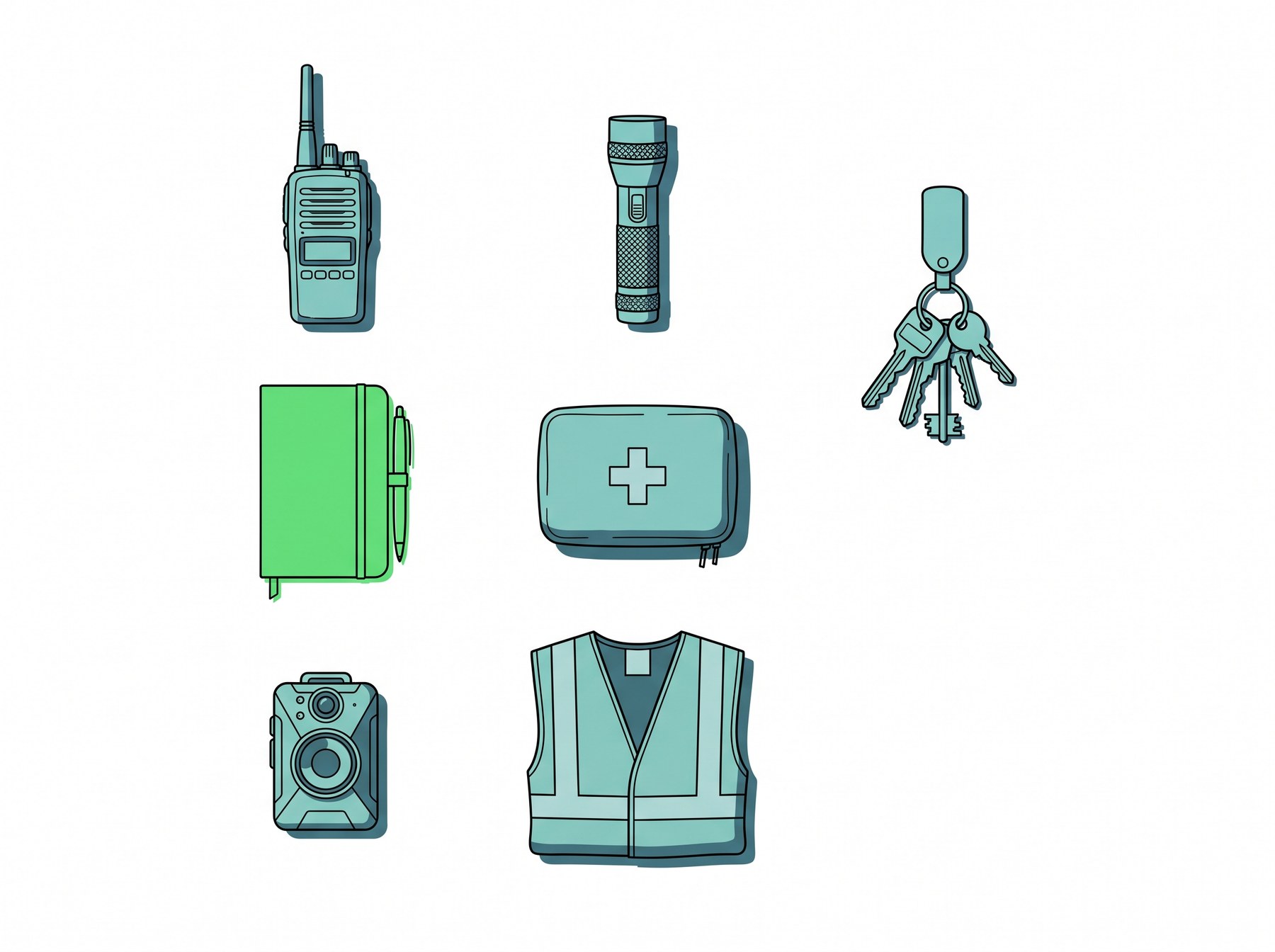
→ The occurrence book
· p.130 → Giving handover · p.129128
4
4 · OPERATIONSchecklist
Equipment check, then giving handover
SHIFT HANDOVER (2/2)
TEST the radio Charged,
correct channel, radio check with control.
COUNT and sign for keys Check
numbers against the key log before you sign.
TEST torch and body-worn video Torch even on day shifts. BWV charged, if your site issues
it.
CHECK the first aid kit Stocked and where you can reach it fast.
BRIEF the incoming officer
Every incident from your shift, worst first.
EXPLAIN anything still live
Ongoing situations, people to watch, promises made.
FLAG expected events
Visitors, deliveries, contractors due on their shift.
REPORT equipment faults
Show them, do not just mention them.
COMPLETE your occurrence book entry
Close your shift in writing before you leave.
SIGN keys and kit over
Both officers sign the log.
STAY until they confirm ready
Do not leave until your relief says they are set.
→ Occurrence book
entries · p.130 → Body-worn video checks
· p.144129
4
4 · OPERATIONSquickref
The site's legal record of your shift
THE OCCURRENCE BOOK
Courts can read the occurrence book. Gaps and erasures look like
cover-ups.
WRITE in ink Never pencil.
Never leave blank lines between entries.
USE the 24-hour clock Entries
in time order: 14:30, not 2:30pm.
RECORD facts you saw Not
opinions, not guesses. Quote exact words spoken.
CROSS OUT mistakes with one line Initial it. Never overwrite, never tear out pages.
SIGN every entry Name and
time. Anonymous entries are worthless as evidence.
LOG quiet patrols too Write
the patrol and the time even when nothing happened.
Sample occurrence book entry
22:14. Zone 3 fire exit found wedged open on patrol. No persons seen.
Door closed and secured. CCTV checked: cleaner propped it open at 21:50. Reported to
control. A. KHAN.
Occurrence bookThe site log of
everything that happens on shift. Also called the daily log or DOB.
→ Full incident
reports · p.171 → Handover checklist ·
p.128130
4
4 · OPERATIONSchecklist
Before you go, and what to check
PATROL PROCEDURES
Never skip checkpoints. Your signature confirms you checked.
CHECK route and timing
Vary both. Do not be predictable.
RADIO control before you start
Radio check, your route, expected finish time.
CARRY a torch
Even in daytime. Plant rooms and stairwells are dark.
TAKE the keys for the route
Sign them out first.
DOORS, windows, locks secure Push them, do not just look. Scratched plates can mean
attempted entry.
LIGHTING working Report failed
lights. Dark corners invite trouble.
FIRE exits clear Nothing
blocking, nothing wedged.
CAMERAS in position Not
turned, blocked or covered.
NO unauthorised persons Challenge politely or report. Never alone into danger.
NOTHING out of place Suspicious items, vehicles, spills, damage, obstructions. Log
and report all.
CLOCKING points scanned Every
point, every patrol.
Clocking pointsCheckpoints you scan or
tag to prove you completed the patrol.
→ Found something?
Next page · p.132 → Patrolling alone ·
p.133131
4
4 · OPERATIONSflowchart
Stop. Observe. Report.
PATROL INCIDENTS
Your safety comes first. Never tackle alone what you can report in
seconds.
1Safe to approach?
No fire, no weapon, no intruder, stable ground. Assess before
every step.
STAY BACK. Observe from a safe distance. Radio control: location,
what you see, numbers involved.
▼ ALL YES
OBSERVE: who, what, how many. REPORT to control. Then follow control's
instruction.
NOT SAFE
| DO | DON'T |
|---|---|
| Vary your route and times | Patrol a predictable pattern |
| Look up, down and around | Walk head-down on your phone |
| Listen. Smell for smoke or gas | Wear headphones or earbuds |
| Note times exactly | Rush through checkpoints |
→ Judging the risk
fast · p.54 → Radio procedure · p.157132
4
4 · OPERATIONSchecklist
Check-ins keep you alive
LONE WORKING (1/2)
No one knows you are in trouble unless the system does. Check in on time,
every time.
01
CONFIRM your check-in schedule Agree times with control at shift start. Write them
down.
02
TEST your lone-worker device If your site issues one, test it and follow your site
training.
03
CHARGE your phone Save
control, your supervisor and the out-of-hours number.
04
LEARN the dead spots Know
where radio and phone signal fail on your site.
05
TELL control before risk tasks Roof, plant rooms, dark yards, confined spaces. Location and
expected time.
CHECK IN at every agreed time Never skip one. A missed check-in triggers a response.
REPORT patrol start and finish Control should always know where you are.
KEEP exits in mind Know your
way out of every area you enter.
Lone-worker deviceA device or phone
app that raises an alarm. Press the button, or it triggers when you stop moving.
LEGAL BASIS · Health and Safety at Work etc. Act
1974→ Missed check-in? Next page · p.134 → Radio procedure · p.157133
4
4 · OPERATIONSflowchart
Missed check-ins and no answer
LONE WORKING (2/2)
Alone, you never confront. Withdraw. Observe from a safe distance. Call
999.
MISSED your check-in?
Answer control's follow-up call at once. Silence sends
responders to you.
CONFIRM you are safe
If your site uses an all-clear or duress code word, follow
your site training.
NEVER give a false all-clear
Under threat, use the duress word or stay silent. Help comes.
1Can you reach control?
Radio first. Then mobile. Then a landline.
Danger to life? Call 999 direct, now. Then keep trying control on
every channel. No danger? Call the out-of-hours number and keep trying. Log each
attempt as an equipment fault.
▼ ALL YES
REPORT in. Continue your shift. Log the failed channel as an equipment
fault.
NO CONTACT
→ Judging the risk
fast · p.54 → Emergency numbers · p.178134
4
4 · OPERATIONSchecklist
Set up, stay sharp, take breaks right
STATIC POST DUTIES
Never leave your post without authorised relief or supervisor permission.
POSITION for clear sightlines See the approaches. Be seen yourself.
TEST your comms Radio and
phone, before your first visitor.
LOCATE emergency equipment First aid kit, fire alarm points, extinguishers,
defibrillator.
REVIEW the visitor list Who is
expected and what access they get.
KEEP the post presentable Clean desk, kit ready, personal phone away.
STAND alert, eyes scanning Not
slouched, not head-down. Your presence deters.
GREET every visitor Warm and
professional. Then check ID consistently.
LOG every visitor No
exceptions, however senior or familiar.
REPORT unusual activity at once Radio control. Do not wait to be sure.
REQUEST relief by radio
For breaks, call control. Do not just walk away.
WAIT at post
Until relief arrives and you have briefed them.
RETURN on time
As agreed. Your relief is covering two jobs until you do.
→ Checking ID and
access · p.136135
4
4 · OPERATIONSchecklist
Four checks, in order, every time
ACCESS CONTROL
In doubt? Do not grant access. Verify with the host or your supervisor
first.
IDENTITY
Check the photo matches the face in front of you.
AUTHORISATION
Check they are on the list or expected.
PURPOSE
Ask why they are here. The reason must make sense.
CREDENTIALS
Check the pass or ID is valid and current.
MATCH the photo Look at the
face, then the photo, then the face again.
MATCH the name Against the
booking or authorisation.
CHECK the expiry date Reject
expired ID. No exceptions.
LOOK for tampering Peeling
laminate, misaligned print, altered dates.
→ Awkward cases: next
page · p.137 → Refusing entry: the words
· p.160136
4
4 · OPERATIONSmatrix
The awkward cases, one line each
ACCESS SCENARIOS
Never base a refusal on race, sex, disability, religion or any protected
characteristic. That is unlawful discrimination.
| SITUATION | ACTION |
|---|---|
| No ID | Deny entry. Suggest they contact their host. |
| Expired ID | Deny entry. Expired credentials do not count. |
| Not on list | Contact the host. Do not admit without host confirmation. |
| Tailgating | Challenge politely. Each person shows their own ID. |
| VIP or executive | Same rules. Verify politely but firmly. |
| Aggressive refusal | Deny entry. Call for backup. Report it. |
| Lost pass | Issue a temporary pass. Report the lost pass to admin. |
| Emergency services | Verify uniform and ID. Grant immediate access. Escort. |
Someone in a hurry refuses the ID check
“I understand you're in a hurry. I must check your ID first.”
“I'm late. Just let me through!”
“It takes ten seconds. It keeps everyone safe, including you.”
LEGAL BASIS · Equality Act 2010→ De-escalating anger · p.69 → Visitor arrivals · p.148137
4
4 · OPERATIONSchecklist
Sign, count, return. Every time.
KEY MANAGEMENT
One lost key can force a whole building re-lock. Account for every key,
every time.
NEVER leave keys unattended On
you, or locked in the cabinet. Nowhere else.
NEVER lend keys Only
authorised, verified people get keys.
NEVER copy keys Duplication
needs written authorisation.
ALWAYS sign in and out The key
log is your protection when a key goes missing.
VERIFY authorisation
Is this person allowed these keys? Check the list.
CHECK ID
If site rules require it.
RECORD in the key log
Name, key number, time out, expected return.
SIGN, both of you
No signature, no key.
ON RETURN: count and check
Key numbers match, time in, both sign, back on the hook.
→ Key lost or
missing? · p.139138
4
4 · OPERATIONSflowchart
Time-critical. Act now.
LOST OR MISSING KEY
Every minute a key is missing, the areas it opens are exposed.
1Found within 15 minutes?
Search everywhere the key holder went. Pockets, bags, vehicles,
desks, floors.
REPORT to your supervisor now. Do not keep searching quietly. Then
complete an incident report. Include key number, holder, last seen time and place,
search done.
▼ ALL YES
RETURN the key to the cabinet. Record the find in the key log. Tell
anyone you alerted.
NOT FOUND
01
SECURE the affected areas Extra patrols past every door that key opens.
02
HIGH-SECURITY area? Tell your
supervisor now. The supervisor decides on lock changes.
Key number
Issued to
Time out
Signature out
Time in
Signature in
→ Incident reports ·
p.171139
4
4 · OPERATIONSquickref
Check before you sit at the monitors
CCTV: LICENCE CHECK
Working on the wrong licence is a criminal offence. Up to 6 months in
prison and a fine.
01
CHECK who employs you Contracted (supplied by a security company)? The licence rules
below apply to you.
02
CHECK what the post asks Watching the public, identifying people, or guarding against
disorder needs the PSS (CCTV) licence.
03
IN-HOUSE employee? Usually
exempt from SIA licensing for CCTV work. Check with your employer.
04
UNSURE? Ask before you start Confirm your licence category with your supervisor
first.
- With a guarding or door supervisor licence: use CCTV to identify a trespasser
- With a guarding or door supervisor licence: use CCTV to protect property
- Without a PSS (CCTV) licence: proactively watch members of the public
- Without a PSS (CCTV) licence: track or identify particular people
- Without a PSS (CCTV) licence: monitor crowds to guard against disorder or assault
PSS (CCTV) licenceThe SIA's Public
Space Surveillance licence. The category for watching people, not just property.
LEGAL BASIS · s.3 Private Security Industry Act
2001→ Key legislation · p.181 → Monitoring procedure · p.141140
4
4 · OPERATIONSchecklist
Start-of-shift checks, stay systematic
CCTV MONITORING
CCTV footage of identifiable people is personal data under the UK GDPR and
the Data Protection Act 2018. Handle footage with care. Know your site's retention policy.
01
LOG IN and record the time Your session is part of the audit trail.
02
CHECK every camera works Report offline cameras immediately. Log the fault.
03
VERIFY recording is running A
monitor that shows but does not record is half a system.
04
REVIEW the previous shift Incidents, faults, anything flagged to watch.
SCAN monitors systematically A
set pattern beats random glancing.
CYCLE cameras on sequence Dwell on high-risk areas.
RESPOND to alarms promptly Check the zone camera before anything else.
TAKE short breaks Fatigue
blinds you. Arrange cover, then rest your eyes.
UK GDPRThe UK's data protection law.
Footage of people counts as personal data.
LEGAL BASIS · UK GDPR; Data Protection Act
2018→ Licence check first · p.140 → Footage requests · p.143 → UK GDPR essentials · p.41141
4
4 · OPERATIONSquickref
Alert. Track. Note. Preserve.
CCTV: INCIDENT SEEN
ALERT
Radio control and responders immediately. Location, what is
happening, numbers.
TRACK
Keep the camera on the subjects. The licence check applies to
tracking people.
NOTE
Time, camera numbers, descriptions, direction of travel.
PRESERVE
Mark the footage for retention before it overwrites.
LOITERING without clear purpose Especially near entrances, deliveries or secure doors.
WATCHING cameras or security Noting positions, testing responses. Report it.
REPEAT visits, no business Same person, no transaction, no reason.
CLOTHING wrong for conditions Heavy coat in heat, face covered without cause.
→ Licence rules on
tracking · p.140 → Radio procedure ·
p.157 → Classifying what you see · p.52142
4
4 · OPERATIONSscript
Preserve first. Never release yourself.
CCTV FOOTAGE REQUESTS
Footage is often overwritten within days. Preserve first, every time.
Anyone asks for CCTV footage
“I'm not authorised to release footage directly. I'll log your request
now and mark the footage for preservation.”
“How long will it take?”
“If the footage is of you, you'll get a response without undue delay
and within one calendar month.”
01
MARK footage for retention now Before anything else, so it is not overwritten.
02
LOG the request Who asked,
when, what footage, contact details.
03
PASS to the data protection contact They answer the request. You never hand footage over.
01
POLICE request? Take details Officer's name, collar number, force, crime reference.
02
PRESERVE the footage Then
escalate to the data protection contact immediately.
03
NO one-month wait for police Police requests use the crime exemption, not the one-month
process.
LEGAL BASIS · UK GDPR Art 15; DPA 2018 Sch 2 Pt 1
para 2→ Data rules for monitoring · p.141143
4
4 · OPERATIONSchecklist
When to switch on, what to say
BODY-WORN VIDEO (1/2)
A missing recording looks like hiding something. Switch on early, not
mid-incident.
If your site issues body-worn video, follow your site training on the
device. The rules on this spread apply everywhere.
FORCE looks likely Any
situation that could turn physical. Record before it does.
REFUSING entry or ejecting The
camera protects your account of what happened.
THREATS or abuse start Verbal
aggression is your trigger. Do not wait for contact.
MAKING an arrest Record the
grounds you state and everything after.
ANY incident you will report If it goes in the occurrence book, it should be on
camera.
SOMEONE asks you to record Record. It protects them and you.
Starting to record
“I am recording this interaction on body-worn video.”
“Turn that camera off!”
“The camera stays on. It protects both of us.”
→ After using force ·
p.28 → Footage rules: next page · p.145144
4
4 · OPERATIONSchecklist
Footage is evidence. Treat it that way.
BODY-WORN VIDEO (2/2)
BWV footage is disclosable in court. Deleting or editing it can destroy
evidence and end your career.
- Record incidents using the triggers on the previous page
- Review your own footage to write your report, if site policy allows
- Tell the data protection contact when footage is requested
- Delete or edit any footage, ever
- Copy footage to a personal phone or share it
- Record in private areas such as toilets or changing rooms
- Post or show footage to anyone outside the official process
01
DOCK and upload at shift end Follow your site's download procedure. Footage stays in the
system.
02
LOG recordings in the occurrence book Incident, time, and that BWV footage exists.
03
REPORT device faults A dead
camera on an incident is a problem for everyone.
04
ROUTE footage requests like CCTV Preserve, log, pass to the data protection contact.
LEGAL BASIS · UK GDPR; Data Protection Act
2018→ Footage requests procedure · p.143 → Occurrence book · p.130145
4
4 · OPERATIONSflowchart
Acknowledge. Check. Decide. Report.
ALARM RESPONSE
Never assume a false alarm. Investigate every activation.
ACKNOWLEDGE the alarm
Note type, zone and time. Tell control.
CHECK the zone on CCTV
Look for the cause. Is anyone there?
1Zone clear and safe?
No person, no forced entry, no movement on camera.
DO NOT ENTER ALONE. Observe from a safe distance. Call control.
Intruder seen? Request police on 999.
▼ ALL YES
INVESTIGATE the zone. Find the cause. Document it. Reset the alarm per
site procedure.
NOT CLEAR
→ Fire alarm?
Different rules · p.83 → Alarm types
table · p.147146
4
4 · OPERATIONSmatrix
Cause and response, at a glance
ALARM TYPES
| ALARM | CAUSE | RESPONSE |
|---|---|---|
| Intruder / PIR | Movement detected | Check CCTV. Investigate the zone. |
| Door / window | Contact broken | Check the opening. Secure if open. |
| Fire | Smoke or heat | Evacuate. Call 999. Do NOT silence. |
| Panic / duress | Manual activation | Call 999 immediately. Treat as real. |
| Tamper | Device interference | Investigate. It can mean a bypass attempt. |
| Technical | Low battery, fault | Log the fault. Report for maintenance. |
BALLOONS, banners near sensors Anything that moves in a draught.
HEATING or air-con draughts Check vents near the sensor.
ANIMALS or pests Common in
warehouses and lofts.
STAFF in early or late Cleaners and contractors trip zones. Verify, do not
assume.
FAULTY sensor Log it and
report for repair. Document every alarm, even false ones.
PIRPassive infrared sensor. Detects
body heat and movement.
→ Fire response ·
p.83 → Alarm response flow · p.146147
4
4 · OPERATIONSchecklist
Identified, confirmed, logged, badged
VISITOR ARRIVAL
GREET and ask name and host
You are the first face of the site. Who are they visiting?
CHECK the booking
Appointment or pre-registration on the list.
VERIFY photo ID
Photo matches face. Name matches booking.
CALL the host to confirm
Host confirms and collects, or authorises escort.
LOG the entry
Name, company, host, badge number, time in, signature.
ISSUE the visitor pass
Worn visibly at all times.
BRIEF on safety
Fire exits, alarm sound, assembly point.
Visitor with no booking on record
“May I take your name and the reason for your visit?”
“I don't have a record of your visit. Let me call your host to
confirm.”
“Just let me up. They know me.”
“I can't let anyone through unconfirmed. It won't take a minute.”
→ Access checks ·
p.136 → Departure and reconciliation ·
p.149148
4
4 · OPERATIONSchecklist
Sign out, then reconcile at end of day
VISITOR DEPARTURE
An unreturned badge is a live key. Someone can use it to enter the
building. Report it at once.
COLLECT the visitor pass
Every badge, every time.
RECORD time out
In the visitor log, against the entry.
TAKE back access cards
Any temporary cards or keys issued.
ESCORT out if required
Escort the visitor out if site rules require it.
01
REVIEW the log Anyone not
signed out?
02
CALL hosts to confirm Did
their visitor actually leave?
03
SEARCH if unaccounted Check
the building before you lock down.
04
CHASE missing badges Collect
what you can. Report the rest to your supervisor.
→ Arrival procedure ·
p.148149
4
4 · OPERATIONSchecklist
Higher risk means higher scrutiny
CONTRACTORS ON SITE
Contractor in an unauthorised area? Do not confront. Observe and report at
once.
CHECK the expected list
Not listed? Verify with facilities before anything else.
VERIFY photo ID
Person matches ID. ID matches the company sent.
CHECK the work order
Or permit. The paperwork says what they may do.
HIGH-RISK work? Check the permit
Hot work, working at height, confined space, electrical
isolation.
CALL the internal sponsor
Someone inside must confirm and own this visit.
LOG and badge
Contractor badge, distinct from visitor passs.
BRIEF site rules
Emergency procedures, permitted areas, your contact channel.
CHECK their location periodically They stay in authorised areas only.
COLLECT badge and keys at exit Record the departure time.
CHECK the work area Left
secure. Note any equipment left on site.
→ ID checks · p.136 → Refusing access: the words · p.160150
4
4 · OPERATIONSchecklist
Check before you sign. Guard the bay.
DELIVERIES & LOADING
A radio or phone signal can trigger a device. Never transmit within 15
metres of a suspect item.
VERIFY against the expected list
Unexpected delivery? Confirm with the recipient before
accepting.
CHECK driver ID and registration
Record both if site rules require it.
MATCH paperwork to goods
Count items. Check descriptions.
INSPECT before signing
Damaged? Write 'Received in damaged condition' on the
paperwork.
SIGN only if authorised
Then log it: time, company, items, recipient.
DIRECT to the recipient
Never leave packages unattended in public areas.
NEVER leave an open bay unsupervised Bays bypass main security. Criminals know it.
ONE vehicle, no walk-throughs Watch loading actively. No one enters the building through the
bay unchecked.
SECURE the bay after use Closed and locked when not in use.
Suspect item? Do not touch or move it. Move people away. Clear at
least 100 metres. Call 999 from behind hard cover, out of sight; never transmit within 15
metres. Full procedure and distances: see Suspicious Package.
→ Suspicious package
procedure · p.75151
4
4 · OPERATIONSchecklist
Treat every found item as evidence
LOST PROPERTY
NOTE the exact location
Where found, date, time, and who found it.
DESCRIBE the item in detail
Colour, brand, condition, contents.
CHECK inside for owner ID
With a witness for wallets, bags and phones.
TAG the item
Complete a lost property tag with a reference number.
STORE securely
The designated lost property location only.
ENTER it in the register
Same details as the tag. Register and tag must match.
Item number
Description
Found: date, time, location, finder
Storage location
Claimed: date, claimant, ID checked, signature
→ Someone claims an
item · p.153152
4
4 · OPERATIONSflowchart
They describe it. You verify.
PROPERTY CLAIMS
Releasing to the wrong person is theft from the true owner. Verify before
anything leaves your hands.
1Description matches, unseen?
They describe the item before they see it. Never show it first.
DO NOT RELEASE. Record the request and their contact details.
Escalate to your supervisor.
▼ YES
2Photo ID checked and logged?
Record name, ID type and number in the register.
DO NOT RELEASE. No ID, no release. Record the request. Escalate to
your supervisor.
▼ YES
3Supervisor approved, if high value?
Cash, cards, electronics, jewellery, keys and ID documents need
supervisor approval. Ordinary items: proceed.
HOLD the item. Call your supervisor now.
▼ ALL YES
RELEASE the item. Get a signature confirming receipt. Update the
register.
ANY CHECK FAILS
Claimant's description does not match
“I can't release this without a matching description and ID.”
“It's obviously mine!”
“Then it's safe here until you can confirm the details. I'll record
your contact details now.”
→ Logging found items
· p.152153
4
4 · OPERATIONSquickref
The whole section, one line each
OPERATIONS SUMMARY
| TASK | KEY POINTS |
|---|---|
| Handover | Arrive early. Full briefing. Sign for kit. Stay until relief is ready. |
| Occurrence book | Ink. Time order. Facts only. Sign every entry. |
| Patrols | Vary times. Check every point. Stop, observe, report. |
| Lone working | Check in on time, every time. Never confront alone. |
| Static post | Alert and visible. Relief before you leave. |
| Access | Identity. Authorisation. Purpose. Credentials. In doubt, no entry. |
| Keys | Sign in and out. Count. Missing 15 minutes? Report. |
| CCTV | Right licence first. Check cameras. Preserve footage fast. |
| Footage requests | Preserve, log, pass on. One calendar month. Police: escalate now. |
| Body-worn video | Switch on early. Announce it. Never delete. |
| Alarms | Investigate every one. Intruder signs? Do not enter alone. |
| Visitors | ID. Host confirms. Badge. Log. Reconcile at close. |
| Deliveries | Inspect before signing. No radio within 15m of a suspect item. |
| Lost property | Describe first, then ID, then release. High value: supervisor. |
You have limited powers, and that is fine. When in doubt: observe,
document, call police.
→ Report writing ·
p.171 → Emergency numbers · p.178154
4
5
SECTION 05 · COMMUNICATIONS
Say it right. Write it so it stands up.COMMUNICATIONS
The emergency radio call comes first. Then radio basics, the phonetic
alphabet and codes. Scripts for entry refusals, ejections, challenges, cameras and
witnesses. Then worked reports you can copy, and the handover. Boxed lines are exact words.
Say them as written.
5
5 · COMMUNICATIONSchecklist
Learn this before your first shift
EMERGENCY RADIO CALL
SUSPICIOUS ITEM: never transmit or phone within 15 metres of it. Move
away, out of line of sight, before you call. Then follow the 4 Cs: Confirm, Clear,
Communicate, Control.
SAY the emergency proword
Your site's word, three times. Example: "EMERGENCY, EMERGENCY,
EMERGENCY."
SAY your callsign
"This is Alpha One."
SAY your location
Exact. "North Gate, outside the barrier."
SAY what is happening
"One male with a knife threatening staff."
SAY what you need
"Police and ambulance. All units stay clear."
CONFIRM your site's prowords Emergency word, hidden duress word meaning you are under
threat, stand-down word (usually "ALL CLEAR"). Check assignment
instructions.
KNOW your emergency button Many radios have one. Know what yours triggers.
Hear an emergency call? Stop transmitting. Stay off the channel until
you hear the stand-down word. Then resume normal calls.
ProwordA fixed word with a fixed
meaning on the radio, like ROGER or EMERGENCY. Everyone hears it the same way.
LEGAL BASIS · BS 7499: assignment instructions
define emergency procedures→ Suspicious items: the 4 Cs ·
p.75 → Emergency numbers · p.178 → Radio basics · p.157156
5
5 · COMMUNICATIONSquickref
Test your radio every shift
RADIO BASICS
Assume someone else hears every transmission. Never transmit names,
medical details or anything confidential.
LISTEN, then press PTT PTT is
the press-to-talk button. Check the channel is clear. Press, pause one second,
then speak.
SPEAK clearly, normal pace Do
not shout. Hold the radio 5cm from your mouth. One message, one subject.
RELEASE and wait Let go of
PTT. Wait for the response.
| Element | Example |
|---|---|
| Who you're calling | "Control..." |
| Who you are | "...this is Alpha One..." |
| Your message | "...requesting backup at North Gate..." |
| End transmission | "...over." |
| Response | Meaning |
|---|---|
| "Roger" | Message received and understood |
| "Wilco" | Will comply with instruction |
| "Say again" | Please repeat your message |
| "Stand by" | Wait. I will respond shortly |
| "Go ahead" | Ready to receive your message |
| "Negative" / "Affirmative" | No / Yes |
| "Out" | Conversation complete. No response needed |
→ Emergency radio
call · p.156 → Common codes · p.159157
5
5 · COMMUNICATIONSquickref
Spell it so control hears it once
PHONETIC ALPHABET
Spell names, registrations and codes with this alphabet. Alfa and
Juliett are the official NATO spellings. Say them the usual way: AL-fah, JEW-lee-ett.
| Letter | Word | Letter | Word |
|---|---|---|---|
| A | Alfa | N | November |
| B | Bravo | O | Oscar |
| C | Charlie | P | Papa |
| D | Delta | Q | Quebec |
| E | Echo | R | Romeo |
| F | Foxtrot | S | Sierra |
| G | Golf | T | Tango |
| H | Hotel | U | Uniform |
| I | India | V | Victor |
| J | Juliett | W | Whiskey |
| K | Kilo | X | X-ray |
| L | Lima | Y | Yankee |
| M | Mike | Z | Zulu |
Digits 0 to 9: Zero, Wun, Too, Tree, Fower, Fife, Six, Seven, Ait,
Niner. Registration AB12 CDE: "Alfa Bravo Wun Too, Charlie Delta Echo."
→ Radio basics ·
p.157158
5
5 · COMMUNICATIONSquickref
Codes vary by site. Learn YOURS.
COMMON CODES
Code Black or any suspicious item: never transmit or phone within 15
metres. Move away, out of line of sight, first. Then follow the 4 Cs: Confirm, Clear,
Communicate, Control.
| Status code | Meaning |
|---|---|
| Code 1 | Available / On patrol |
| Code 2 | Urgent: respond when possible |
| Code 3 | Emergency: immediate response |
| Code 4 | Situation under control / No assistance needed |
| Incident code | Meaning |
|---|---|
| Code Blue | Medical emergency |
| Code Red | Fire |
| Code Black | Bomb threat / Suspicious package |
| Code Silver | Weapon / Active threat |
| Code Adam | Missing child |
These are common examples only. Write your site's codes on the My Site
pages at the back of this manual.
→ Suspicious packages
· p.75 → Emergency radio call · p.156159
5
5 · COMMUNICATIONSscript
Firm, warm, no apologies
REFUSING ENTRY (1/2)
Never say someone is drunk. State the decision, not a diagnosis.
Refuse entry with a reason and an alternative. One apology at most,
then hold the line. Aggression? Step back, create space, call backup on the radio. Never
square up.
No valid ID (corporate or visitor site)
“I can't allow entry without valid photo ID. That's site policy, for
everyone's security.”
“If site policy allows, I can sign you in with a written vouch from
staff.”
“Otherwise come back with photo ID and I'll help you then.”
Not on the visitor list
“I don't have a record of your appointment. Give me your name and
reason, and I'll check with [name or department].”
Dress code
“Our venue has a dress code that doesn't permit [item]. You're welcome
to return if you can change.”
Intoxication
“I can't let you in this evening. Can I call someone for you, or
arrange a taxi?”
“say "I'm not even drunk!"”
“I haven't said you are. The decision stands for tonight. Come back
another evening.”
→ Age checks:
Challenge 25 · p.162 → Refusing entry
(2/2) · p.161 → De-escalation · p.69160
5
5 · COMMUNICATIONSscript
Pushback, bans, capacity, searches
REFUSING ENTRY (2/2)
NEVER take custody of an unsearched bag. You do not know what is in it.
If they push back (any refusal)
“argue the decision”
“The decision is made. I can't change it at the door.”
“turn aggressive”
“I'm stepping back now. This conversation is over.”
Banned person
“You are currently banned from these premises until [date].”
“If you believe it's an error, contact our management office. I can't
change it here.”
At capacity
“We're at maximum capacity for fire safety. I can't let anyone in
until guests leave. You're welcome to wait.”
They refuse a bag search (condition of entry)
“Entry requires a bag search. You have every right to refuse, but then
I can't let you in.”
“You're welcome to reconsider, or to return without the bag.”
A cloakroom accepts items only AFTER they are searched. A refused bag
that raises suspicion: do not touch it. Treat it as suspicious: Confirm, Clear, Communicate,
Control. And never refuse entry on protected grounds: race, faith, disability, sex. That is
unlawful discrimination.
LEGAL BASIS · Searches by consent only; Equality
Act 2010 s.29→ Search consent rules · p.29 → Suspicious items · p.75 → Age checks: Challenge 25 · p.162161
5
5 · COMMUNICATIONSquickref
No valid ID? No entry. No exceptions.
AGE ID: CHALLENGE 25
Admit someone on a vouch and they get served underage? The venue and staff
face prosecution and licence review.
25
Look under 25? See ID before entry.
PASSPORT In date, showing
photo and date of birth.
PHOTO-CARD driving licence With photo and date of birth.
PASS card Proof of Age
Standards Scheme. Must carry the PASS hologram.
MOD identity card Military ID
with photo and date of birth.
Valid ID shows a photo, a date of birth, and a hologram or UV feature.
Vouching never counts for age checks. Digital ID only counts if it comes from a certified
Digital Verification Service and your site accepts it. Check your site policy.
Age check at the door
“Challenge 25: you look under 25 to me, so I need ID. Passport,
driving licence or PASS card.”
“say "My mate inside will vouch for me"”
“Vouching doesn't work for age checks. Only ID does. No ID, no entry
tonight.”
“show ID on a phone”
“I can't accept ID on a screen for age checks. Physical ID only.”
LEGAL BASIS · Licensing Act 2003 s.19A; SI
2014/2440 Sch. para 3→ Refusing entry scripts · p.160162
5
5 · COMMUNICATIONSscript
One stage at a time. Give them the exit.
ASKING TO LEAVE (1/2)
Once they leave, your authority ends. Do not follow them off the premises.
Escalate one stage at a time. Most people leave at stage one. Your
calm gives them a way out.
The escalation ladder: Stage 1 request, Stage 2 direction, Stage 3
warning
“Excuse me. I need to ask you to move on now, please. Thank you.”
“refuse or ignore the Stage 1 request”
“I've asked you to leave and you've refused. I'm now directing you to
leave these premises immediately.”
“still refuse after the Stage 2 direction”
“This is your final warning. Leave now or I will use reasonable force
to remove you. I may also call the police.”
Still refusing after the final warning? That is Stage 4. Read the next
page BEFORE you go hands-on.
Variation: shoplifter, no arrest
“I've seen your behaviour and I'm asking you to leave the store. Do
not return today.”
Variation: rough sleeper
“I can't let you stay here. There's a shelter at [location]. Can I
help you get there?”
LEGAL BASIS · Common law: a trespasser may be
removed after refusal and time to leave→ Stage 4: force,
last resort · p.164 → Trespass removal ·
p.36 → De-escalation · p.69163
5
5 · COMMUNICATIONSchecklist
Stage 4: force is the last resort
ASKING TO LEAVE (2/2)
People have died from positional asphyxia during ejections. Read this
before you touch anyone.
CALL backup. CHECK your training
Never alone. Physical intervention is door supervisor training
only. Untrained? Do not touch: contain, observe, call police.
USE minimum force to escort
Escort holds, to the exit. Avoid taking anyone to the ground.
PROTECT their breathing
Never press on the neck, chest or stomach. Never hold anyone
face-down or face-up on the ground.
MONITOR them constantly
Someone who can speak may still be unable to breathe.
Breathing trouble: release immediately, get help.
DOCUMENT it immediately
Use of force report within the hour.
During any ejection
“demand your name or SIA number”
“My name is [name]. My SIA licence number is here.”
Positional asphyxiaSuffocation caused
by body position. Pressure on the chest, neck or stomach stops breathing. It can kill
someone who can still talk.
LEGAL BASIS · s3 Criminal Law Act 1967: reasonable
force to prevent crime→ Force options matrix · p.24 → Safe restraint · p.25 → After using force · p.28 → Use of force report · p.174164
5
5 · COMMUNICATIONSscript
Direct, not accusing
CHALLENGING BEHAVIOUR
Unknown person in a restricted area
“Hello, I'm [name] from security. Can I help you? This area needs
authorisation. Can I see your pass?”
Someone acting suspiciously
“Excuse me, is everything alright? I noticed you've been here a while.
Can I help with something?”
Loitering
“Good evening. Are you waiting for someone, or can I direct you
somewhere?”
If they push back
“get defensive”
“I'm not accusing you of anything. I'm checking everyone's okay. It's
my job to keep everyone here safe.”
“refuse to answer”
“You're under no obligation to answer. But this is private property. I
need to know you're authorised to be here. If not, I'll ask you to leave.”
- Approach from the front, in view.
- Keep a safe distance and an exit route.
- Open with a question: "Can I help you?"
- Never startle anyone from behind.
- Never corner them, or yourself.
- Never open with an accusation.
Something feels wrong? Trust it. Call for backup before you approach.
Filming you or the site? See BEING FILMED.
→ Being filmed ·
p.166 → De-escalation · p.69 → Dynamic risk check · p.54165
5
5 · COMMUNICATIONSscript
Cameras are legal. Stay calm.
BEING FILMED (1/2)
Grab a phone or camera and YOU commit the offence. Assume every second is
streaming live.
STAY calm and polite The video
is the product. Your anger is the prize.
KEEP doing your job Stand
normally. Do not block or cover the lens.
NEVER touch them or the device That is assault, on camera.
NEVER demand deletion You have
no power to require it. Ever.
GIVE no security detail Camera
positions, staffing, patrol times: never discuss.
REPORT it Tell control. Note
time and description in the occurrence book.
Filming in public places is lawful. No permit needed. Police cannot
stop public filming or delete images. Neither can you.
Auditor filming from public land
“You're fine to film from public land. I can't discuss site details.
Have a good day.”
“demand your name and licence”
“I'm [first name]. My SIA licence is displayed, here.”
“try to provoke you”
“I've nothing to add. Enjoy your day.”
AuditorSomeone who films security
staff and buildings hoping to provoke a reaction for online videos. Calm officers make
boring videos.
→ Being filmed (2/2)
· p.167 → Challenging behaviour · p.165166
5
5 · COMMUNICATIONSscript
Private land and press
BEING FILMED (2/2)
Never give a casualty's name or condition on camera. Dignity first: use
screens, not snatched phones.
On private land the occupier sets the rules. You may ask filming to
stop, or ask the person to leave. The camera itself stays untouched.
- Ask someone filming ON private land to stop or leave
- Use the asking-to-leave ladder if they refuse
- Ask press to stay behind a cordon line
- Shield casualties from view with your body or screens
- Report harassment or threats to police
- Seize a phone, camera or memory card
- Delete footage, or demand deletion
- Block, grab or cover a lens
- Detain anyone just for filming
- Stop filming INTO the site from public land
Press or filming crowd at an incident
“I can't comment. Our management team handles media enquiries.”
“Please stay back behind this line. Thank you.”
“keep asking questions”
“I've nothing to add. Management will issue any statement.”
LEGAL BASIS · Public filming is lawful; private
land: common law trespass rules→ Asking someone to leave ·
p.163 → Your own camera: BWV · p.144167
5
5 · COMMUNICATIONSscript
Their words, not yours
WITNESS STATEMENTS (1/2)
One leading question can ruin evidence. Ask open questions only.
Approaching a witness
“Hello, I'm [name] from security. Did you see what happened?”
“Would you tell me what you saw? The police may use it as evidence.”
ASK: "What did you see?" Then
let them speak. Do not interrupt.
ASK: "What happened next?" Keep them in their own sequence.
ASK: "Can you describe the person?" Do not suggest any detail.
ASK: "Where were you standing?" Position fixes what they could see.
ASK: "What did you hear said?" Exact words matter most.
Closing
“Thank you. Can I take your contact details in case the police follow
up? Name, phone number and address, please.”
“refuse to give a statement”
“I understand. You're under no obligation. May I note what you told
me, without your details?”
- Separate witnesses straight away.
- Write their exact words.
- Ask: "What did you see?"
- Never let witnesses compare stories.
- Never paraphrase or tidy their words.
- Never ask: "Did you see him hit her?"
→ Sample witness
record · p.169 → Calling 999 · p.170168
5
5 · COMMUNICATIONSscenario
Copy this format
WITNESS STATEMENTS (2/2)
WITNESS name Full name,
spelled back to them.
CONTACT details Phone and
address.
TIME statement taken And who
took it.
RELATIONSHIP to the incident Customer, staff, passer-by, friend of anyone involved.
THEIR exact words In quote
marks. Read back and confirmed.
Sample witness record (copy this format)
Witness statement. Taken 21:26, 14 Mar 2026, by A. Begum (security),
Unit 3, Harbour Retail Park. Witness: Priya SHARMA, 07700 900456, 12 Dock Road.
Customer, no connection to the male. "I was by the tills. A man in a red jacket pushed
the guard and ran for the door. He dropped a bottle. He shouted, 'Get off me.' I hadn't
seen him before." Her exact words, read back to her and confirmed. Signed: P. Sharma. A.
Begum.
→ Taking the
statement · p.168 → Report writing ·
p.171169
5
5 · COMMUNICATIONSscript
The operator follows your lead
CALLING 999
SAY which service
"Police." Or ambulance, or fire.
GIVE your location first
Full address, postcode, building name. Help can move before
you finish.
SAY what is happening
"Assault in progress." "I have detained a shoplifter."
SAY how many people
Involved, and anyone still on scene.
DESCRIBE suspects
Gender, age, build, height, hair, clothing, marks.
STATE weapons, if any
Seen or claimed.
STATE injuries, if any
Who is hurt and how badly.
GIVE your name and number
A callback number they can reach you on.
Model 999 call
"Police please. I'm a security officer at Westfield Shopping Centre,
Ariel Way, W12 7GF. I've detained a male for theft. He's calm now but was aggressive
earlier. No weapons. One member of staff has a minor injury. My name is John Smith,
callback 07700 900123."
Stay on the line. Keep watching the scene. The operator will guide
you.
→ Emergency numbers ·
p.178 → Witness statements · p.168 → Report writing · p.171170
5
5 · COMMUNICATIONSquickref
Facts, times, quotes. Sign it.
REPORT WRITING
Your report may go before a court. Write facts, precisely, professionally.
| Section | Content |
|---|---|
| Header | Date, time, location, report number, your name |
| Summary | One sentence: what happened |
| Details | Chronological account with times |
| Persons | Names, descriptions, contact details |
| Evidence | CCTV cameras, items, photographs, BWV |
| Actions | What you did and why |
| Outcome | Result, police involvement, follow-up needed |
| Signature | Sign, print name, date, time written |
Describe people in one fixed order, every time: gender, age, build,
height, hair, clothing, marks.
Sample occurrence book entries
22:14 Male, approx 30s, grey hoodie, refused entry: intoxicated. Left
without incident. AB.
03:05 Patrol, loading bay. Fire door 3 found insecure. Secured. Control informed. AB.
→ Sample report: good
· p.172 → Use of force report · p.174 → Occurrence book · p.130171
5
5 · COMMUNICATIONSscenario
Copy this structure every time
SAMPLE REPORT: GOOD
Incident report (model)
INCIDENT REPORT 2026-041. Date: 14 Mar 2026. Location: Unit 3, Harbour
Retail Park. Officer: A. Begum. Written: 21:50.
SUMMARY: Male detained after leaving with unpaid goods; police attended and arrested
him.
DETAILS: At 21:04 I observed a male place a bottle of whisky inside his jacket. I kept
continuous observation. At 21:09 he passed all tills without paying and left. At 21:10 I
stopped him outside and said, "Stop, please. I need that item back." He said, "I paid
for it earlier." He pushed my chest and ran. He dropped the bottle at the door. I
detained him at 21:11 using an escort hold and called 999.
PERSONS: Male, approx 25 to 30, slim build, around 5'10", short dark hair, red jacket,
tattoo on left forearm. Witness: P. Sharma (statement attached).
EVIDENCE: Bottle of whisky, £32. CCTV cameras 4 and 6, 21:00 to 21:15. My BWV, activated
21:09.
ACTIONS: Detained with minimum force. Monitored his breathing throughout. Police called
21:11.
OUTCOME: PC 4413 HUGHES arrested the male at 21:26. Item recovered. Staff member D.
Cole: minor bruise, treatment refused.
Signed: A. Begum. 14 Mar 2026, 21:50.
Write your report before viewing CCTV. Your memory is evidence. Note
the exact quotes, the times, the approximations.
→ The same report,
done badly · p.173 → Sample witness
record · p.169 → Citizen's arrest gates ·
p.18172
5
5 · COMMUNICATIONSscenario
Same incident. Six failures.
SAMPLE REPORT: BAD
The same report, done badly
"Yesterday evening around closing time a suspicious looking male tried
to steal some alcohol. He was obviously a shoplifter and was probably on drugs. When
challenged he became abusive so we grabbed him and restrained him until police arrived.
He was arrested. No further issues."
| What it says | Why it fails |
|---|---|
| "Yesterday evening around closing time" | No date. No times. A court needs 21:04, not "around closing". |
| "Suspicious looking... obviously a shoplifter" | Opinion, not observation. State what you SAW him do. |
| "Probably on drugs" | A guess. You cannot diagnose. It discredits the whole report. |
| "He became abusive" | Quote his exact words instead. |
| "We grabbed him" | Who did what? Which hold? How long? Force must be justified. |
| No names, no signature | Unsigned reports carry no evidential weight. |
- I observed
- At 21:04
- He said, "I paid for it."
- Approximately 25 to 30
- The officer observed
- Around closing time
- He was abusive
- Definitely 27
→ The model version ·
p.172173
5
5 · COMMUNICATIONSscenario
Threat. Response. Justification.
USE OF FORCE REPORT
No report, no defence. Write it within the hour, before you watch any
footage.
THREAT
What you saw and heard that made force necessary. Exact words,
exact actions.
RESPONSE
What you tried first. Then the force used: which hold, how
long, by whom.
JUSTIFICATION
Why it was necessary and proportionate. Why lesser options had
failed.
AFTERCARE
Their condition, breathing checks, injuries, help offered.
Witnesses and footage listed.
Use of force entry (model)
THREAT: At 23:40 the male told D. Cole, "I'll knock you out," and
swung a punch at his head. Other guests stood within two metres.
RESPONSE: I gave two verbal warnings: "Stop now." He swung again. I used a standing arm
escort hold, right arm, and walked him to the exit. Contact lasted about 40 seconds. No
one went to the ground.
JUSTIFICATION: He had twice tried to strike a person. Warnings had failed. The hold was
the minimum needed to stop the assault and remove him.
AFTERCARE: Released outside at 23:42. He stayed standing, speaking, breathing normally.
No injuries seen. First aid offered; refused. BWV active throughout. Witness: D. Cole.
LEGAL BASIS · s3 Criminal Law Act 1967: reasonable
force to prevent crime→ Force options matrix · p.24 → After using force · p.28 → Safe restraint · p.25 → Body-worn video · p.144174
5
5 · COMMUNICATIONSchecklist
Tick each group. Out loud.
HANDOVER BRIEFING
Poor handovers cause incidents. Never rush one.
01
INCIDENTS What happened.
Status of anything ongoing. Follow-ups owed.
02
PERSONS of interest Banned
individuals, suspicious persons, anyone to watch for.
03
SITE status Faults, areas
locked or unlocked, alarms armed or disarmed.
04
EXPECTED events Deliveries,
visitors, contractors, special activity.
05
EQUIPMENT sign-over Keys
counted, radio, BWV, first aid. Full checklist: Operations section.
06
SPECIAL instructions Tasks for
this shift. Management notes. Procedure changes.
07
ASK the question "Is there
anything else I should know?" Wait for a real answer.
Incidents
Persons to watch
Site status
Expected events
Special instructions
Do not leave until your relief confirms they understand and are ready.
→ Equipment handover
checklist · p.128 → Occurrence book ·
p.130175
5
5 · COMMUNICATIONSquickref
One line per task
COMMS QUICK REFERENCE
| Task | Key points | See |
|---|---|---|
| Emergency call | Proword x3. Callsign. Location. What. Need. | Emergency Radio Call |
| Radio call | Who you're calling, who you are, message, over | Radio Basics |
| Refusing entry | Reason. Alternative. No apologies. | Refusing Entry |
| Age ID | No valid ID, no entry. No vouching. | Age ID: Challenge 25 |
| Asking to leave | Request, Direction, Warning, Action | Asking to Leave |
| Challenge | Open questions. Front approach. Safe distance. | Challenging Behaviour |
| Being filmed | Legal in public. Never touch the camera. | Being Filmed |
| Witness | Separate. Don't lead. Exact words. | Witness Statements |
| 999 call | Service, location, what's happening, you | Calling 999 |
| Report | Facts, times, quotes. Sign it. | Sample Report: Good |
| Use of force | Threat, Response, Justification, Aftercare | Use of Force Report |
| Handover | Incidents, persons, site, events, kit, ask | Handover Briefing |
Clear communication prevents incidents. Think before you speak. Write
it like a court will read it. When in doubt: observe, document, call police.
→ Emergency radio
call · p.156 → Radio basics · p.157 → Refusing entry · p.160 → Age ID: Challenge 25 · p.162 → Asking to leave · p.163 → Challenging behaviour · p.165 → Being filmed · p.166 → Witness statements · p.168 → Calling 999 · p.170 → Report writing · p.171 → Use of force report · p.174 → Handover briefing · p.175176
5
6
SECTION 06 · QUICK REFERENCE
Find any answer in ten secondsQUICK REFERENCE
Emergency numbers first. Key contacts. The SIA. A legislation index, then
eight law cards in one fixed layout. Five sector checklists that add only what your sector
needs. Four blank incident logs. A one-page digest at the end.
6
6 · QUICK REFERENCEquickref
Two numbers cover almost everything
EMERGENCY NUMBERS
999
Life at risk. Crime in progress. Fire. Serious injury. Now.
101
Crime already over. No one at risk. Suspicious activity.
Unsure which? Anyone at risk right now means 999. It is never the
wrong call when life is at stake.
→ All other key
numbers · p.179178
6
6 · QUICK REFERENCEquickref
Grouped by what is happening
KEY NUMBERS
| WHEN | SERVICE | NUMBER |
|---|---|---|
| THREAT | Anti-Terrorist Hotline | 0800 789 321 |
| THREAT | Crimestoppers (anonymous) | 0800 555 111 |
| UTILITIES | National Gas Emergency | 0800 111 999 |
| UTILITIES | Power cut (National Grid) | 105 |
| WELFARE | NHS non-emergency advice | 111 |
| WELFARE | Samaritans | 116 123 |
| WELFARE | NSPCC (child protection) | 0808 800 5000 |
| WELFARE | Childline | 0800 1111 |
| DATA | ICO (Information Commissioner's Office) | 0303 123 1113 |
Write your site's control room and key holder numbers on the My Site
pages at the back. Check them every first shift.
→ 999 and 101 · p.178 → Suspicious item procedure · p.75179
6
6 · QUICK REFERENCEquickref
Your regulator on one page
THE SIA
Breaching your licence conditions is a criminal offence. Wear your licence
where it can be seen.
Websitewww.gov.uk/sia
Business support line (holders: use SIA
account/form)0300 123 9298
Licence check (public register)services.sia.homeoffice.gov.uk/rolh
Report wrongdoingwww.gov.uk/report-security-staff-or-companies
Written enquiriesContact form at www.gov.uk/sia
Covert role (close protection, store detective)? Carry your licence
and produce it on request. Non-front-line holders produce theirs on inspection. Reporting a
crime? Call police first, then give the crime number on the SIA form.
| LICENCE | COVERS |
|---|---|
| Security guarding | Static guarding, mobile patrol, reception |
| Door supervision | Licensed premises, venues, events |
| CCTV (public space) | Public area surveillance |
| Close protection | Protecting individuals |
| Cash and valuables in transit | Secure transport of cash and valuables |
LEGAL BASIS · s9(4) Private Security Industry Act
2001 (licence conditions)→ Licence law and penalties ·
p.185180
6
6 · QUICK REFERENCEmatrix
Find your authority, then the card
LEGISLATION INDEX
| POWER OR TOPIC | AUTHORITY | CARD |
|---|---|---|
| Citizen's arrest | s24A PACE 1984 | Law: Citizen's Arrest |
| Use of force | s3 Criminal Law Act 1967 | Law: Use of Force |
| Self-defence | Common law; s76 CJIA 2008 | Law: Use of Force |
| Removing trespassers | Common law (occupier) | Law: Trespass |
| Aggravated trespass | s68 CJPOA 1994 (police enforce) | Law: Trespass |
| Your SIA licence | Private Security Industry Act 2001 | Law: Your SIA Licence |
| Data, CCTV, BWV | UK GDPR & Data Protection Act 2018 | Law: Data Protection |
| Safety at work | Health and Safety at Work etc. Act 1974 | Law: Health & Safety |
| Licensed premises | Licensing Act 2003 | Law: Licensed Premises |
| Discrimination | Equality Act 2010 | Law: Equality Act |
| Venue terror duties | Terrorism (Protection of Premises) Act 2025 | Events: Terrorism (2/2) |
| Theft, damage, assault | Theft Act 1968; Criminal Damage Act 1971; OAPA 1861 | Section 1: Legal Powers |
Every law card uses the same layout: what it lets you do, limits,
penalty. PACE: Police and Criminal Evidence Act. CJIA: Criminal Justice and Immigration Act.
CJPOA: Criminal Justice and Public Order Act. OAPA: Offences Against the Person Act. BWV:
body-worn video.
→ Citizen's arrest
card · p.182 → Use of force card · p.183 → Trespass card · p.184 → SIA licence card · p.185 → Data protection card · p.186 → Health and safety card · p.187 → Licensed premises card · p.188 → Equality card · p.189 → Full arrest flowchart · p.18181
6
6 · QUICK REFERENCEquickref
The power behind the four gates
LAW: CITIZEN'S ARREST
Unlawful arrest is false imprisonment. You can be sued and prosecuted. Run
the four gates first.
Indictable offenceA serious crime that
can be tried in Crown Court. Theft, burglary and robbery all qualify.
| WHAT IT LETS YOU DO | Arrest anyone committing an indictable offence. Or anyone you reasonably suspect is committing one. Offence already over? Arrest only if it definitely happened. Then you may arrest anyone reasonably suspected of it. |
| LIMITS | All four gates must pass. Arrest only when necessary. Necessary means stopping them: hurting themselves or others, getting hurt, causing property loss or damage, or making off. Ask: could police realistically arrest instead? If yes, do not arrest. Refusing a name is never a ground: that is police-only. No citizen's arrest for racial, religious or sexual-orientation hatred offences. |
| PENALTY IF YOU GET IT WRONG | Unlawful arrest is false imprisonment and assault. You can be sued, prosecuted, and lose your licence. |
LEGAL BASIS · s24A PACE 1984; s24(5)(a) PACE
(police-only ground)→ The four gates flowchart · p.18 → Force during arrest · p.183182
6
6 · QUICK REFERENCEquickref
Three tests before any contact
LAW: USE OF FORCE
You must justify every use of force. Every push, every hold.
| WHAT IT LETS YOU DO | Use reasonable force to prevent crime or make a lawful arrest. Defend yourself or others. You need not wait to be hit. |
| LIMITS | Force must be necessary, proportionate and reasonable. Try words first. Step down the moment they calm. Courts judge what you honestly believed at the time. |
| PENALTY IF YOU GET IT WRONG | Excessive force is assault, or worse. Expect prosecution, a civil claim and licence action. |
Going hands-on risks lives. Restraint can kill. Read the safe
restraint pages before your first shift.
LEGAL BASIS · s3 Criminal Law Act 1967; s76 CJIA
2008→ Force options matrix · p.24 → Safe restraint · p.25 → De-escalation first · p.69183
6
6 · QUICK REFERENCEquickref
Ask. Wait. Then minimum force.
LAW: TRESPASS
Going hands-on before asking is assault. Expect arrest and a civil claim.
Force is the last resort, never the opening move.
| WHAT IT LETS YOU DO | Ask a trespasser to leave, on the occupier's behalf. They refuse after reasonable time to go? Escort them off. Use reasonable minimum force only then, with the occupier's authority. |
| LIMITS | This is the occupier's COMMON LAW right, not a police power. Ask first. Wait. CJPOA directions and aggravated trespass arrests are police-only. Violent or threatening? Disengage where possible and call police. Self-defence rules then apply (s3 Criminal Law Act 1967). |
| PENALTY IF YOU GET IT WRONG | Early or excessive force is assault and battery. You can be arrested and sued. |
Simple trespass is CIVIL, not a crime. Police rarely attend.
Aggravated trespass (intent to intimidate, obstruct or disrupt) is criminal: call police.
LEGAL BASIS · Common law (occupier); s68 CJPOA 1994
(police)→ Removal procedure · p.36 → Word-for-word script · p.163184
6
6 · QUICK REFERENCEquickref
Your licence, your livelihood
LAW: YOUR SIA LICENCE
Working a licensable role unlicensed is a crime: up to 6 months' prison
and an unlimited fine.
| WHAT IT LETS YOU DO | Work licensable security roles once the SIA licences you. Your licence proves identity, criminality and training checks passed. |
| LIMITS | Wear your licence where it can be seen, every licensable shift. Covert roles (close protection, store detective): carry it, produce it on request. Never work unlicensed. Never accept a shift deploying unlicensed staff. |
| PENALTY IF YOU GET IT WRONG | Working unlicensed: up to 6 months' prison and an unlimited fine. Deploying unlicensed staff: up to 6 months and an unlimited fine in magistrates' court. On indictment: up to 5 years and an unlimited fine. Hiding your licence breaches conditions: a criminal offence, plus suspension or revocation. |
LEGAL BASIS · ss.3, 5, 9 Private Security Industry
Act 2001→ SIA contacts and licence check · p.180185
6
6 · QUICK REFERENCEquickref
Handle data like it is evidence
LAW: DATA PROTECTION
Miss the one-month data request deadline and the ICO can act against your
company. Log it and escalate the same shift.
| WHAT IT LETS YOU DO | Collect and use personal data for security: CCTV, incident reports, visitor logs, body-worn video. Lawful when you collect only what the job needs. |
| LIMITS | Keep data secure. Delete it when no longer needed. Tell people they are recorded: signage. Never share footage or records without authorisation. Someone asks for their own data? Log it and escalate today. |
| PENALTY IF YOU GET IT WRONG | Fines reach £17.5 million or 4% of total annual worldwide turnover, whichever is higher. That is for the most serious infringements. Misusing data can also cost you your job. |
Subject access request (SAR)A person
asking for a copy of their own data. It can be verbal. 'Can I see your CCTV of me?' counts.
LEGAL BASIS · UK GDPR; Data Protection Act
2018→ CCTV footage requests · p.195 → ICO number · p.179186
6
6 · QUICK REFERENCEquickref
Safety duties cut both ways
LAW: HEALTH & SAFETY
| WHAT IT LETS YOU DO | Take reasonable care of your own safety. Protect others your work affects. Report hazards without blame. Ask for the training and kit the job needs. |
| LIMITS | Never interfere with safety equipment. Never ignore a hazard because it is not your job. Follow site rules and risk assessments. A task turns dangerous? Stop and reassess before continuing. |
| PENALTY IF YOU GET IT WRONG | You have personal duties: you can be prosecuted, not just your employer. Fines are unlimited. The worst cases bring prison. |
Your employer must give you a safe system of work. Missing kit, no
training, lone shifts with no check-ins: report it in writing.
LEGAL BASIS · ss.2, 7, 33 Health and Safety at Work
etc. Act 1974→ Dynamic risk assessment · p.54187
6
6 · QUICK REFERENCEquickref
Four objectives rule the night
LAW: LICENSED PREMISES
Selling alcohol to under-18s is a criminal offence. Challenge 25 protects
you and the licence.
Challenge 25Ask anyone who looks under
25 for ID. Serve or admit only when ID proves 18 or over.
| WHAT IT LETS YOU DO | Support the licence holder on all four objectives. Prevent crime and disorder. Keep the public safe. Prevent public nuisance. Protect children from harm. Refuse entry and sales that would breach the licence. |
| LIMITS | Know tonight's conditions: capacity, hours, search policy, door staff numbers. Run Challenge 25 at the door and the bar. Accept only photo ID with date of birth and a hologram or ultraviolet (UV) mark. Accept: passport, photocard driving licence, PASS card (Proof of Age Standards Scheme), or MOD identity card. |
| PENALTY IF YOU GET IT WRONG | Under-18 sales are criminal offences (Licensing Act 2003, ss.146-147). Condition breaches can trigger a licence review and close the venue. |
LEGAL BASIS · Licensing Act 2003; mandatory licence
conditions (age verification)→ Door supervision checklist
· p.194 → Refusing entry lawfully · p.189188
6
6 · QUICK REFERENCEquickref
Refuse fairly or pay for it
LAW: EQUALITY ACT
Refusing under-18s and Challenge 25 checks are lawful. Discriminating
against adults is not.
| WHAT IT LETS YOU DO | Refuse entry for reasons anyone could trigger: behaviour, intoxication, dress code, a ban. Refuse under-18s and run Challenge 25: the services age rules only protect adults (18+). |
| LIMITS | Never refuse entry or treat someone worse because of a protected characteristic. These are: age, disability, gender reassignment, pregnancy or maternity, race, religion or belief, sex, sexual orientation. Age-based treatment of adults is lawful only where objectively justified. Marriage and civil partnership: protected at work only, not services. |
| PENALTY IF YOU GET IT WRONG | Discrimination claims land in court. You and your employer can both be sued. Compensation, legal costs and licence scrutiny follow. |
Give the real, lawful reason for every refusal. Document it. 'Venue
policy' with no reason invites a discrimination claim.
LEGAL BASIS · Equality Act 2010, Part 3; s28(1)(a)
(age exception for under-18s)→ Refusing entry script ·
p.160 → Challenge 25 rules · p.188189
6
6 · QUICK REFERENCEchecklist
What retail adds to the basics
SECTOR: RETAIL
Never chase a fleeing offender. Let them go. Note direction of travel.
Call police.
SteamingA group rushing a store
together to overwhelm staff and steal.
TEST the EAS gates EAS:
Electronic Article Surveillance. The door alarm gates.
REVIEW the banned persons list Photos if available. Every shift.
WALK high-theft areas first Spirits, razors, cosmetics, electronics.
VARY patrol times and routes Predictable patrols protect nothing.
CHECK fitting rooms per policy Count items in. Count items out.
EAS alarm? Approach politely Invite them back to the till. Stay calm: tags misfire.
SEE the whole sequence, or do not approach Selection, concealment, keeping it, last till, exit.
GANG theft? Do not intervene Steaming: observe, describe, direct CCTV, call 999.
TILL snatch? Stand back Protect people, not cash. Call 999. Preserve the scene.
PRESERVE CCTV for every incident Ask control before it overwrites.
→ Arrest: the four
gates · p.18 → De-escalation · p.69 → Occurrence book and handover · p.130190
6
6 · QUICK REFERENCEchecklist
Access control is the job
SECTOR: CORPORATE
Tailgating defeats every other control. Every person badges in. No
exceptions.
VERIFY every visitor No
exceptions, whoever they claim to be.
MATCH photo ID to the face Look up from the card. Compare.
CONFIRM the host first Before
any badge is issued.
CHALLENGE tailgating politely 'Sorry, I need everyone to badge in.'
LOG entries and exits accurately The log is your evacuation roll call.
COLLECT badges on departure Chase unreturned badges the same day.
CHECK the contractor list Approved list, plus the work order or permit.
VERIFY certificates for risky work Hot works, roofs, confined spaces.
BRIEF site rules and emergencies Before work starts, not after.
CHECK on contractors during work Confirm departure. Take the badge back.
CONFIRM every visitor signed out Reconcile the log before you lock up.
SWEEP, then arm the alarm All
areas clear, doors locked, per procedure.
→ Refusing entry
script · p.160 → Handover · p.128 → Occurrence book · p.130191
6
6 · QUICK REFERENCEchecklist
Crowds move like water
SECTOR: EVENTS (1/2)
Dangerous crowd density? STOP admitting people. Alert control now.
ATTEND the event briefing Know
the plan, your post, your responsibilities.
STUDY the site map Emergency
exits, first aid points, control room.
TEST your radio Correct
channel. Full battery.
LEARN tonight's search procedure Consent-based. Know the prohibited items list.
KNOW capacity and count method Ask before doors open.
KEEP emergency exits clear At
all times. No stock, no barriers, no queues.
WATCH for surges and crush points Report crowd concerns IMMEDIATELY.
NEVER push against crowd pressure Open more exits. Keep movement flowing.
GUIDE a steady exit Exit and
post-event: prevent rushing and bottlenecks.
SWEEP toilets and hidden areas Before you secure the site.
→ Counter-terror
duties, overleaf · p.193 → Search by
consent · p.29 → De-escalation · p.69192
6
6 · QUICK REFERENCEchecklist
Martyn's Law and your venue
EVENTS: TERRORISM (2/2)
Suspicious item: do not touch it. Do not use your radio or phone near it.
Martyn's LawThe Terrorism (Protection
of Premises) Act 2025. Public-protection duties for premises holding 200+ and events of 800+
people, staff included. Expected in force from 2027. The SIA regulates it.
01
ASSESS items with HOT Hidden?
Obviously suspicious? Typical of this location?
02
CLEAR the area if suspicious Small item 100m. Car 200m. Lorry 400m.
03
REPORT to control. Call 999 From a safe distance, away from the item.
KNOW the four procedures Evacuation out. Invacuation (shelter inside). Lockdown.
Communication.
ATTACK: RUN, HIDE, TELL Free
ACT awareness training: ProtectUK.police.uk.
Anti-Terrorist Hotline (concerns and
tip-offs)0800 789 321
Guidance and free trainingProtectUK.police.uk
LEGAL BASIS · Terrorism (Protection of Premises)
Act 2025→ Martyn's Law duties in full · p.78 → Suspicious package response · p.75 → Active threat response · p.81193
6
6 · QUICK REFERENCEchecklist
The door sets the night's tone
SECTOR: DOOR SUPERVISION
Duty of care continues after ejection. Never eject anyone into danger.
WEAR your licence visibly Check it before the queue forms.
KNOW tonight's licence conditions Capacity, hours, search policy, banned list with photos.
RUN Challenge 25 on ID Passport, photocard driving licence, PASS card or MOD identity
card. Venue policy covers anything else.
REFUSE intoxicated people Firm, polite, no debate.
SEARCH only with consent Follow venue policy. No consent, no search.
WATCH the queue for flashpoints Queue jumping starts most door fights.
PATROL toilets regularly Drug
use and dealing hide there.
DE-ESCALATE early Step in at
raised voices, not thrown punches.
EJECT safely, never into danger Call a taxi or a friend for vulnerable people.
DOCUMENT every ejection Time,
reason, force used, witnesses.
SWEEP all areas at close Clear
the venue calmly.
→ Challenge 25 law ·
p.188 → Lawful refusals · p.189 → Search by consent · p.29 → Safe restraint · p.25 → De-escalation · p.69194
6
6 · QUICK REFERENCEchecklist
You are the site's memory
SECTOR: CCTV OPERATOR
Never release footage without authorisation. One wrong release is a data
breach.
LOG IN and record the time Your session log is evidence too.
CHECK every camera works Report faults immediately. Blind spots invite incidents.
CONFIRM the system is recording Monitors on is not the same as recording.
TAKE regular screen breaks Tired eyes miss things.
REFUSE informal footage requests Direct everyone to the data protection contact.
LOG every request Who asked,
when, what footage.
POLICE request? Note details Officer name, number and crime reference.
MARK incident footage now Before it overwrites. Know your site's retention period.
→ Data protection law
· p.186 → Occurrence book · p.130195
6
6 · QUICK REFERENCEfill
Facts only. 24-hour clock. Sign it.
INCIDENT LOG (1/4)
Your notes are evidence. Courts trust notes made at the time. Write in
ink. Never erase: cross out with one line and initial.
Date
Time (24-hour)
Location
Incident type (circle): Theft · Assault · Ejection · Trespass · Damage
· Medical · Alarm · Suspicious activity · Other
What happened (facts, in order)
People involved (names, descriptions)
Witnesses (names, contact details)
Police called: Y / N Crime reference:
CCTV preserved: Y / N Camera and time window:
Action taken
Reported to (name, time)
Officer name and SIA licence number
Signature · Date and time written
→ How to write it ·
p.171 → Occurrence book rules · p.130196
6
6 · QUICK REFERENCEfill
Facts only. 24-hour clock. Sign it.
INCIDENT LOG (2/4)
Date
Time (24-hour)
Location
Incident type (circle): Theft · Assault · Ejection · Trespass · Damage
· Medical · Alarm · Suspicious activity · Other
What happened (facts, in order)
People involved (names, descriptions)
Witnesses (names, contact details)
Police called: Y / N Crime reference:
CCTV preserved: Y / N Camera and time window:
Action taken
Reported to (name, time)
Officer name and SIA licence number
Signature · Date and time written
→ How to write it ·
p.171197
6
6 · QUICK REFERENCEfill
Facts only. 24-hour clock. Sign it.
INCIDENT LOG (3/4)
Date
Time (24-hour)
Location
Incident type (circle): Theft · Assault · Ejection · Trespass · Damage
· Medical · Alarm · Suspicious activity · Other
What happened (facts, in order)
People involved (names, descriptions)
Witnesses (names, contact details)
Police called: Y / N Crime reference:
CCTV preserved: Y / N Camera and time window:
Action taken
Reported to (name, time)
Officer name and SIA licence number
Signature · Date and time written
→ How to write it ·
p.171198
6
6 · QUICK REFERENCEfill
Facts only. 24-hour clock. Sign it.
INCIDENT LOG (4/4)
Date
Time (24-hour)
Location
Incident type (circle): Theft · Assault · Ejection · Trespass · Damage
· Medical · Alarm · Suspicious activity · Other
What happened (facts, in order)
People involved (names, descriptions)
Witnesses (names, contact details)
Police called: Y / N Crime reference:
CCTV preserved: Y / N Camera and time window:
Action taken
Reported to (name, time)
Officer name and SIA licence number
Signature · Date and time written
Photocopy a blank page before you use the last one. Witness statements
need their own form.
→ Witness statements
· p.168199
6
6 · QUICK REFERENCEquickref
This section in ten lines
QUICK REFERENCE DIGEST
| MOMENT | RULE |
|---|---|
| Any arrest | All FOUR gates pass. Then 999 at once |
| Any force | Necessary, proportionate, reasonable. Last resort |
| Trespasser | Ask. Wait. Only then minimum force |
| Your licence | Wear it visibly, every licensable shift |
| Data request | Log it. Escalate today. One-month clock |
| Looks under 25 | Challenge 25: passport, driving licence, PASS, MOD ID |
| Refusing entry | Lawful reason. Never a protected characteristic |
| Suspicious item | HOT. Do not touch. Clear. 999 |
| Footage request | Refuse. Log. Refer to data protection contact |
| Any incident | Write it, sign it, within the hour |
999
Life at risk or crime in progress. Everything else: 101.
WHEN IN DOUBT: OBSERVE. DOCUMENT. CALL POLICE.
→ Legislation index ·
p.181 → Emergency numbers · p.178 → The four gates · p.18200
6
SECTION 0 · BACK MATTER
Your site, your licence, your notes.BACK MATTER
My Site pages for your site's details and contacts. Scotland and Northern
Ireland differences. Your licence record and SIA contacts. Looking after yourself after an
incident. About Get Licensed. Four notes pages. Quick reference at the end.
BACK MATTERfill
Fill this in on day one.
MY SITE (1/2)
Update this whenever your site details change. Check every line on
your first shift. Ask your supervisor for anything you cannot find.
Site name
Site address
Postcode
Assignment instructions location
Muster point
First aid kit location
Defibrillator location
Fire panel location
→ Site contacts ·
p.203202
BACK MATTERfill
Numbers you need before you need them.
MY SITE (2/2)
Control room number
Site supervisor name and number
Site manager name and number
Duty manager number
CCTV operator number
DPO name and number
Local police station
Maintenance / facilities number
Key holder number
Emergency proword
Stand-down proword
Prowords are in your assignment instructions. Duress word: memorise
it. Never write it down. A written duress word is no longer hidden.
DPOData Protection Officer. Answers
for CCTV, body-worn video (BWV) and personal data at your site.
→ Site details ·
p.202203
BACK MATTERmatrix
Different law north of the border.
SCOTLAND
You can be prosecuted for using a power that does not exist in Scotland.
Check before acting.
| Topic | England & Wales | Scotland |
|---|---|---|
| Citizen's arrest | s.24A PACE: four gates | No PACE. Narrow common law power only: a serious crime you witnessed. |
| Your SIA licence | Valid | One licence covers the UK. |
| Emergency numbers | 999 and 101 | Same. 999 and 101. |
| Licensed premises | Licensing Act 2003 | Licensing (Scotland) Act 2005. Different rules, different offences. |
| Trespass | Civil only, no arrest power | Not the same. Some trespass is a criminal offence under the Trespass (Scotland) Act 1865, and the Land Reform (Scotland) Act 2003 gives public access rights. |
PACEThe Police and Criminal Evidence
Act 1984. The law behind the four arrest gates in England and Wales.
This manual states England and Wales law. In Scotland, when in doubt:
observe, document, call police.
204
BACK MATTERmatrix
Different law. Same licence.
NORTHERN IRELAND
| Topic | Detail |
|---|---|
| Police force | PSNI (Police Service of Northern Ireland). Call 999 or 101. |
| Your SIA licence | One licence covers the UK. |
| Arrest law | Mirrors England and Wales: the four gates apply (Art 26A PACE (NI) Order 1989). When in doubt: observe, document, call PSNI. |
CARRY your SIA licence SIA
licensing has covered NI since 1 December 2009. In-house door staff: from 1
April 2010.
WEAR it where it can be seen Same licence conditions as Great Britain.
LEGAL BASIS · Art 26A PACE (NI) Order 1989; PSIA
2001 (Amendment) (NI) Order 2009→ My Licence · p.206205
BACK MATTERfill
Your number, your renewal, your proof.
MY LICENCE
Breaching your licence conditions is a criminal offence (s.9(4) PSIA
2001). It can also cost you your licence: suspension or revocation. WEAR your licence where
it can be seen, whenever you work. Covert roles (close protection, store detective): carry
it and produce it on request.
Licence number (16 digits)
Licence sector
Issue date
Expiry date
Renewal reminder set for
First aid certificate expiry
SIA websitewww.gov.uk/sia
Licence check (Register of Licence
Holders)services.sia.homeoffice.gov.uk/rolh
Report wrongdoingwww.gov.uk/report-security-staff-or-companies
LEGAL BASIS · s.9(4) Private Security Industry Act
2001→ Northern Ireland · p.205206
BACK MATTERquickref
Look after yourself too.
AFTER AN INCIDENT: YOU
One page in this manual covers you after a bad incident: checks,
welfare and where to get help. Use it. It lives in the Incidents section.
Samaritans116
123. Free, any hour.
→ After the incident:
you · p.95 → Notes pages · p.209207
BACK MATTERtext
Trained. Licensed. Working.
ABOUT GET LICENSED
Get Licensed has trained people for security work since 2007. Book
training, track your licence and find work at get-licensed.co.uk.
450,000+
People trained since 2007. 95% first-time pass rate. 100+ UK
locations.
Questions about this manual? Contact us through get-licensed.co.uk.
208
BACK MATTERfill
Facts only. 24-hr clock. Date and sign.
NOTES (1/4)
Sample notes entry
22:14. Male, approx 30s, grey hoodie, refused entry. Intoxicated. Left
towards High Street. No force used.
Date
Time
Entry
Signature
209
BACK MATTERfill
Facts only. 24-hr clock. Date and sign.
NOTES (2/4)
Date
Time
Entry
Signature
210
BACK MATTERfill
Facts only. 24-hr clock. Date and sign.
NOTES (3/4)
Date
Time
Entry
Signature
211
BACK MATTERfill
Facts only. 24-hr clock. Date and sign.
NOTES (4/4)
Date
Time
Entry
Signature
212
BACK MATTERquickref
The whole section in ten seconds.
BACK MATTER QUICKREF
| Need | Where |
|---|---|
| My site details and contacts | My Site (1/2) and (2/2) |
| Scotland differences | Scotland page p.204 |
| Northern Ireland differences | Northern Ireland page p.205 |
| Licence number and renewal | My Licence page |
| Support after an incident | After an Incident: You |
| Blank notes | Notes (1/4) to (4/4) |
Licence checkservices.sia.homeoffice.gov.uk/rolh
SIA websitewww.gov.uk/sia
Report wrongdoingwww.gov.uk/report-security-staff-or-companies
Samaritans116
123
When in doubt: observe, document, call police.
→ My Site · p.202 → Scotland · p.204 → Northern Ireland · p.205 → My Licence · p.206 → After an incident · p.207 → Notes · p.209213
INDEX
1
100 metres76
10140, 178
4
4 Cs76
7
72 hours44
9
9999, 14, 22, 32, 40, 53, 58, 64,
71, 83, 88, 91, 101, 115, 124, 170, 178
999 call125
999 information82
A
ABC26
Abdominal thrusts12, 107
Abduction91
ABH59
About208
Abuse89
Access control136, 137, 191
Access route125
ACT74
Activation146
Active threat81
Adrenaline120
Adult at risk89
AED11, 104, 105
After force28
After incident207
After the event20
Aftercare174
Age verification162
Aggravated trespass35, 184
Aggression69
Agonal breathing101
Airspace77
Airway12, 13, 100, 106
Airway obstruction107
Alarm83, 146
Alarm types147
Alfa158
All clear86
Allergic reaction120
Ambulance14, 62, 124, 125
Amputation111
Anaphylaxis120
Annotated example173
Announcement144
Anti-terrorist hotline74
Approach script56
Armed police82
Arrest18, 20
Arrest power39
Arrest procedure22
Arrest words21
Ask to leave36
Asking to leave163
Aspirin118
Assault58, 59
Assault on officer96
Assembly point85
Attacker81
Auditor166
B
Back blows12, 107
Back matter201, 213
Backup15
Bad report173
Licence149
Bag search29, 161
Ban37
Banned68, 161
Barred37
Blade72
Blank form196, 197, 198,
199
214
INDEX
B
Bleed kit110
Bleeding10, 109
Blood loss112
Blotchy skin121
Body language69
Body-worn video144, 145
Breaks135
Breathing13, 100
Briefing128, 175
Broken bone113
Burns114
BWV28, 144, 145
C
Call police40
Call structure157
Camera166
Cameras141
Can't breathe25
Cannot touch30
Capacity161, 192
Cardiac118
Cardiac arrest11, 102
Catastrophic bleeding110
CCTV28, 42, 64, 140, 141, 142,
186, 195
CCTV evidence47
Cctv footage143
Certifications8
Chain of custody46
Challenge74, 165
Challenge 25162, 188, 194
Chase56
Check-in133
Checklist5
Checkpoints131
Chemical burns115
Chest pain118
Chest thrusts108
Child abuse93
Child CPR103
Child exploitation67
Childline94
Choking12, 107, 108
Citizen's arrest18, 21,
182
Civil39
Claims153
Clammy112
Classification52
Cling film114
Clocking points131
Code black159
Code blue159
Codes159
Collapse9, 101
Commands82
Common assault19
Common law35, 184
Communication79, 87
Communications155, 176
Compressions11, 102
Concealed weapon72
Concealment55
Condition of entry31
Consent29
Consent refused30
Contacts53, 179, 203, 213
Contamination45
Contents3, 51, 99, 127,
177
Contractors150, 191
Control holds24
215
INDEX
C
Control room53, 203
Convulsion116
Cooling114
Copyright2
Cordon47, 76, 167
Corporate191
County lines67
Court48
CPR11, 102
Criminal39
Criminal damage19
Crisis87
Crisis team88
Cross-examination49
Crowd management192
D
Daily duties127
Daily log130
Danger100
Data breach44
Data controller42
Data handling145
Data protection41, 141, 143,
186, 195
Data request43
De-escalation69, 70
Dealing65
Dealing signs66
Defence lawyer49
Defibrillator104
Deliveries151
Dementia89
Description order171
Descriptions170
Detain18, 22, 59
Detained57
Diabetic117
Digest16, 176, 200
Direct pressure10, 109
Disclaimer2
Disclosure94
Discrimination137, 161,
189
Distance72
Distress87
Documentation28, 37, 57
Door188
Door search31
Door supervision194
Dpo203
DR ABC100
Dress code160
Dressing109
Drills80
Drink spiking63
Drone77
Drug log33
Drug recognition66
Drugs61, 65, 67, 122
Drugs found33
Drunk61
Duress134, 156
Duty of care62, 187, 194
Dynamic risk54
E
EAP95
EAS190
Edge colours4
Eject62
Ejection163, 164, 194
Electrical burns115
Embedded object111
216
INDEX
E
Emergency9, 97, 98, 156,
178
Emergency call14, 124,
170
Emergency contact8
England and Wales2
Enhanced tier78
Entry136
Epilepsy116
EpiPen120
Equality189
Equipment check129
Escalation24, 52, 53, 134,
139
Escalation ladder163
Escort36
Etiquette157
Evacuate71
Evacuation76, 79, 84
Events192
Evidence45, 57, 60, 64, 65, 130,
145, 168, 196, 210
Evidence log46
Exact words169
Exclusion37
Exits91, 192
Exploitation90
Extinguisher83
Eye injury111
F
Face droop119
False alarm86, 147
False imprisonment20
FAST119
Manual1
Fight58
Filming166, 167
Final warning70
Fines186
Fire83
Fire alarm86
Fire brigade85
Fire marshal84
Firearm71
First aid60, 99
First shift7
Fitting116
Flowchart5
Footage145
Footage requests195
Force23, 183
Force matrix24
Force report174
Formats5
Former employees38
Found items152
Four gates18
Fracture113
G
Gas179
GBH59
GDPR41, 186
Get Licensed1, 208
Giving evidence49
Glucose117
Golden rules45
H
Haemorrhage109
Haemostatic10, 110
Handover15, 128, 129, 175
HASAWA187
Hazards187
Health and safety187
Heart attack118
Helpline90
217
INDEX
H
Hidden75
High value153
Honest belief27
Host confirmation148
Hostile reconnaissance73
HOT75, 193
Hot work150
Hotline179
How to use4
Hyper117
Hypo117
I
ICO44, 179
Icon key6
Icons6
ID160, 162
Id check136
If safe54
Imminent attack27
Incident132, 142
Incident log196, 197, 198, 199,
209
Incident report171
Incidents51, 97, 98
Index4, 97, 98, 177, 181
Indictable19, 59, 182
Infant choking108
Infant CPR103
Infection121
Insulin117
Intervention58
Intoxicated61, 62
Intoxication63, 160
Intruder146
Invacuation79
J
Juliett158
Jurisdiction17, 204, 205
Justification174
K
Key control138
Key log138, 139
Keys138
Knife32, 71, 72
L
Last till55
LEAPS69
Legal authority181
Legal powers17
Legislation50, 181
Levels52
Licence180, 206
Licence check180, 206
Licensing objectives188
Life threat9
Lithium battery83
Loading bay151
Lockdown79
Log130
Loitering165
Lone working133, 134
Lone-worker device133
Lost key139
Lost property152, 153
M
Martyn's Law78, 79, 80,
193
Media167
Medical99, 126
Medical mimics61
Mental health87, 88
Missed check-in134
Missing adult92
Missing child91
Missing key139
218
INDEX
M
Missing person92
Misuse of drugs33
Model report172
Modern slavery90
Monitoring26, 141
My site202
N
Naloxone123
Narcan123
NATO158
Navigation4, 5, 16
Necessary23
Necessity18, 182
Needle spiking63
Neglect93
Night shift133
Non-emergency40
Northern Ireland17, 205
Nosebleed111
Notebook211
Notes209, 210, 211, 212
NSPCC94
O
Oath48
Occupier35
Occurrence book130, 171
One month43
Open questions168
Operations127, 154
Operator14, 125
Opinion173
Opioid123
Opioids122
Overdose122, 123
P
PACE182
Pacemaker105
Pads104
Paediatric103
Paediatric pads105
Page types5
Pale112
Panic alarm147
Paraphernalia66
PASS162
Patrol131, 132
PEEP84
Permits150
Personal data41
Personal details8
Phonetic alphabet158
Photography166
Physical intervention164
Pir147
Poisoning122
Police170, 178
Police request143
Positional asphyxia25,
164
Possession65
Power cut179
Powers summary50
Pre-emptive27
Pregnant108
Preparation7
Preparedness80
Preserve footage142
Press167
Primary survey100
Priority156
Privacy41
Private land167
219
INDEX
P
Prohibited items34
Prone25
Proportionate23, 183
Prosecution39
Protected characteristic189
Protester68
Protesters38
Proword156
PSIA185
Psni205
Pss licence140
PTT157
Public land166
Public space surveillance140
Pushback161
Q
Quick reference16, 50, 97, 98,
126, 154, 176, 177, 200
Quickref213
R
R v Self20
Radio155, 156, 157
Rash121
Re-entry86
Reasonable183
Reasonable force23, 36,
164
Receipt34
Reception135
Reconciliation149
Reconnaissance77
Record212
Recording144
Records130
Recovery26
Recovery position13, 106
Reference201
Refuge84
Refusal137, 189
Refuse29
Refuse entry34, 160
Register152
Regulator180
Release26
Relief129, 135
Removal68, 184
Renewal206
Report28, 44, 94, 96, 180
Report mistakes173
Report writing171
Reporting74
Reports155
Rescue breaths102, 103
Response100, 146
Responsible person80
Restraint25, 26
Restricted area165
Retail190
Retail worker96
Retention42, 195
RICE113
RIDDOR96
Risk92
Risk assessment54
Robbery57
Roger157
Roll call85
Rough sleeper68
Rough sleepers38
Route131
Run hide tell81, 193
220
INDEX
S
S24A182
Safeguarding89, 93, 94
Safety132
Samaritans88, 95, 207
Same-gender31
Sample report172
Sample statement169
SAR43, 186
Scalds114
Scenarios137
Scene preservation47
Scope2
Scotland17, 204
Scots law204
Script21
Scripts70, 155
Search29, 91, 92
Search find32
Search limits30
Second officer15
Section two51
Sections4
Seize33
Seizure116
Self-defence27, 183
Sepsis121
Serious burns115
Setup7
Severity52
Sexual assault60
Shift change175
Shift end129
Shift start128
Shock104, 112
Shoplifter20, 56
Shoplifting55, 190
SIA78, 180, 206
SIA licence8, 140, 185
Sign in148
Sign out138, 149
Signage31, 42
Signing151
Site details202
Sling113
Slurred speech119
Spelling158
Spiking63, 64
Spinal injury106
Sprain113
Stabbing10, 110
Standard tier78
Statement168
Static post135
Status codes159
Statute181
Steaming190
Stop observe report132
Storage34, 152
Stress95
Stroke119
Subject access43
Subject access request143
Suicide88
Summary126, 154, 200
Summary-only19
Summons48
Surveillance73
Suspicious74
221
INDEX
S
Suspicious behaviour73, 142,
165
Suspicious item193
Suspicious package75, 76,
151
Sweep84
Symbols6
T
Tailgating137, 191
Taking over128
Team response15
Terrorism73, 78, 81, 193
Theft55, 56, 57
Threat level24
Threats70
TIA119
Till snatch190
Title1
Tourniquet10, 110
Trafficking90
Training208
Transfer46
Transport hub67
Trauma95
Trespass35, 184
Trespasser68, 163
Trespasser removal36
Triage9, 16, 126
TRiM95
U
UAV77
Uk gdpr141
Unaccounted85
Unattended item75
Unconscious13, 101, 106
Under-18188
Underage162
Unlicensed185
Unresponsive11, 101
Use of force174
V
Verification136, 153
Victim96
Victim care60, 64
Vigilance135
Visitor160
Visitor pass148
Visitor departure149
Visitors148, 191
Vulnerable38, 92
Vulnerable adult89
W
Warning6
Warning signs93
Weapon found32
Weapons71
Wear licence185
Welfare95, 207
Wellbeing207
Wet chest105
When in doubt200
When to call124
Wilco157
Withdraw54
Witness168
Witness box48
Witness record169
Work order150
Worked example172
222
NOTES
NOTES
YOUR NOTES ARE EVIDENCE · DATE AND
SIGN223
Every answer.
On every shift.
On every shift.
Flowcharts for the decisions that can end a career. Checklists for the jobs that keep a site safe. Word-for-word scripts for the conversations that go wrong. First aid to current UK guidelines. Model reports worth copying.
Built by Get Licensed with working security professionals. Written and checked by Get Licensed security experts. Everything findable in under ten seconds.
get-licensed.co.uk/security-guide
1Legal Powers
2Incidents
3Medical
4Operations
5Communications
6Quick Reference