





Knife crime is one of the few subjects on which every door supervisor already has an opinion. What the industry has less of is a shared, written protocol — the boring, unglamorous stuff that keeps staff safe, venues out of licensing reviews, and evidence usable when police arrive.
For context, the Home Office publishes a quarterly series on police-recorded knife-enabled robbery, and the ONS runs the wider crime and justice statistics. Both are worth a look if you brief teams. Neither breaks these offences down by postcode or venue type — so anyone who tells you “the data says shisha lounges at 2am” is guessing. Your local force intelligence briefing is a better source for that level of detail.
The protocol at a glance
- Wand every patron after a set trigger time. Consistency is your legal shield.
- If a blade turns up, refuse entry as the default. Escalate to 999 when the item, context, demeanour or concealment tip it into a weapon.
- Do not confiscate, do not pass it round the team, do not stash it behind the bar.
- Preserve CCTV timestamps immediately. Retention windows are short and unforgiving.
- Write the log the same shift. A report drafted three days later reads that way to a solicitor.
Search and entry: proportionate, consistent, documented
Searching patrons on the door is not a police power. It is a condition of entry — the patron consents by choosing to come in, and you refuse entry if they refuse the search. That distinction matters. Get it wrong in front of a licensing sub-committee and it becomes their problem, not the patron’s.
Practical adjustments
- Wand every patron after a set time. Many venues use 22:00 as the trigger. Selective searching invites discrimination complaints under the Equality Act 2010.
- Brief the queue. A visible sign — “All patrons will be searched from 10pm as a condition of entry” — reduces friction and makes the consent basis clear.
- Two-person searches. One searches, one watches the crowd. Ask the patron who they would prefer to be searched by, rather than assigning a searcher based on how they look — it takes a second and heads off the most common complaint category on the door.
- Bag policy in writing. Small bags only, or no bags after a certain hour. Put it on the ticket, on the door, and in the site file.
Refusing entry sits with the venue under its premises licence conditions and the licensee’s authority to manage the premises. Document every refusal in the incident log — time, reason, description, and the SIA badge number of the officer who made the call.
When the wand goes off: finding a knife on a search
This is the moment the whole search policy is really written for, and it is the one door staff most often ask about. The wand chirps, the patron shifts their weight, and you have about three seconds to decide what happens next. Have the answer rehearsed before it happens.
Good reason or weapon?
Not every blade on the door is a weapon in the criminal sense. A commis chef on the way home from a shift with knives in a roll, a tradesperson with a Stanley knife in a work bag, a fisherman with a filleting knife — all may have a good reason or lawful authority under section 139 of the Criminal Justice Act 1988. That is a matter for the police to weigh, not for you to adjudicate at the door.
Your job is narrower and more useful: refuse entry, do not let the item into the venue, and let the police make the legal call where the circumstances warrant it. A locking pocket knife on a stag do at 1am is a different conversation from a boning knife in a chef’s whites at 11pm — but in both cases the item does not come inside.
What tips a refusal into a police matter
Four things push a find from “refuse entry and log it” into “call 999”: the item itself (a lock-knife, a kitchen knife carried loose, anything clearly designed as a weapon), the context (a night out versus a plausible work journey), the person’s demeanour (aggression, intoxication, evasiveness), and whether they had attempted to conceal it. Any combination of those and you are no longer dealing with a working tool.
Path A — refuse entry (working tool, plausible context)
- Refuse entry politely and clearly. Do not confiscate. The item is theirs; they simply cannot bring it in.
- Log it and preserve the CCTV. Same standard as any other incident — see the Documentation section below.
Path B — call police and detain if safe and proportionate
- Minimal handling. Do not pass it round the team, do not photograph it in your hand, and do not stash it behind the bar, in a drawer, or in a locker. Every hand it touches muddies the forensic picture.
- Detain only if safe and proportionate. A citizen’s arrest is available for an indictable offence, but a busy door is a poor place for one. If the patron walks off, note the description and direction and let the police pick it up.
- Call 999. Give the location, a description, and whether the item is still in the person’s possession or has been dropped or handed over.
- Log it and preserve the CCTV. Same standard as Path A — see the Documentation section below.
- Home Office knife surrender bins. Some forces still operate amnesty bins locally. They are for members of the public to dispose of items voluntarily — not a substitute for calling police when you have already recovered a blade on the door.
If a knife incident happens near your venue
A lot of the knife incidents connected to licensed premises happen just outside them — on the pavement, at the taxi rank, round the corner by the cashpoint. That still puts door staff in the frame as witnesses, as first responders, and sometimes as the reason a victim survives.
The immediate chain
- Call 999. Do not assume someone else has. Give the exact street, the direction of travel of any suspect, and a clothing description.
- Do not pursue. Your job is the venue and the people in it, not a foot chase down a dark side street.
- Secure the scene if it is safe to do so. Move bystanders back. Do not place staff between an offender and an exit route, and do not use staff as a physical cordon near an active knife scene — use bar rope, chairs, or verbal direction from a safe distance.
- First aid within your training. If you hold a current certificate, apply direct pressure to bleeding wounds. Catastrophic bleed kits — tourniquets, haemostatic dressings — should only be used by staff trained in them. If your ticket has lapsed, a refresher emergency first aid at work course is a day well spent.
- Do not clean up. Blood, dropped items, and discarded weapons are evidence. Leave them for police.
Documentation: the part everyone skips
An incident that ends without an arrest can still end with a licence review. What protects the venue — and you personally — is the paperwork. This is also where all your CCTV and logging obligations live, whether the incident was a refused entry, a police call-out, or an assault on the pavement.
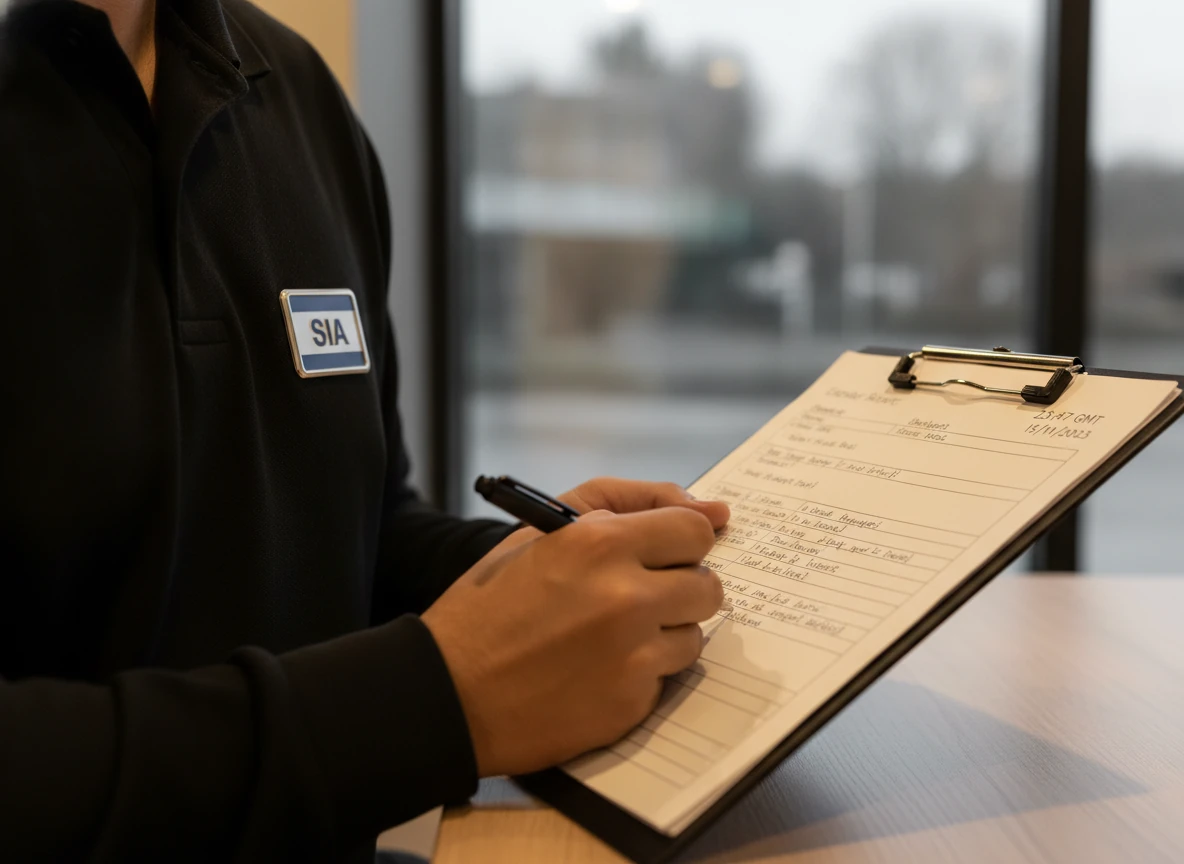
Your incident report should include: date and time, location, names and SIA numbers of staff involved, a factual account (no opinion, no speculation), witness details, first-aid administered, police reference number, and CCTV timestamps preserved. File it the same shift. Memories rot fast, and a report written three days later reads that way to a solicitor.
On CCTV: note the exact timestamp and flag the footage to your DPS or manager immediately. Retention periods are set by your premises licence conditions and UK GDPR proportionality — many licences specify 31 days, but check yours, because once it is overwritten it is gone.
A door supervisor’s notebook is one of the most valuable pieces of evidence a court will see. Treat it like one. Write in it at the time, not from memory. If you make a mistake, put a single line through the error and initial it — do not obliterate it, do not tear the page out, and do not leave gaps between entries. A neatly corrected notebook is credible in a witness box. A tidied-up one is not.
Welfare — yours and your team’s
Attending a serious knife incident is not a normal night’s work, no matter how experienced you are. Post-incident welfare is one of the weakest links in the industry’s response chain, and it costs nothing to fix.
As good practice, managers should offer a debrief in the days after the incident, signpost employee assistance schemes if the contractor runs one, and — critically — never pressure staff back onto the same door the next night without checking in. Trauma responses can be delayed by days or weeks. A door supervisor who has patched up a stab wound on Saturday is not automatically fit to work Sunday, and pretending otherwise is how good operators lose good staff.
The fundamentals do not change
Trained staff. Working CCTV. A written entry policy. The discipline to log what happens. Local intelligence from your force’s licensing officer. That combination is what every venue needs, whether you are on a quiet market square or a Friday-night hospitality strip. The postcode may change the odds. It does not change the fundamentals.
If you are new to the door — or if the search-and-scene material above felt unfamiliar — a proper door supervisor training course covers the first-aid, conflict management and legal-basis content this piece assumes you already have. It is the fastest way to close the gap.
If you already hold a badge and your renewal is coming up, the SIA Top-Up Refresher Training for Door Supervisors is the course you need — not the initial six-day qualification. Leaving it late risks a gap in your licence and a gap in your earnings.