





Knife-enabled robbery offences across England and Wales remain at concerning levels, according to newly published Home Office statistics covering the year ending March 2026. For door supervisors working the late shift, the figures aren’t just numbers on a Whitehall spreadsheet — they shape how you search, who you watch, and when you pick up the phone to police.
This isn’t a story about panic. It’s a story about pattern recognition. Knife crime clusters. It clusters by time, by place, and by venue type. The supervisors who know the pattern stay ahead of it.
What the Home Office Figures Actually Show
The Home Office releases police-recorded knife-enabled robbery data annually, broken down by force area. The year ending March 2026 release continues a trend that’s been visible since the post-pandemic period: knife-enabled robbery offences are sitting well above pre-2020 baselines, with the bulk of incidents concentrated in metropolitan force areas.
According to the published data, the Metropolitan Police, West Midlands, and Greater Manchester forces continue to record the highest volumes. That’s not a surprise — population density drives the raw numbers. But per-capita rates in some smaller cities are also climbing, which matters if you work in a Birmingham, Liverpool, Nottingham, or Leicester venue.
Importantly, the statistics measure recorded offences. Under-reporting is a known issue, particularly for robberies that happen near, but not inside, licensed premises.
Where and When these Offences Cluster
Home Office and ONS analysis over the past several years has consistently shown three patterns relevant to door teams:
- Time of night. The bulk of knife-enabled robberies in the night-time economy cluster between 11 pm and 4 am — peak chuck-out and post-chuck-out windows.
- Location. Offences often occur within a short walk of licensed premises rather than inside them. Bus stops, taxi ranks, side streets and ATMs are common flashpoints.
- Victim profile. Lone customers — particularly intoxicated lone customers — are disproportionately targeted on the walk home.
For a door supervisor, that means the risk window doesn’t end when someone steps off your premises. How you manage dispersal matters as much as how you manage entry.
Recommended Reading: New Reality of Door Supervisors
What SIA Training Says about Elevated Knife-Crime Areas
The SIA’s Door Supervisor specification has, since the 2021 syllabus refresh, placed greater emphasis on terror threat awareness and edged-weapon recognition. The principles are straightforward, but worth repeating when local knife crime is elevated:
Search Protocols
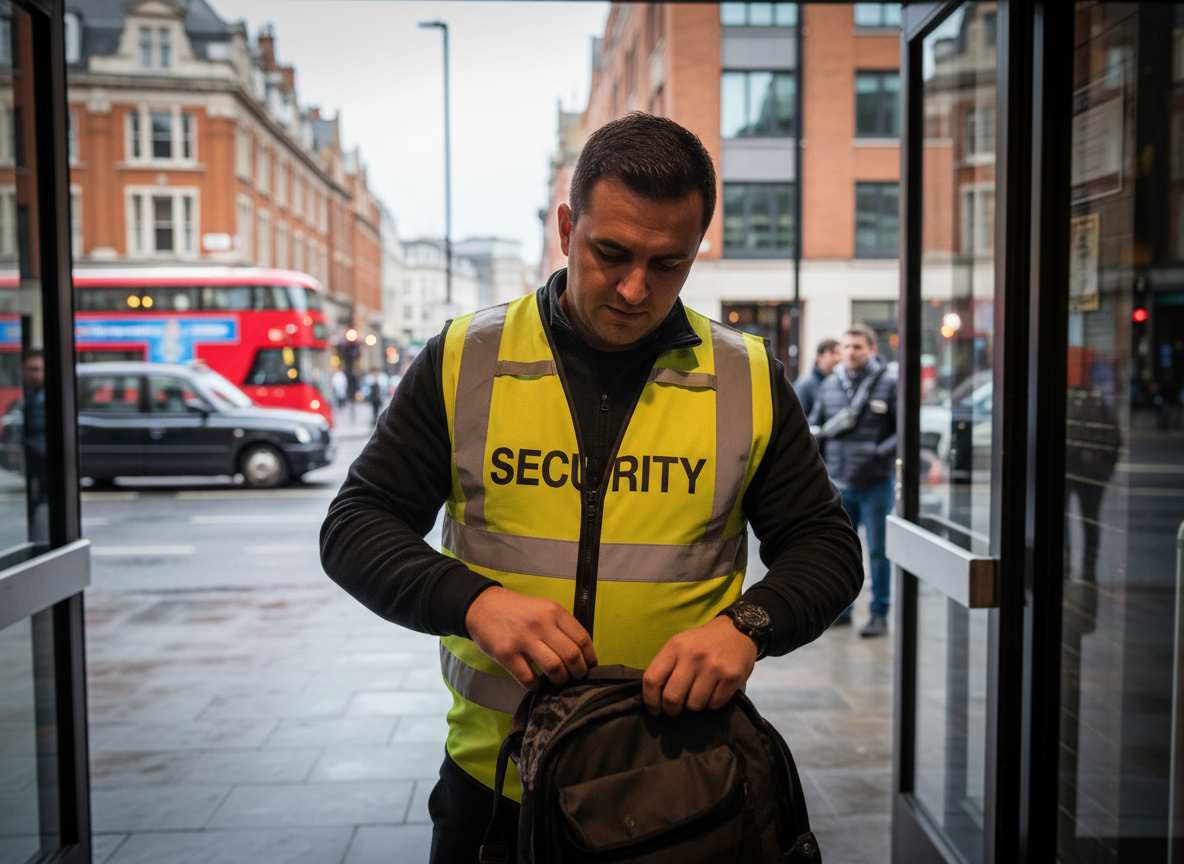
Searches must be proportionate, consensual where required, and conducted in line with your venue’s documented policy. When local intelligence suggests heightened knife risk — for example, a recent incident in your postcode or a police request to step up searching — your designated premises supervisor should be authorising a documented escalation, not a freelance change at the door.
Random search percentages, wanding, and bag checks all need to be applied consistently. Selective searching that appears to target customers by ethnicity is both unlawful and operationally useless.
Identifying Concealed Weapons
SIA training covers the visual cues — unusual gait, repeated touching of a waistband or pocket, reluctance to remove a jacket — but these are indicators, not proof. A trained door supervisor uses them to justify a closer conversation or a search, not to make accusations.
When to Call the Police
This is the bit that separates experienced supervisors from new ones. Police would rather attend a precautionary call than a stabbing. Specifically, consider an early 999 or 101 call when:
- You’ve refused entry to someone you reasonably believe is carrying a weapon, and they remain in the immediate vicinity.
- You’ve recovered a knife or bladed article during a search, and the person has left the queue.
- A group has been involved in a dispute inside your venue, and tensions appear to be continuing outside.
- You’ve received credible information from a colleague, customer, or neighbouring venue about a specific threat.
Document the call. Log the time, the call handler reference, and what you reported. If something escalates later, that log is your protection — and the prosecution’s evidence.
Practical Steps for the Next Twelve Months
If you run a venue or manage a door team, the March 2026 figures are a prompt to review three things:
- Your search policy. When was it last reviewed? Does it reflect current local crime patterns? Is it documented and trained out?
- Your dispersal plan. Are taxi ranks lit and visible? Do you have a designated meeting point for lone customers? Is there a relationship with the local Pubwatch or Business Improvement District?
- Your team’s refresher training. SIA door supervisor training covers the fundamentals, but a sharp team revisits edged-weapon awareness annually, not just at licence renewal.
The Home Office data tells a national story. Your job is to read the local chapter — what’s happening on your street, in your postcode, on your shift — and adjust accordingly. The supervisors who do that don’t make the news. Which is exactly the point.
The Bottom Line
Knife-enabled robbery isn’t a problem you can solve from the door of a venue. But you can make your premises and the area around it a place where offenders calculate the risk and walk on. That calculation is built on visible, professional, consistent door work — and on a team that calls the police early, searches by policy, and treats every shift like the stats matter. Because, increasingly, they do.