

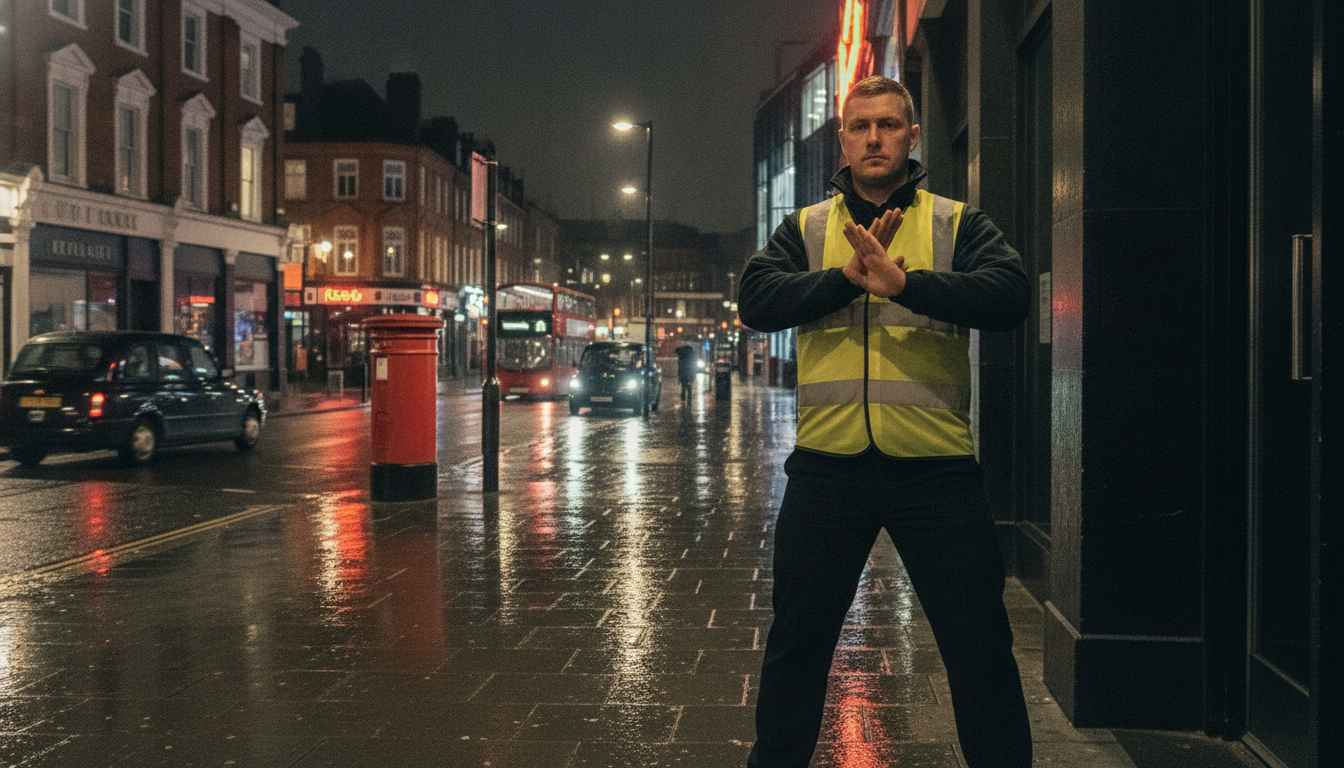


Every door supervisor and security guard in the UK learns the same three-stage de-escalation model during their SIA training course. You sat through the slides. You did the role-play. You ticked the box. Then you went to work — and the first time someone screamed in your face, half of it walked out of your head.
That’s normal. De-escalation is a skill, not a memory test. And with the SIA sharpening its enforcement priorities for 2026–2029, how you handle aggressive customers — and how you log it afterwards — matters more than ever.
Here’s the three-step model, revisited for the real world.
Step 1: Create Distance — Before You Say A Word
The first stage isn’t verbal. It’s spatial. Before your mouth opens, your feet should already be moving.
Most physical incidents on UK doors start within an arm’s length. Step back. Angle your body at 45 degrees — not square-on, which reads as a challenge, and not side-on, which leaves you off-balance. Hands visible, around chest height, palms open. This is the fence position your trainer drilled into you.
Why it works:
- It gives you reaction time if things turn physical.
- It de-triggers the aggressor — you look calm, not combative.
- Witnesses and CCTV see a professional, not a brawler. That matters in court.
What It Looks Like In Real Settings
Venue door: A refused punter steps into your space. You step back into the doorway, hands up, partner moves to your shoulder. You haven’t said anything yet — and you’ve already de-escalated 40% of the threat.
Retail: A shoplifter is cornered near the exit. Don’t block them with your body. Step to one side. Give them an out. Most retail violence happens when staff make a thief feel trapped.
Lone working: A drunk customer follows you to the back office. Don’t retreat into a confined space. Stay in the open, near a camera, with a clear route out.
Step 2: Verbal Technique — Calm, Short, Repeated
Now you talk. But not the way you talk to your mates.
The model your SIA trainer taught you boils down to four habits:
- Lower your volume. If they’re shouting, you go quieter. It forces them to listen.
- Use their name if you know it. First names dissolve aggression faster than any other word.
- Acknowledge, don’t agree. “I can see you’re frustrated” is not the same as “you’re right”. One de-escalates. The other commits you.
- Offer a clear choice with a face-saving exit. “You can finish your drink and head off, or I’ll have to call it in. Up to you.”
The trap most new officers fall into is arguing the facts. Don’t. An aggressive customer is not in a logical state. You’re not trying to win the argument — you’re trying to lower the temperature long enough for them to leave or comply.
The goal isn’t to be right. The goal is to be done.
Phrases That Work
- “I hear you. Let’s sort this out.”
- “I’m not here to argue with you. I’m here to do my job.”
- “What would make this easier for you right now?”
Phrases That Make It Worse
- “Calm down.” (Nobody in history has ever calmed down on command.)
- “Mate, you’re being ridiculous.”
- Anything sarcastic. They will remember it. So will the bodycam.
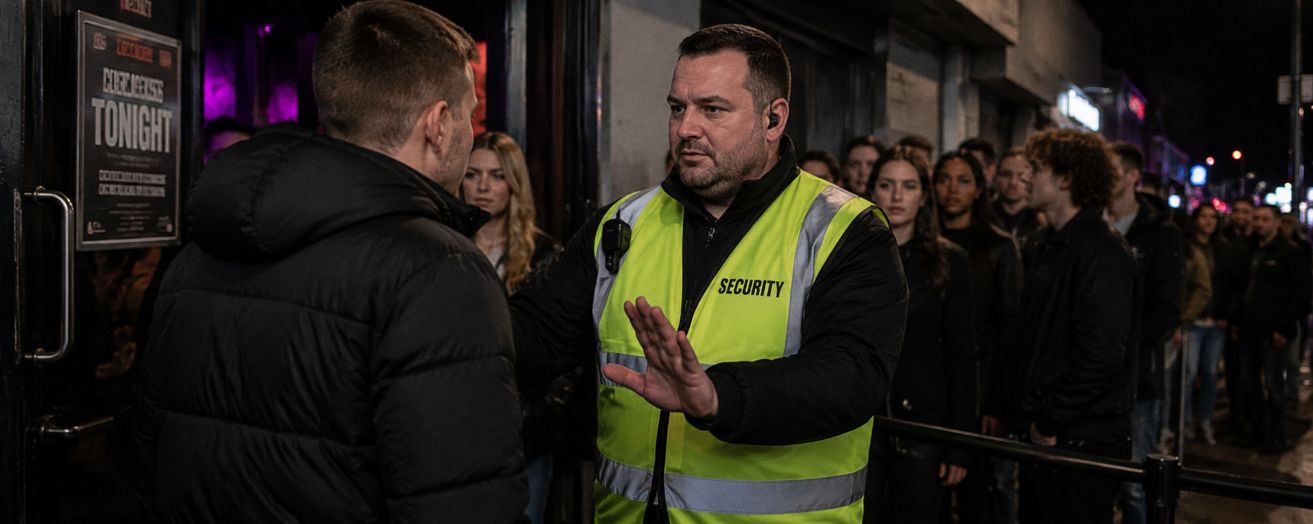
Step 3: Controlled Disengagement — Knowing When To Stop Talking
The third stage is the one nobody practises and everybody needs.
De-escalation has a shelf life. If you’ve stepped back, kept your voice down, offered a way out, and they’re still escalating — keep talking is no longer the answer. Disengage.
That means:
- Call for backup or police. Do it visibly. Often the act of picking up the radio ends the incident.
- Withdraw to a defensive position — behind a counter, into a doorway, towards your colleagues.
- Stop trying to resolve it. Containment is now the job, not resolution.
This is the stage where ego gets people hurt. You are not paid to win the encounter. You are paid to manage risk until someone with more authority — or more backup — takes over. The lessons from what happened in Dublin when restraint went wrong are a sharp reminder of what the consequences look like when that line gets crossed.
When De-Escalation Fails: The Legal Picture
If a physical incident follows, the law looks at what you did before the contact almost as closely as the contact itself.
Under Section 3 of the Criminal Law Act 1967, you can use reasonable force to prevent crime or make a lawful arrest. “Reasonable” is judged on what you genuinely believed at the time — but courts and the SIA will ask: did you try to talk it down first? Did you create distance? Did you have a way out you didn’t take?
If your answer to all three is yes, you’re on solid ground. If you went straight to hands-on, you’ve got a problem — even if the customer swung first.
Why Your Incident Log Matters More In 2026
The SIA has signalled that its 2026–2029 enforcement cycle will lean harder on documented compliance — not just whether you have a valid SIA licence, but whether your employer can show consistent, professional handling of incidents across their workforce.
That means your incident log is no longer just paperwork. It’s evidence. Write it like a barrister will read it — because one might.
Good incident notes include:
- Time, location, and who was present.
- What you saw and heard, in order — not what you concluded.
- The de-escalation steps you took, in the language of your training.
- The point at which force became necessary, and why.
- Witnesses, CCTV references, bodycam timestamps.
“He was being aggressive so I removed him” is not a log entry. It’s a liability.
Recommended Reading: Writing Professional Security Reports
The Bottom Line
The three-step model — distance, verbal, disengage — isn’t a script. It’s a habit. The officers who use it well aren’t the ones with the best memory of the training manual. They’re the ones who’ve practised it enough that it kicks in before the adrenaline does.
If you haven’t reviewed it since your course, now’s the time. Run through it with your colleagues before your next shift. Talk through the last incident you had and ask which step you skipped. That ten minutes of conversation is worth more than any refresher slide deck.
Because when it goes wrong at 1 am on a wet Saturday, you won’t rise to the occasion. You’ll fall to the level of your training.
Sharpen Your Skills — Or Get Started In The Industry
Whether you’re refreshing the basics or stepping into security for the first time, your training is the difference between a clean log and a court summons.
Book your SIA door supervisor course with Get Licensed and learn the techniques that actually hold up on the door — and on the page.