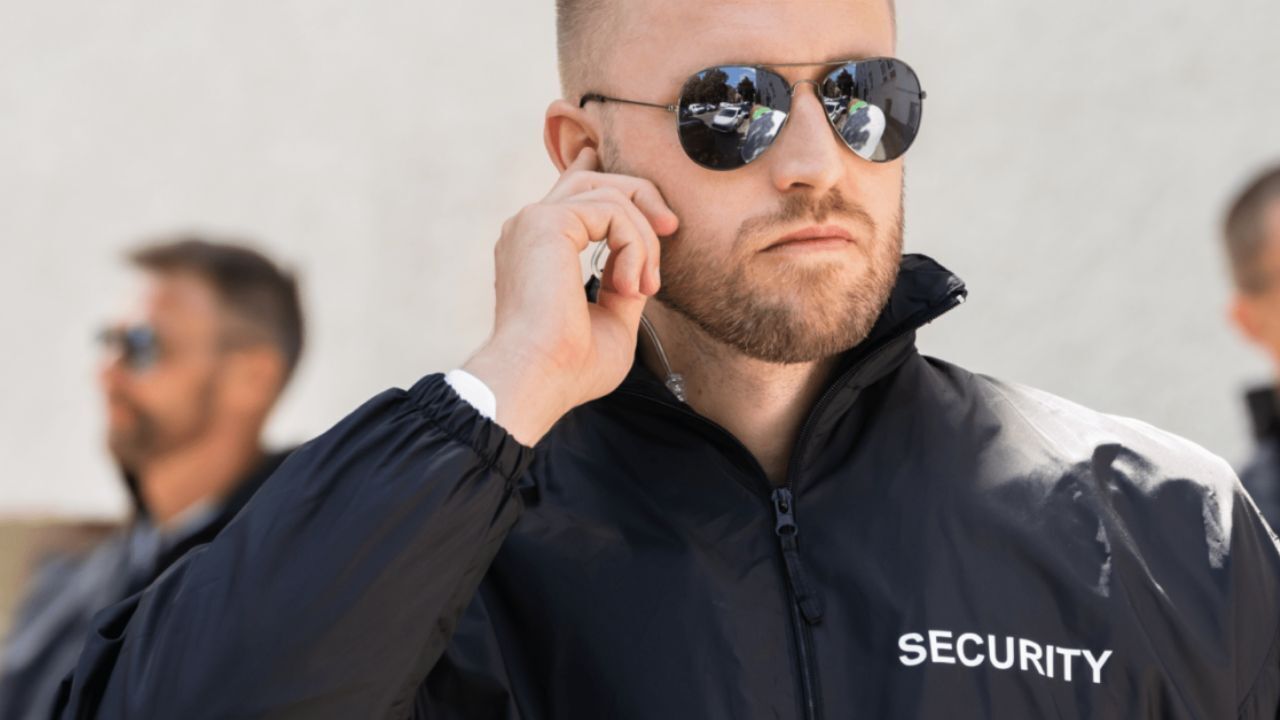
Your next shift might involve a colleague you’ve never met: an algorithm. Door supervisors are already working alongside live facial recognition at supermarket entrances, and police forces are rolling out their own AI tools for investigations.
North Yorkshire Police recently moved to reassure the public about one such tool — a sign of the direction policing is heading in, even if the specific tool in question isn’t one private security will be handling directly.
Retail and event security are adopting AI on their own track already, separate from what police forces are doing. Sainsbury’s has moved past trialling; its Facewatch system is now live in more than 55 stores and set to expand to as many as 200 by the end of 2026. Facewatch is live in hundreds of UK shops more broadly. Auror is helping some retailers flag repeat offenders across their own store networks.
If you hold an SIA licence, the tech is coming for your workflow, whether you asked for it or not.
What AI Is Actually Doing On The Frontline Right Now
Forget the sci-fi. The AI showing up in UK security work is fairly narrow and fairly practical. Four flavours dominate.
AI-Assisted CCTV
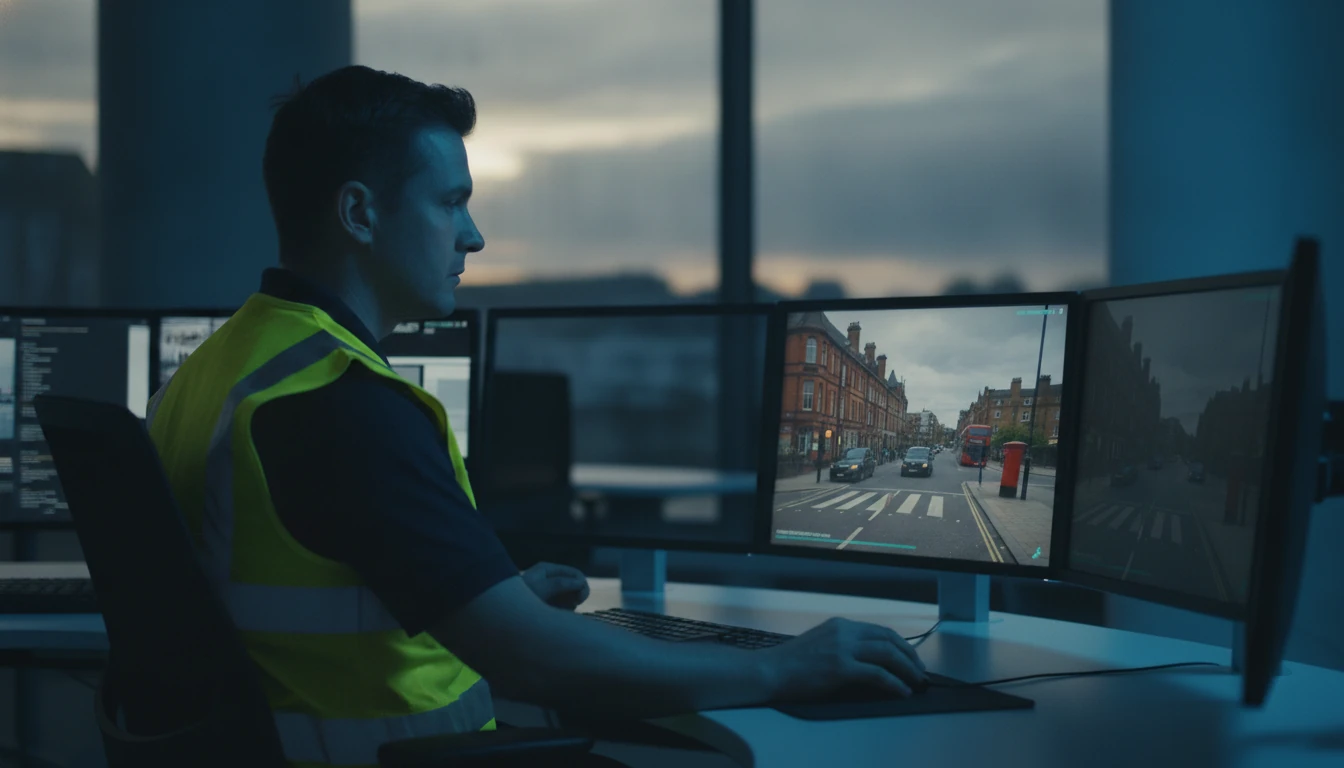
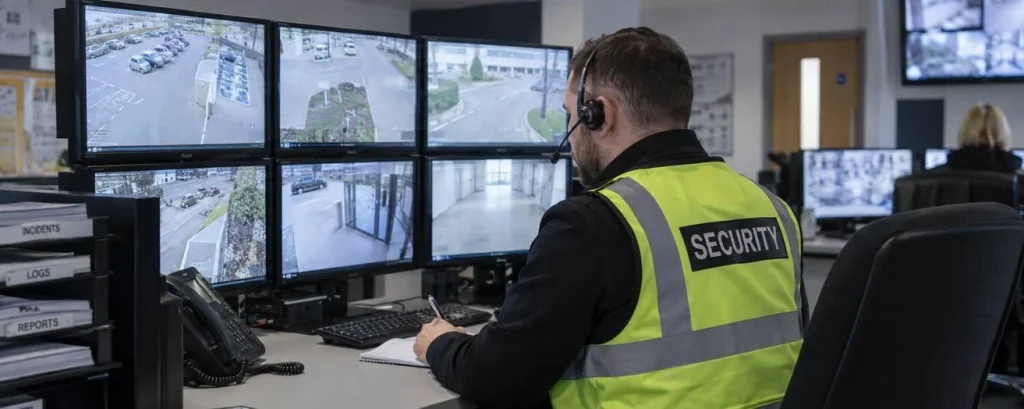
Instead of an operator watching 40 screens hoping to spot trouble, some systems flag the trouble first: someone loitering by a fire exit, a bag left too long, a face that matches a watchlist. The operator still makes the call, but the alert lands in front of them, not buried in a wall of pixels.
If this is the direction you want your career to go, it’s worth reading about how CCTV operator training can build your career in this space.
Live Facial Recognition (LFR)
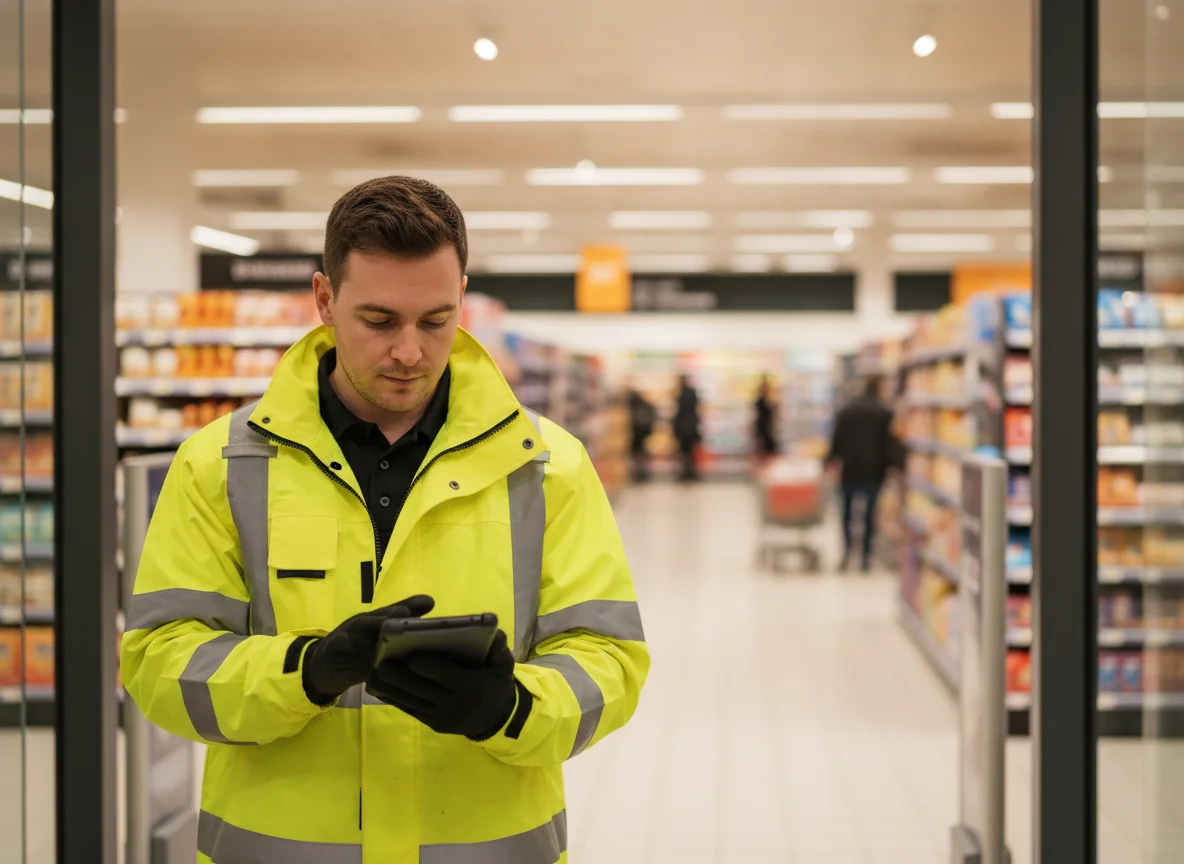
Cameras at entrances scan faces against a watchlist of banned or wanted individuals. If there’s a match, staff get a ping. Sainsbury’s, Home Bargains and Southern Co-op have all deployed versions. The Metropolitan Police have deployed LFR vans across London, backed by Home Office funding.
Retailer-Wide Intelligence Platforms
Tools like Auror let a single retailer share suspect profiles across its own store network — but, by design, not with competing chains. A shoplifter banned from a Boots in Leeds can be flagged the moment they walk into a Boots in Bristol, but that watchlist stops at Boots’ own front door.
AI-Assisted Weapon Detection
Knife arches and AI-powered scanners are increasingly appearing at office buildings, event venues and hospitality sites, flagging concealed weapons before someone reaches the door.
This is worth treating with real caution rather than blind trust: a 2026 analysis from the Alan Turing Institute’s Centre for Emerging Technology and Security found that AI weapons-detection systems have a documented history of failures, including a case where a scanner failed to detect a weapon before a fatal stabbing, and a more recent US case where a packet of crisps was misidentified as a firearm.
If your site deploys this tech, treat every alert the same way you’d treat an LFR match: as a prompt to look, not a verdict to act on.
The Police AI Factsheet & Why It Matters To Private Security
The government’s Police AI Factsheet sets out where UK forces are being encouraged to use AI, including facial recognition and automated numberplate recognition to identify suspects, triaging digital evidence and 999/101 calls, and back-office tasks like note-taking and transcription. The Home Office frames it as productivity gains: officers freed up from admin, faster identification of suspects, better use of scarce resources.
When you work in partnership with a local force, for e.g. event stewarding, retail loss prevention, or licensed premises, you may increasingly be handed AI-generated intelligence, from ANPR flags to facial-recognition matches. Some police AI, like North Yorkshire’s new CCTV search tool, is used internally for investigations rather than shared operationally with private security, but it signals where force priorities and budgets are heading.
That means two things. One, you need to understand where the alert came from. Two, you need to know what the law says you can and can’t do about it.
The Legal And Ethical Bit: Acting On An AI Alert
An AI flag is not evidence. It is not grounds to detain. It is a prompt for a trained human to make a judgement. The ICO has consistently taken the position that facial recognition matches should be treated as intelligence, not proof, and that any action taken must meet the same legal thresholds as if the AI wasn’t there.
In practical terms, for a door supervisor or retail officer, that means:
An LFR match is a reason to look, not a reason to grab.
You still need reasonable grounds under common law or the Police and Criminal Evidence Act to detain a suspected shoplifter.
Refusing entry to a venue based on a watchlist match must be handled the same as any other refusal — polite, documented, and free from discriminatory application.
You should never share images or personal data from an AI system with anyone outside your authorised chain of command.
Get this wrong, and the consequences are real. Wrongful detention claims. Data protection complaints. SIA licence reviews. The tech is new; the liabilities are not.
The Skills That Will Make You More Employable
If you want to stay ahead of the curve and command a better day rate, start building competencies now. Employers running AI-enabled sites are already asking for them.
Digital Literacy
You don’t need to code. You do need to be comfortable navigating dashboards, acknowledging alerts, logging incidents into a digital system, and understanding what a “confidence score” on a facial match actually means.
Data Protection Awareness
UK GDPR isn’t going anywhere. A basic understanding of lawful bases for processing, retention periods for CCTV footage, and subject access requests is now baseline knowledge for any officer working with AI systems.
Report-Writing That Stands Up In Court
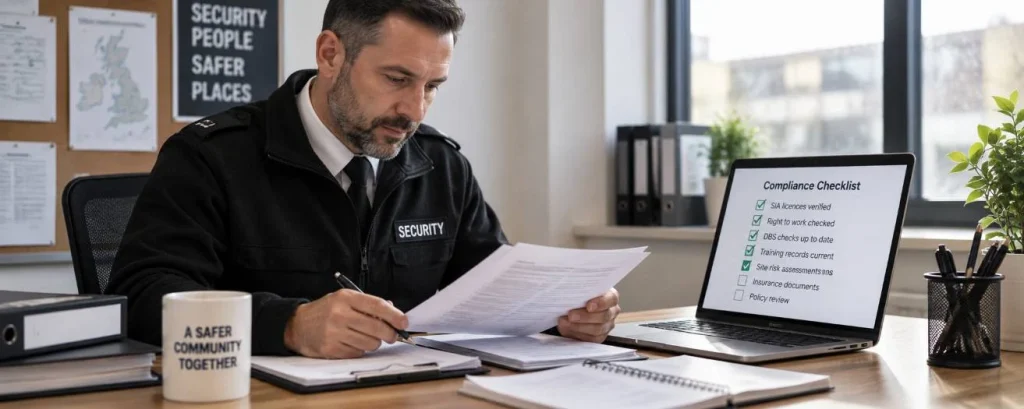
When an incident starts with an AI alert, your report needs to record that clearly. What system flagged it. What you observed independently. What action you took and why. Vague reports get torn apart in cross-examination.
De-Escalation
Ironically, the more AI enters the industry, the more valuable human soft skills become. Anyone can respond to a ping. Not everyone can talk a wrongly-flagged shopper down from a public row without it ending up on TikTok. De-escalation is a security skill you can’t miss out on.
How To Put This On Your CV And Licence Renewal
SIA licence renewals don’t currently ask about AI competency directly, but employer expectations are shifting fast. When updating your CV or LinkedIn, name the systems you’ve worked with. “Experienced with Facewatch alerts and incident escalation procedures” tells a hiring manager far more than “CCTV monitoring.”
If your employer offers training on a new AI platform, take it and get the certificate. If they don’t, ask. Continuing professional development is quietly becoming the dividing line between officers who get the premium contracts and those who don’t. Consider adding short online courses in data protection basics or digital evidence handling. And if your SIA licence is due for renewal, make sure your mandatory refresher training is booked well ahead of the deadline.
The Bottom Line
AI isn’t replacing security officers. It’s replacing the officer who refuses to learn it. The frontline in 2026 will belong to people who can work alongside the tech, understand its limits, and still bring the human judgement no algorithm can fake.
Get familiar now. Ask questions on shift. Read the guidance your employer puts out. The officers treating this as a threat will be the ones squeezed out. The ones treating it as an upgrade to their toolkit will be the ones running the control room, and if AI-enabled monitoring is where you want your career to head next, explore the SIA CCTV Operator licence as your entry point into that side of the industry.
This blog is for informational purposes only. Please verify details independently before making decisions. Get Licensed is not liable for any actions based on this content.
Maryam explores security career opportunities, licensing processes, and industry developments. She provides clear, accessible guidance for individuals entering or progressing within the sector. Her work inspires confidence for learners taking their first steps into security careers.
Your next shift might involve a colleague you’ve never met: an algorithm. Door supervisors are already working alongside live facial recognition at supermarket entrances, and police forces are rolling out their own AI tools for investigations.
North Yorkshire Police recently moved to reassure the public about one such tool — a sign of the direction policing is heading in, even if the specific tool in question isn’t one private security will be handling directly.
Retail and event security are adopting AI on their own track already, separate from what police forces are doing. Sainsbury’s has moved past trialling; its Facewatch system is now live in more than 55 stores and set to expand to as many as 200 by the end of 2026. Facewatch is live in hundreds of UK shops more broadly. Auror is helping some retailers flag repeat offenders across their own store networks.
If you hold an SIA licence, the tech is coming for your workflow, whether you asked for it or not.
What AI Is Actually Doing On The Frontline Right Now
Forget the sci-fi. The AI showing up in UK security work is fairly narrow and fairly practical. Four flavours dominate.
AI-Assisted CCTV
Instead of an operator watching 40 screens hoping to spot trouble, some systems flag the trouble first: someone loitering by a fire exit, a bag left too long, a face that matches a watchlist. The operator still makes the call, but the alert lands in front of them, not buried in a wall of pixels.
If this is the direction you want your career to go, it’s worth reading about how CCTV operator training can build your career in this space.
Live Facial Recognition (LFR)
Cameras at entrances scan faces against a watchlist of banned or wanted individuals. If there’s a match, staff get a ping. Sainsbury’s, Home Bargains and Southern Co-op have all deployed versions. The Metropolitan Police have deployed LFR vans across London, backed by Home Office funding.
Retailer-Wide Intelligence Platforms
Tools like Auror let a single retailer share suspect profiles across its own store network — but, by design, not with competing chains. A shoplifter banned from a Boots in Leeds can be flagged the moment they walk into a Boots in Bristol, but that watchlist stops at Boots’ own front door.
AI-Assisted Weapon Detection
Knife arches and AI-powered scanners are increasingly appearing at office buildings, event venues and hospitality sites, flagging concealed weapons before someone reaches the door.
This is worth treating with real caution rather than blind trust: a 2026 analysis from the Alan Turing Institute’s Centre for Emerging Technology and Security found that AI weapons-detection systems have a documented history of failures, including a case where a scanner failed to detect a weapon before a fatal stabbing, and a more recent US case where a packet of crisps was misidentified as a firearm.
If your site deploys this tech, treat every alert the same way you’d treat an LFR match: as a prompt to look, not a verdict to act on.
The Police AI Factsheet & Why It Matters To Private Security
The government’s Police AI Factsheet sets out where UK forces are being encouraged to use AI, including facial recognition and automated numberplate recognition to identify suspects, triaging digital evidence and 999/101 calls, and back-office tasks like note-taking and transcription. The Home Office frames it as productivity gains: officers freed up from admin, faster identification of suspects, better use of scarce resources.
When you work in partnership with a local force, for e.g. event stewarding, retail loss prevention, or licensed premises, you may increasingly be handed AI-generated intelligence, from ANPR flags to facial-recognition matches. Some police AI, like North Yorkshire’s new CCTV search tool, is used internally for investigations rather than shared operationally with private security, but it signals where force priorities and budgets are heading.
That means two things. One, you need to understand where the alert came from. Two, you need to know what the law says you can and can’t do about it.
The Legal And Ethical Bit: Acting On An AI Alert
An AI flag is not evidence. It is not grounds to detain. It is a prompt for a trained human to make a judgement. The ICO has consistently taken the position that facial recognition matches should be treated as intelligence, not proof, and that any action taken must meet the same legal thresholds as if the AI wasn’t there.
In practical terms, for a door supervisor or retail officer, that means:
An LFR match is a reason to look, not a reason to grab.
You still need reasonable grounds under common law or the Police and Criminal Evidence Act to detain a suspected shoplifter.
Refusing entry to a venue based on a watchlist match must be handled the same as any other refusal — polite, documented, and free from discriminatory application.
You should never share images or personal data from an AI system with anyone outside your authorised chain of command.
Get this wrong, and the consequences are real. Wrongful detention claims. Data protection complaints. SIA licence reviews. The tech is new; the liabilities are not.
The Skills That Will Make You More Employable
If you want to stay ahead of the curve and command a better day rate, start building competencies now. Employers running AI-enabled sites are already asking for them.
Digital Literacy
You don’t need to code. You do need to be comfortable navigating dashboards, acknowledging alerts, logging incidents into a digital system, and understanding what a “confidence score” on a facial match actually means.
Data Protection Awareness
UK GDPR isn’t going anywhere. A basic understanding of lawful bases for processing, retention periods for CCTV footage, and subject access requests is now baseline knowledge for any officer working with AI systems.
Report-Writing That Stands Up In Court
When an incident starts with an AI alert, your report needs to record that clearly. What system flagged it. What you observed independently. What action you took and why. Vague reports get torn apart in cross-examination.
De-Escalation
Ironically, the more AI enters the industry, the more valuable human soft skills become. Anyone can respond to a ping. Not everyone can talk a wrongly-flagged shopper down from a public row without it ending up on TikTok. De-escalation is a security skill you can’t miss out on.
How To Put This On Your CV And Licence Renewal
SIA licence renewals don’t currently ask about AI competency directly, but employer expectations are shifting fast. When updating your CV or LinkedIn, name the systems you’ve worked with. “Experienced with Facewatch alerts and incident escalation procedures” tells a hiring manager far more than “CCTV monitoring.”
If your employer offers training on a new AI platform, take it and get the certificate. If they don’t, ask. Continuing professional development is quietly becoming the dividing line between officers who get the premium contracts and those who don’t. Consider adding short online courses in data protection basics or digital evidence handling. And if your SIA licence is due for renewal, make sure your mandatory refresher training is booked well ahead of the deadline.
The Bottom Line
AI isn’t replacing security officers. It’s replacing the officer who refuses to learn it. The frontline in 2026 will belong to people who can work alongside the tech, understand its limits, and still bring the human judgement no algorithm can fake.
Get familiar now. Ask questions on shift. Read the guidance your employer puts out. The officers treating this as a threat will be the ones squeezed out. The ones treating it as an upgrade to their toolkit will be the ones running the control room, and if AI-enabled monitoring is where you want your career to head next, explore the SIA CCTV Operator licence as your entry point into that side of the industry.
This blog is for informational purposes only. Please verify details independently before making decisions. Get Licensed is not liable for any actions based on this content.
Maryam explores security career opportunities, licensing processes, and industry developments. She provides clear, accessible guidance for individuals entering or progressing within the sector. Her work inspires confidence for learners taking their first steps into security careers.