




Iceland boss Lord Richard Walker has done something most retail bosses only mutter about over a pint: he’s tabled a bill in the House of Lords to let trained, licensed retail security staff carry truncheons and pepper spray. According to Retail Gazette, the private members’ bill lands at a moment when shop theft is at record highs and retail workers are being assaulted in numbers the industry hasn’t seen before.
So, should retail guards actually be carrying CS spray on the shop floor? And if Parliament said yes tomorrow, what would it mean for your SIA licence, your training, and your liability the next time someone kicks off in the booze aisle?
Let’s break it down.
What the Bill Actually Proposes
The bill is a private members’ bill, which means it’s introduced by an individual peer rather than the Government. Lord Walker’s proposal, as reported, would amend the law to allow SIA-licensed retail security officers to carry defensive equipment currently classed as offensive weapons or Section 5 firearms under UK law.
Specifically, it would cover:
- Truncheons or extendable batons — currently an offensive weapon to carry in public without lawful authority.
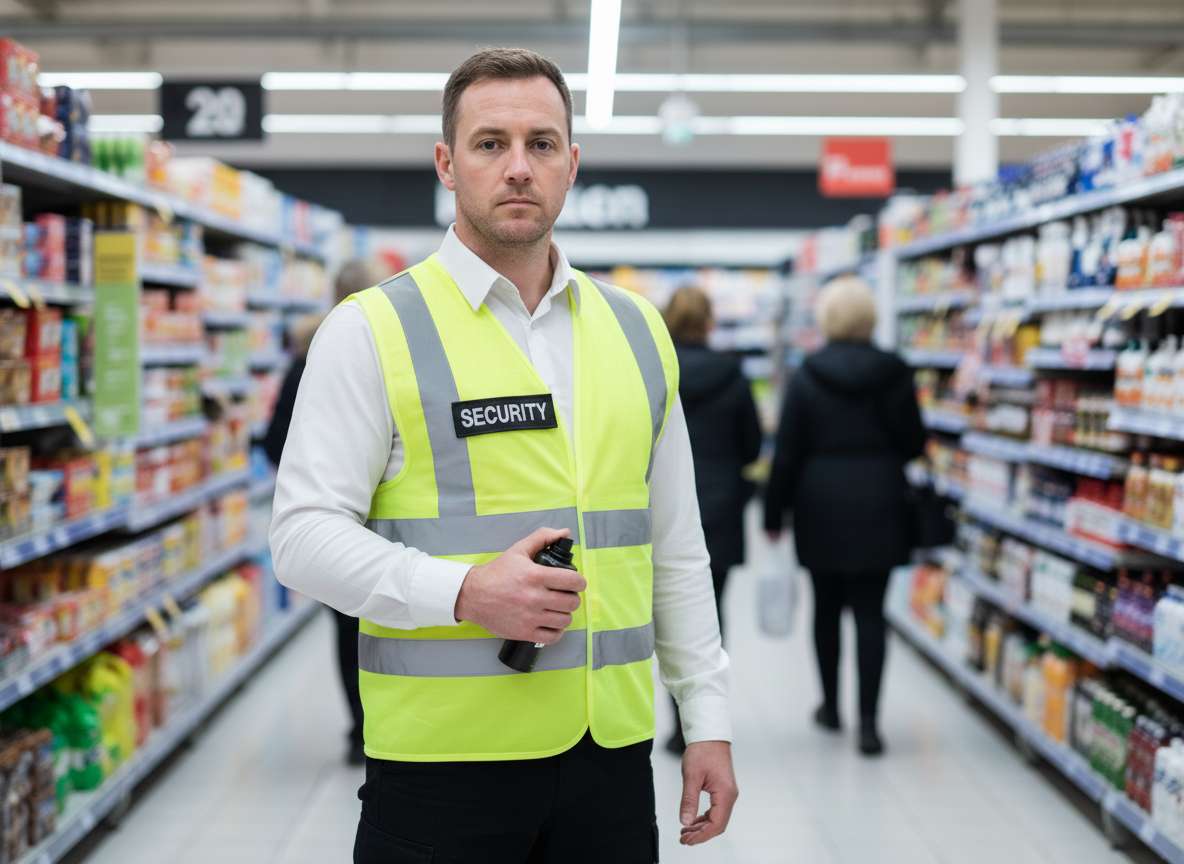
- Pepper spray (CS or PAVA) — currently a prohibited firearm under Section 5 of the Firearms Act 1968, carrying up to 10 years inside for unlawful possession.
The bill stops well short of arming guards with anything police-grade as standard. The framing is defensive equipment for trained professionals operating in high-risk retail environments — not a free-for-all.
Why Now? The Retail Crime Backdrop
This isn’t a thought experiment. The British Retail Consortium’s most recent figures put incidents of violence and abuse against retail workers at over 2,000 a day. Shop theft recorded by police has hit its highest level since records began. Iceland itself has been vocal that frontline staff are routinely threatened with needles, knives and worse.
The bill also arrives in the slipstream of the Crime and Policing Act 2026, which created a standalone offence of assaulting a retail worker — something the sector campaigned for over the years. Lord Walker’s argument, broadly, is that creating a new offence is useful after the fact, but it doesn’t stop the punch landing in the first place.
His pitch: give the people standing between the offender and the shop assistant the tools to actually deter and, if necessary, defend.
Recommended Reading: Retail Crime Prevention Strategies
What It Would Mean for SIA-Licensed Officers
If — and it’s a big if — the bill became law, the practical effect on the door supervisor and retail security workforce would be significant. Industry observers expect any workable version to include a tiered licensing model, on top of the existing SIA framework. This also would drastically affect what security guards can and cannot do currently.
A New Licence Endorsement
The most likely route is an additional endorsement to the SIA Security Guarding or Door Supervisor licence — let’s call it a “Retail Defensive Equipment” tier. To earn it, you’d almost certainly need:
- Enhanced use-of-force training, well beyond current physical intervention modules.
- Specific training on deployment, retention and aftercare for pepper spray.
- Annual refresher and competency testing.
- Likely an enhanced DBS check and possibly medical/psychological screening.
In other words, this would not be a freebie bolt-on. Expect a separate course, separate fee, and a much higher bar than the standard door supervisor training course.
Use-of-Force Exposure
Here’s where it gets serious. Carrying defensive equipment hugely raises your legal exposure if you use it. Section 3 of the Criminal Law Act 1967 lets you use reasonable force — but “reasonable” is judged in hindsight, by a jury, with all the time in the world to second-guess a two-second decision.
Spray someone who turns out not to have been a threat, and you’re not just facing an SIA review. You’re potentially facing assault charges, a civil claim, and the end of your career in the industry.
Any officer carrying pepper spray would need to be rock-solid on:
- The legal threshold for deployment.
- Documenting and reporting every use, every time.
- De-escalation as the default — spray as the last option, not the first.
The Objections
The bill has critics, and not just the ones you’d expect.
The Police Federation has historically been cautious about expanding who can carry defensive sprays, citing the risk of weapons being taken off staff and used against them or the public. There’s also the question of public perception — pepper spray on the shop floor is a long way from the British retail experience most shoppers expect.
Civil liberties groups will argue that arming private staff with chemical weapons blurs the line between policing and private security in a way the UK has historically resisted.
And then there’s the practical concern: training a workforce of tens of thousands to a standard high enough to deploy CS spray safely is a serious undertaking. The SIA would need significant new resourcing.
Will It Actually Pass?
Honestly? Private members’ bills in the Lords rarely become law without Government backing. Most run out of parliamentary time. The Home Office has not, at the time of writing, signalled support, and the political appetite for being seen to “arm shop guards” is — to put it mildly — limited.
But the bill isn’t pointless. It puts the issue on the record, forces a Lords debate, and pressures Ministers to say publicly what they plan to do about retail violence beyond the new assault offence. That alone shifts the conversation.
For working security officers, the realistic short-term outcome is not pepper spray on your belt. It’s more pressure for better body armour, better radio links to police, better lone-worker tech, and stronger employer backing when you do use lawful force. All of which matters — and all of which is already overdue.
The Bottom Line for Retail Security Staff
If you’re working in retail security right now, nothing changes today. You can’t carry a baton. You can’t carry a spray. Doing so remains a serious criminal offence, regardless of who you work for or what your manager hints at.
What you can do is keep your training current and renew your licence if it’s about to expire, know exactly where the legal use-of-force line sits, and watch this bill’s progress. If it does gain traction, the officers best placed to benefit will be the ones who already have a clean record, current SIA licence, and demonstrable physical intervention training on their CV.
Whether or not Lord Walker’s bill survives the parliamentary mincer, the underlying message is one the industry should welcome: retail security is no longer a soft posting. It’s frontline work. The conversation about how we equip and protect the people doing it is finally happening in the right rooms.