




The wait is over. The Home Office has published the statutory guidance for the Terrorism (Protection of Premises) Act 2025 — better known as Martyn’s Law. If you run security at a pub, a stadium, a shopping centre or a village hall that hosts the occasional wedding, this is the document that tells you what good looks like.
And yes, it has teeth. The Security Industry Authority is being set up as the regulator, and getting it wrong won’t just mean a stern letter. It could mean fines, enforcement notices, and questions you really don’t want to answer after an incident.
Here’s what frontline security teams actually need to do.
Is Your Venue In Scope?
The guidance splits qualifying premises into two tiers, based on how many people could reasonably be expected on site at the same time.
- Standard tier: premises with a capacity of 200 to 799 people.
- Enhanced tier: premises and events with a capacity of 800 or more.
That covers a much wider sweep of the UK than most people realise. Pubs, clubs, theatres, hotels, places of worship, sports grounds, conference centres, libraries, leisure centres, hospitals, schools (in some cases), visitor attractions — if the public can get in, and the numbers stack up, you’re in.
Capacity is judged on what your venue can hold, not what shows up on a quiet Tuesday. The guidance is clear that operators need to do an honest assessment of maximum occupancy across all spaces under their control.
Recommended Reading: Martyn’s Law Guide For Venue Operators
Who is the ‘Responsible Person’?
Every qualifying premises must have a named responsible person — usually the person who controls the premises, whether that’s a freeholder, leaseholder, or event organiser. For most venues, this is the operator or duty holder. For events, it’s whoever is running the event itself.
If you’re a door supervisor reading this, the responsible person is almost certainly your boss’s boss. But the duties trickle down to you — because they have to be delivered on the floor, not on a spreadsheet.
Standard Tier: The Basics
According to the Home Office guidance, standard-tier premises must put in place ‘reasonable and proportionate’ public protection procedures. In practice, this means having simple, well-rehearsed procedures for four scenarios:
- Evacuation — getting people out safely.
- Invacuation — bringing people in or moving them to a safer part of the building when leaving would be more dangerous.
- Lockdown — securing the premises against a threat trying to get in.
- Communication — alerting staff and the public quickly and clearly.
The good news for smaller venues: the standard tier is deliberately low-cost. You don’t need to buy bollards or hire armed guards. You need a written plan, staff who know it, and the ability to act on it. That’s it.
The bad news: ‘staff who know it’ means actual training and actual drills. Briefing your team once in the pre-shift huddle won’t cut it when the regulator comes knocking.
Enhanced Tier: Where It Gets Serious
If your venue holds 800 or more, the guidance ramps up considerably. Enhanced-tier duties include everything in the standard tier, plus:
- A documented assessment of the types of terrorist acts that could reasonably occur at the premises.
- Public protection measures — physical, procedural and behavioural — designed to reduce vulnerability and the impact of an attack.
- A designated senior individual responsible for compliance.
- A formal document recording the measures in place, kept up to date and provided to the SIA on request.
This is where the conversation shifts from ‘have a plan’ to ‘have a security strategy.’ Enhanced-tier venues need to think about monitoring, search regimes, physical security, vehicle mitigation where relevant, and how staff are trained to spot hostile reconnaissance.
What ‘Reasonable and Proportionate’ Really Means
This is the phrase that does a lot of heavy lifting in the guidance. It is not a fixed standard. A 250-capacity community hall is not expected to do what an 80,000-capacity stadium does.
The Home Office expects operators to consider the size and nature of the premises, the activities taking place, the likely audience, and the resources available. If a measure is cheap, effective and obvious — like locking a back door during an event — you’re expected to do it. If it would cost six figures and barely move the needle, you probably aren’t.
The bar is sensible, not crippling. But you must be able to justify your choices.
What Door Supervisors and Venue Security Teams Should Do This Week
If you work the door or manage a venue security team, here’s a practical starting list:
- Confirm your tier. Get a clear, written answer on whether your venue is standard or enhanced. Don’t guess.
- Read the guidance. Yes, all of it. It’s not long, and ignorance won’t be a defence.
- Map your procedures. Evacuation, invacuation, lockdown, communication. Write down what you’d actually do, room by room.
- Drill the team. Tabletop exercises cost nothing. Run one this month.
- Check ACT training. Every member of the security team should have completed the free ACT Awareness e-learning from Counter Terrorism Policing. It is the obvious baseline.
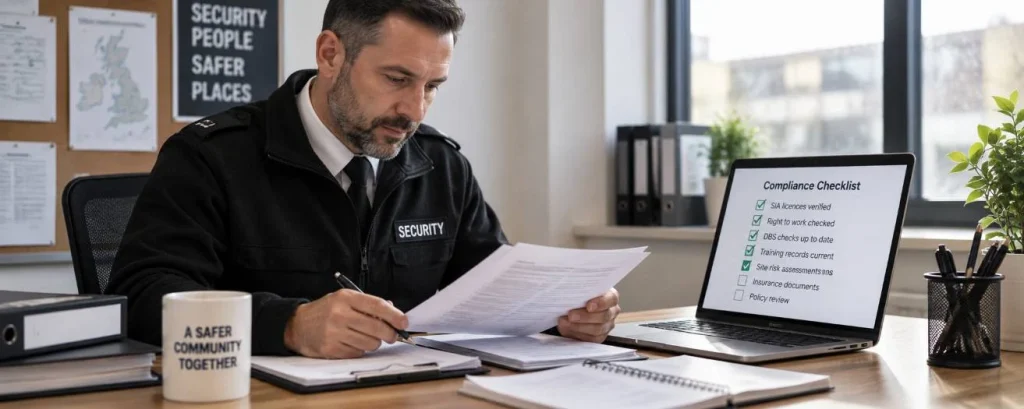
- Document everything. If it isn’t written down, it didn’t happen — especially when the regulator asks.
Recommended Reading: Martyn’s Law Guide For Security Officers
What Happens If You Ignore It?
The SIA, in its new regulatory role, will have the power to issue compliance notices, restriction notices and monetary penalties. Enhanced-tier breaches can attract significant fines. Individuals — including senior managers — can face personal penalties for serious non-compliance.
More importantly, this law exists because of Martyn Hett and the 21 other people killed at the Manchester Arena in 2017. Treating it as a tick-box exercise misses the point entirely. Done properly, the guidance gives security teams the mandate and the structure to do what good operators already wanted to do — protect the public.
The Bottom Line
Martyn’s Law is no longer a future problem. The statutory guidance is live, the duties are defined, and the clock to the enforcement date is running. Standard-tier venues have a clear, achievable checklist. Enhanced-tier venues have real work to do.
If you’re a venue manager, head of security, or a door supervisor with ambitions to move up — this is your moment to lead. The teams that get ahead of this now will be the ones the industry promotes next year. The ones who wait for the SIA to come knocking won’t enjoy the conversation.