

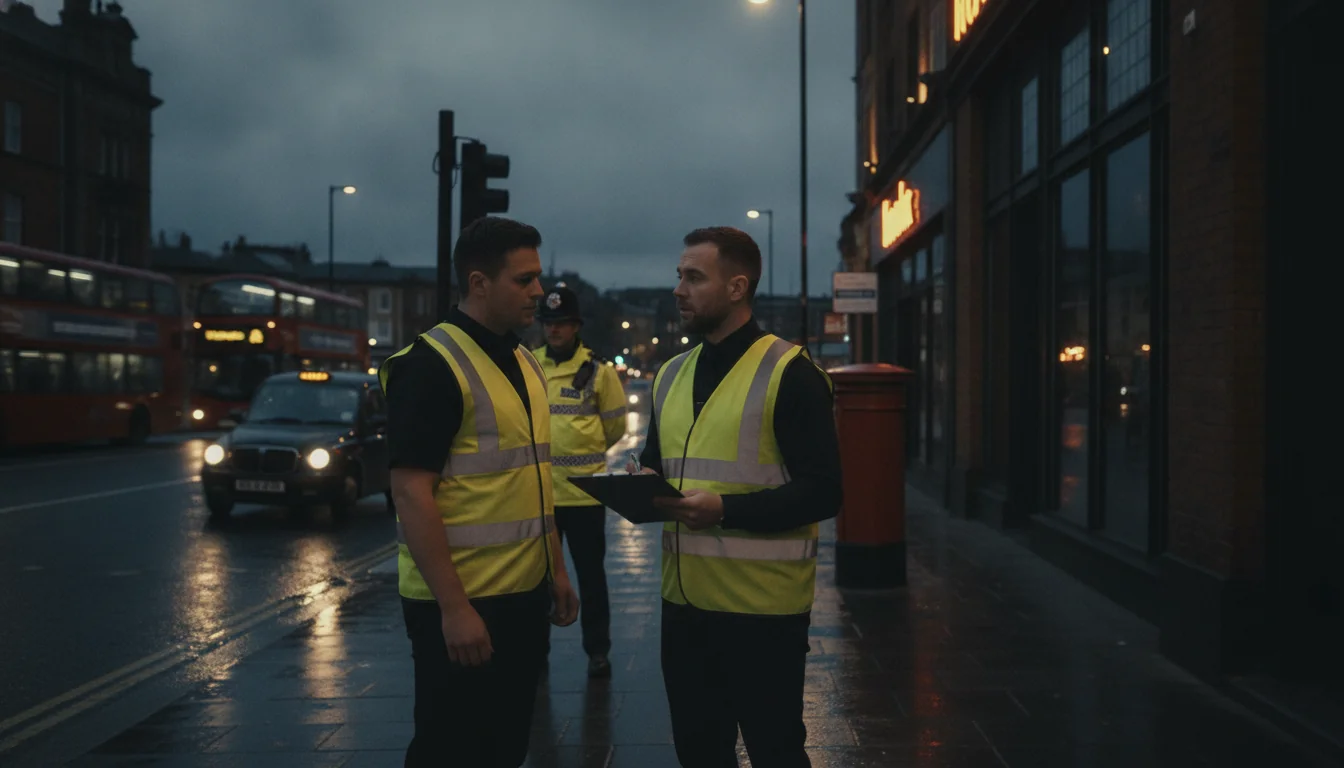



If you worked a door on the night of 21 June 2026, there’s a fair chance someone in a stab vest with an SIA lanyard walked past you with a clipboard. According to the Security Industry Authority, more than 40 inspectors from the SIA’s Inspections and Enforcement Directorate, supported by policing partners, hit 224 licensed premises in a single coordinated sweep — conducting 450 licence checks across the night-time economy. What they found should make every door supervisor, manager and contractor sit up.
This wasn’t a routine paperwork shuffle. It was a public safety operation. And the cracks it exposed are the same ones the industry has been quietly papering over for years.
What the SIA Actually Did on 21 June
The SIA describes the operation as a multi-agency push across the night-time economy, run with local police forces and licensing teams. Inspectors turned up unannounced at bars, clubs and late-night venues across multiple regions to check whether the people on the door were licensed, trained and working under legitimate arrangements.
The headline number — 224 venues in one night — tells you the SIA wanted scale. The regulator has consistently signalled, through its 2023–26 Strategic Plan and successive business plans, that it would shift from desk-based enforcement to proactive, boots-on-the-ground inspections.
As we covered in our breakdown of the SIA’s new three-year plan, expect more enforcement, not less, for the foreseeable future. This is what that looks like in practice.
The Compliance Gaps Inspectors Flagged
The SIA hasn’t published a venue-by-venue breakdown, but its statement points to a familiar set of failings. Based on the regulator’s summary and previous sweeps of this kind, the recurring issues are:
- Operatives working without a valid licence — either expired, suspended, or never held in the first place.
- Licences not displayed correctly — a small thing on paper, a £1,000 fixed penalty in reality.
- Suppliers operating outside the Approved Contractor Scheme, with little oversight of who they’re putting on the door.
- Gaps in venue record-keeping — no incident logs, no proof of right-to-work checks, no clear chain of responsibility.
- Welfare and safeguarding shortfalls, particularly around vulnerable customers being ejected late at night.
An SIA spokesperson said the inspections were about “protecting the public” rather than catching individual operatives out — but the regulator has been clear that enforcement action follows where breaches are found.
Why Non-ACS Contractors Are in the Firing Line
If you’re working through a contractor that isn’t on the Approved Contractor Scheme (ACS), you’re statistically more likely to end up in a venue that fails an inspection. That’s not opinion — that’s the pattern the SIA’s data keeps showing.
ACS firms aren’t perfect. But they’re audited, they have to evidence their vetting, and they generally don’t survive long if they’re putting unlicensed operatives on the door. Non-ACS suppliers, especially the smaller ones bidding on price, are where the SIA tends to find the worst breaches.
For the operative, the risk is personal. If your employer is dodgy and you get swept up in an inspection, it’s your licence on the line, not just theirs. The SIA can — and does — revoke licences from operatives who knowingly work without one, or who can’t account for their training.
What Door Staff Should Do Before the Next Sweep
The next coordinated operation will happen. The SIA has been transparent about that. So treat every shift like an inspection night.
Check Your Own Paperwork First
Pull your licence out of your wallet right now. Is it in date? Is the photo still recognisably you? Is it visible on your outer clothing when you’re working? If the answer to any of those is no, fix it before your next shift. If you’re unsure how to read what’s on the card, our guide to reading and verifying SIA licence cards walks you through it in under a minute.
Know Who You Actually Work For
Sounds obvious. Isn’t. Plenty of door staff work for a contractor who subcontracts to another contractor who supplies a venue. When an inspector as,ks “Who’swho’s your employer?”, you need a clean answer. If you don’t have one, that’s a flag in itself.
Keep Your Training Records Accessible
Top-up training, first aid, ACT awareness — keep digital copies on your phone. If your venue manager can’t produce them on demand, you can. If your refresher training is due, the door supervisor refresher course is the fastest way to stay compliant.
Push Back on Bad Practice
If your supervisor is rostering unlicensed mates to fill gaps, that’s not your problem to solve quietly. It’s a reportable issue. You can report it via the SIA’s online reporting form or anonymously through Crimestoppers on 0800 555 111. Using either is a lot less painful than losing your own ticket because the firm went down.

What Venue Managers Need to Do Now
For licensees and duty managers, the message from the SIA is straightforward: you are responsible for who works your door, even when you’ve outsourced the function. “I used an agency” is not a defence the regulator finds compelling.
Before the next inspection sweep, three things matter:
- Audit your contractor. Are they ACS? If not, why not? Can they produce licence checks for every operative they’ve supplied in the last 90 days?
- Build a nightly check-in habit. A 30-second licence verification at the start of every shift, logged in writing, is the single best protection you have.
- Get your incident records straight. Inspectors look at how you handle ejections, refusals and welfare cases. Vague logs suggest vague practice.
The Bigger Picture
The 21 June sweep is part of a wider shift. The SIA is no longer content to be a licensing body that occasionally writes letters. It’s positioning itself as an active regulator of the night-time economy, working hand-in-glove with police and councils.
For the operatives doing the job properly — licensed, trained, working for a reputable contractor — this is good news. It pushes the cowboys out and lifts the value of the badge you’ve worked for.
For everyone else, the clock is ticking. The next clipboard is already on its way.
Ready to get or renew your SIA licence? Browse all SIA courses and book your place today.