




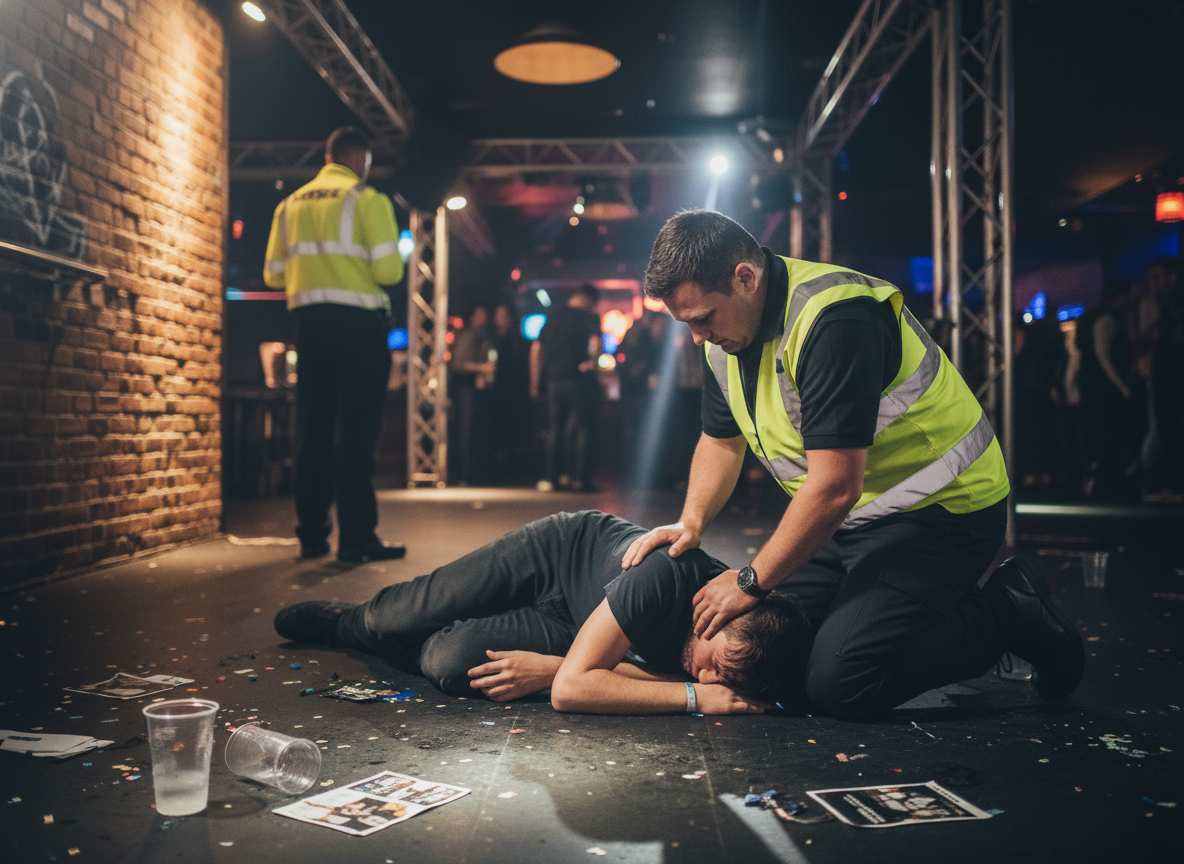
The door supervisor job has changed. You’re not just deciding who gets in anymore — you’re often the first person on scene when someone collapses, overdoses, or gets caught in a crush. A new industry report covered by Integrator Media argues that door staff have quietly become nightlife’s front-line emergency responders, and the training expectations are shifting fast.
If you’ve been in the trade more than five years, you’ve felt it. The calls are different. The risks are different. And the venues that pay best now want proof you can handle more than a stroppy stag do.
Here’s what’s changing, what to put on your CV, and how to turn it into better money.
From Bouncer to First Responder
The old picture of a door supervisor — arms folded, checking IDs, removing the rowdy — is half the job at best. According to the Prima Cura Training report cited by Integrator Media, door staff are now routinely first on scene for medical emergencies, drug-related collapses, mental health crises, and crowd-density incidents.
There are a few reasons for the shift. Ambulance response times in city centres have stretched. Drug strength — particularly synthetic opioids cut into recreational supply — has made overdoses more sudden and more lethal. And post-Manchester Arena, post-Astroworld, venues are taking crowd safety far more seriously than they did a decade ago.
The upshot: if you can keep someone alive for the eight minutes before paramedics arrive, you’re worth more to a venue than a colleague who can only escort them out.
Recommended Reading: Martyn’s Law Guide for Security Workers
The Qualifications Venues Actually Want Now
Your SIA door supervisor licence is the floor, not the ceiling. The training that’s increasingly expected on top:
- First Aid at Work (3-day). The basic Emergency First Aid at Work qualification baked into recent SIA training is fine for licensing. But the full 3-day FAW certificate is what better venues ask for — especially festivals, arenas, and premium late-night.
- Naloxone awareness. Naloxone reverses opioid overdoses. It’s available without prescription in Scotland and through a growing number of harm-reduction schemes in England. Knowing how to recognise an overdose and administer nasal naloxone is fast becoming a job-winner.
- Mental Health First Aid (MHFA England). A huge slice of door incidents are mental health crises, not crime. MHFA training teaches you to de-escalate, assess risk, and hand over to professionals without making things worse.
- Crowd safety / crush awareness. Look for courses aligned with the HSE’s Managing Crowds Safely guidance or the Event Industry Forum’s standards. After Astroworld, this matters at every venue holding more than a couple of hundred people.
- Vulnerability and safeguarding. Welfare-focused training (spotting spiking, identifying victims of trafficking, supporting lone intoxicated customers) is now baked into licensed-premises expectations in many local authority schemes.
We’ve covered this in more detail in our blog on the new reality for door supervisors.
What the SIA Has Changed (& What It Hasn’t)
The updated SIA door supervisor training specification, rolled out in 2021 and refined since, did add more on terror threat awareness, vulnerability, and emergency first aid. That’s a real improvement on what came before. But it’s still a starting point.
The SIA has not — yet — mandated naloxone training, full first aid at work, or mental health first aid as part of the licence. So the responsibility falls on you, the operative, to top up your skills if you want to work the better doors.
Industry voices, including Prima Cura, have been pushing for the SIA to incorporate more medical and welfare content into the core qualification. Whether that lands in the next training spec review remains to be seen.
How To Turn Extra Training Into More Pay
Here’s the bit nobody tells you. Most door supervisors quote the same hourly rate at interview regardless of what’s on their CV. That’s leaving money on the table.
A few practical moves:
- List the certificate, the issuer, and the date. “First Aid at Work — Qualsafe, March 2025″ beats “first aid trained”. Vague claims get vague offers.
- Quantify incidents you’ve handled. “Administered first aid at 14 incidents over 12 months at a 1,200-capacity venue” tells a hiring manager you’re not just paper-qualified.
- Ask about the venue’s incident log. A venue with frequent medical call-outs needs your skills more than a quiet members’ bar. That’s where your premium sits.
- Negotiate per-shift, not per-hour. If you bring naloxone, full FAW, and MHFA to a busy late-night door, a £20–£40 per-shift uplift over the going rate is reasonable and increasingly common in cities like Manchester, Bristol, and Leeds.
- Get on the head-door or supervisor track. The extra qualifications are the single fastest route from operative to supervisor, where rates jump meaningfully.
Where the Door Supervisor Role Stands Now
The role has expanded, whether the pay scales have caught up or not. The operatives who treat the licence as the start of their training — not the end of it — are the ones getting picked first, paid better, and promoted faster.
If your CV still reads like it did when you got your badge, it’s time for a refresh. Pick one extra qualification to chase this quarter. Naloxone awareness is cheap, short, and saves lives. Counterterrorism training is another in-demand skill. Choose a training you can upskill with easily, and start there.