Basic Handcuff training in Nottingham

The Handcuff Training Course provides individuals with a basic Introduction to Handcuffing and Physical Intervention.

Secure your SIA Licence and elevate your career potential now

Watch Course Overview
Icon 2

Fast: Same-day results

Icon 1

Clear: Step-by-step support

Icon 4

Trusted: 400,000+ trained

Icon 3

Proven: 95% pass rate

Duration
1 day course
From
£89.99 Incl. VAT
Pass Rate
95%

Not in Nottingham?

Find your nearest course
Icon 2

Fast: Same-day results

Icon 1

Clear: Step-by-step support

Icon 4

Trusted: 400,000+ trained

Icon 3

Proven: 95% pass rate

Explore SIA training courses

🔥 Employers prefer this
Door Supervisor Training

Work at pubs, clubs, events, shops, and offices. Best choice for flexible, higher-paying jobs.

Starting at just £249.99
🛡️ Static guarding
Security Guard Training

Ideal for static guarding at offices, shops, and warehouses. No door work or nightlife covered.

Starting at just £199.99
🎥 Control room jobs
CCTV Training

Monitor shops, offices, warehouses from control rooms.

Starting at just £239.99
🕶️ Private security
Close Protection Training

Get licensed to work as a Bodyguard for VIPs, celebrities, and high-profile clients. Exclusive, high-paying security work.

Starting at just £1994
🔄 Licence renewal
SIA Top-Up Refresher Training for Door Supervisor

Renew your Door Supervisor licence and stay qualified for door work, events, nightlife, and beyond.

Starting at just £129.99
🔄 Licence renewal
SIA Top-Up Refresher Training for Security Guard

For individuals renewing their Security Guard or Officer licence. Quick refresher to keep you job-ready.

Starting at just £99.99

Real stories from real people

Mark from Get Licensed
Leeds, Door Supervisor Refresher — August 2025
Book this course in Leeds
Mark from Get Licensed
Plymouth, Door Supervisor Training — August 2025
Book this course in Plymouth
Google Rating Starts
Wonderful experience being trained by…
Asuenimhen Harrison
Nov 06, 2025

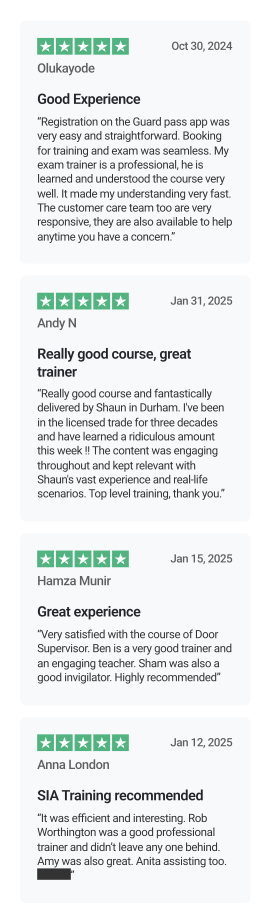
"Wonderful experience being trained by Ben McCarty. He knows his job very well. Give us the trainees opportunities to express ourselves, ask questions and respond to them accordingly. But he is sometimes too fast with words that some of us who are not English native speakers sometimes find it a little difficult to follow along. But he’s a great trainer."

Mark from Get Licensed
Sheffield, Door Supervisor Training — August 2025
Book this course in Sheffield
Calleb from Get Licensed
Calleb Dempster
Door Supervisor
Review Tp Stars
Door Supervisor & First Aid course
Steve Blaker
Nov 03, 2025

“The whole course was well taught and delivered in a professional manner. My instructor, James Gilles, was very knowledgeable over all subjects covered in the door supervisor and the first aid course. any questions raised were answered immediately and a full explanation given. 10/10 for the whole experience & the support from Get Licensed."

Review Img 10
Mark from Get Licensed
Bromley, Door Supervisor Training — August 2025
Book this course in Bromley
Chevron Right Green Circle
Review Img 12
Mark from Get Licensed
Seona Deuchar
Door Supervisor
Chevron Right Green Circle
Google Icon
Google Rating Starts
Completed the DS Top up course with Get licensed and passed. Adame who trained us was great, very professional and down to earth guy. Even though he’s had various jobs and years of experience in security he just treats you like a equal, no better than anyone attitude which is good. Professional training by trainers who WANT you to pass not a back street company. Will be definitely back again for further training. Thank you.
95%
Pass Rate

Not sure where to start?
We'll clear it up!

The aim of the course is to give positive guidance to staff regarding the use of handcuffs and serve as a reference for staff in justifying the use of handcuffs both in terms of policy (who and why do we handcuff) and technique (how do we handcuff).

There is no exam for this handcuff-training course. This is an interactive course and you will be assessed throughout the duration of the 3 hour course. When you have successfully demonstrated that you can use handcuffs correctly, your trainer will give you your certificate.

This course is well suited for any security personnel working within the security industry. This handcuff-training course teaches vital skills on how to safely apprehend someone. This course will also make you more eligible for employment.

It’s easy peasy. You can either book online or you can book through our 24/7 customer service line on 0207 078 7259.

Get Licensed are proud to provide you with a ‘Faster Results’ service for selected courses and locations. Receive your results within just 5 working days after your course is completed. Our aim is to notify you on the same day the training provider sends us your results. Your results will be available online and we’ll also send you an SMS to inform you when your results are available.  

To read our full list of FAQ's, click here

What is covered on this course? 

1. Identification of handcuffs
2. Loading of Handcuffs
3. Powers of arrest
4. Applying Handcuffs
5. Types of positions
6. Handcuff - Passive
7. Handcuff - Active
8. Positional Asphyxia
9. Excited Delirium
 

By the end of this course you will be able to:

1. Understand the primary reason for handcuffing.
2. Understand the law, including compliance with: Section 3 (1) of the Criminal Law Act 1967, Common Law, Section 117 PACE and Articles 5, 3 and 2 of the Human Rights Act 1998.
3. Understand the medical implications of handcuffing, including positional asphyxia.
4. Demonstrate how to apply handcuffs to a passive subject.
5. Demonstrate how to apply handcuffs to an aggressive subject.
6. Demonstrate how to remove handcuffs correctly.
 

Is it legal for security officers to use handcuffs?

Being in possession and the use of handcuffs, providing their intended use is for lawful purposes is perfectly legal. Handcuffs are not an offensive weapon nor are they prohibited in any way. Many areas of the UK encourage the lawful use of handcuffs sanctioned by local police forces; in some cases training is also provided by the local law enforcement teams. Handcuffing is regarded as a preferable restraint as opposed to group restraint tactics which can pose a threat to the welfare of the person being restrained particularly positional asphyxia. When applying handcuffs the subject should be sitting back on their feet and the restraints should be applied within 30 seconds, the suspect should only be placed in the recovery position as a last resort. There are three main reasons for handcuffing as laid out by law and all Company Health and Policies, SAFETY being the main component
 
1. Safety of the public
2. Your own safety
3. The suspects safety
 

When should handcuffs be used?

1. To prevent a violent offender from assaulting or injuring you or a member of the public.
2. When you judge it necessary to prevent the offender's escape from the scene.
3. During the transportation of the offender either by vehicle or during restrained escorting duties.
4. As a prevention tactic to stop the offender from harming themselves, you or members of the public.
 

Officer may employ the use of handcuffs on reasonable grounds when:

1. The offender is likely to commit an act of violence against the arresting officer/s or bystanders.
2. There are reasonable grounds to suspect that the offender is likely to escape custody. The term 'Reasonable Grounds' is defined by the circumstances of individual cases applied as an objective rule based on the decision that the offender is likely to commit an act of violence or will attempt to escape. In the case of juveniles, women or the elderly the consideration of reasonable grounds and exceptional circumstances should be carefully applied.
 

The justified use of handcuffs is governed by Section 3 of the Criminal Law act which clearly states:

A person may use such force as is reasonable in the circumstances in prevention of a crime, or in effecting or assisting in the lawful arrest of offenders or suspected offenders or of persons unlawfully at large.
 

Common Law and use of Force In the UK the use of force on an individual is considered unlawful unless the following circumstances prevail:

1. As an act of self defence
2. To save a life
3. Lawful arrest is the only option
4. The prevention of a crime or further criminal acts
5. Preventing an intended Breach of the Peace
 

Justified use of restraint

1. Force used in any confrontation MUST be seen as REASONABLE based on the likelihood of the suspect's resistance.
2. Other options to calm the situation have failed.
3. When a potentially volatile situation provides no further option.

Top Rated Downloads
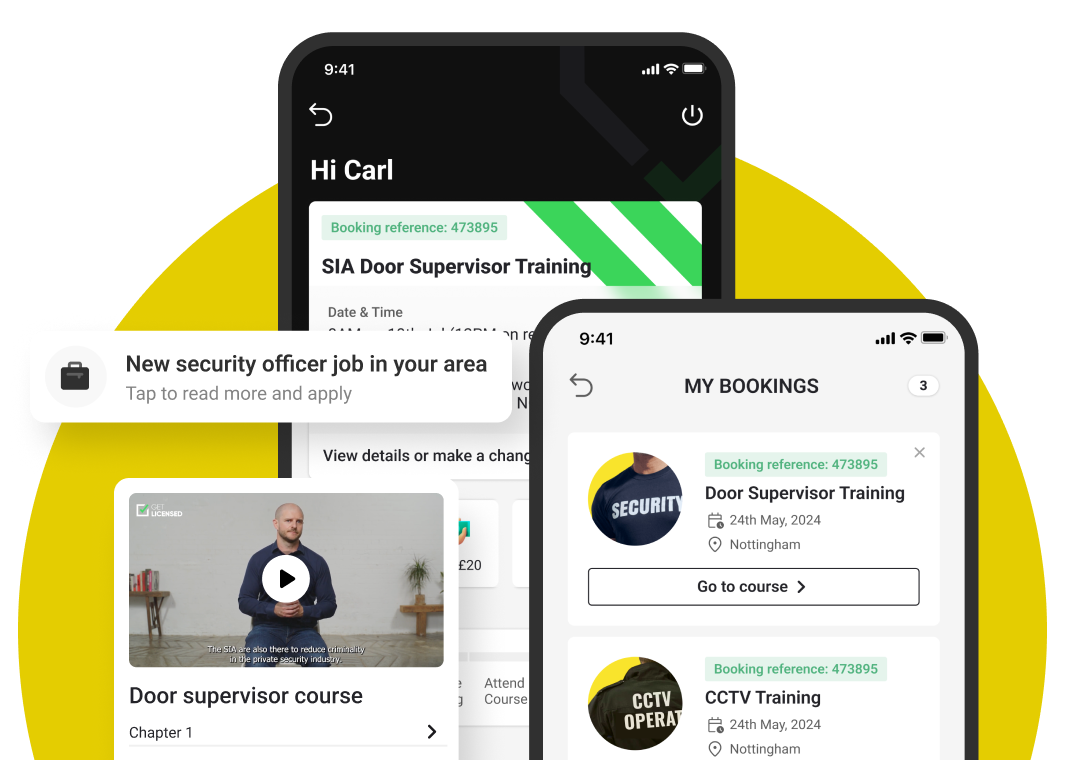
Get GuardPass

Find work, try mock tests and book courses from
the UK’s #1 app for security professionals

Apps Store Play Store
download guard app
Do you need help?

Our team’s got your back.

Help centre
image image image image